Huangpi Fruit, a name for a traditional Chinese medicinal material. It is the ripe fruit of Clausena lansium (Lour.) Skeels, a plant belonging to the genus Clausena in the Rutaceae family. It is distributed in southwestern China as well as in Fujian, Taiwan, Guangdong, Hainan, and Guangxi. It is mostly cultivated. It has the effects of promoting the flow of qi, aiding digestion, and resolving phlegm. It is primarily used to treat food stagnation and abdominal distension, epigastric and abdominal pain, hernia pain, and coughing and wheezing caused by phlegm and fluid retention.

Huangpi Fruit
Huangpi Fruit, a name for a traditional Chinese medicinal material. It is the ripe fruit of Clausena lansium (Lour.) Skeels, a plant belonging to the genus Clausena in the Rutaceae family. It is distributed in southwestern China as well as in Fujian, Taiwan, Guangdong, Hainan, and Guangxi. It is mostly cultivated. It has the effects of promoting the flow of qi, aiding digestion, and resolving phlegm. It is primarily used to treat food stagnation and abdominal distension, epigastric and abdominal pain, hernia pain, and coughing and wheezing caused by phlegm and fluid retention.
Chinese Name : 黄皮果
Latin Name : Clausenae Lansii Fructus
Aliases : Huangpizi, Huangdanzi, Huangdan, Jindanzi
Authentic Producing Area : Guangxi
Nature, Flavor & Meridian Tropism : Taste: pungent, sweet, and sour; nature: slightly warm; enters the Lung and Stomach meridians
Benefits & Efficacy
Benefits
Promotes the flow of qi, aids digestion, and resolves phlegm.
Indications
Used for food stagnation with bloating, epigastric and abdominal pain, hernia pain, and phlegm-retention with cough and wheezing.
Usage and Dosage
Internal use: Decocted as a soup, 15–30 g.
Precautions
*Ben Cao Qiu Yuan*: “Excessive consumption stirs internal heat and may cause boils and abscesses.” Patients requiring treatment with Chinese herbal medicine should first consult a licensed Traditional Chinese Medicine hospital, where a professional TCM practitioner will conduct a differential diagnosis and prescribe an herbal formula.
Chemical Constituents
Huangpi seeds contain Huangpi neocinnamamide A, B, C, and D.
Pharmacological Actions
This product possesses anti-inflammatory, antioxidant, antibacterial, and antiviral properties.
Relevant Discussions
1. Yao Kecheng, *Food Materia Medica*: “Treats vomiting, phlegm, and fluid retention; fullness and pain in the chest and diaphragm; ascending roundworms; and epigastric pain.”
2. *Ben Cao Qiu Yuan*: “Promotes the flow of qi. When young, pickle and sun-dry the fruit; it helps sober up and stimulates the appetite.”
3. *Compendium of Chinese Herbal Medicines*: “Resolves phlegm and aids digestion. Mainly used to treat food stagnation with distension and fullness, as well as phlegm-fluid retention with coughing and wheezing.”
4. *Foods, Chinese Herbs, and Simple Formulas*: “Dispels stagnant heat and alleviates hernia pain.”
Applications
Clinical Applications
1. For treating food stagnation and abdominal distension: 15–30 g of pickled Huangpi fruit, stewed in water and taken orally. (*Fujian Chinese Herbal Medicine*)
2. For treating liver and stomach qi pain: Sun-dry fresh Huangpi fruit; take 10 pieces daily, decocted in water and taken orally. (*Food, Chinese Herbs, and Simple Formulas*)
3. For ascending roundworm infestation causing epigastric pain: 18 g of Huangpi fruit (or 60 g of fresh fruit); decoct in water and take on an empty stomach. (*Food, Chinese Herbs, and Simple Formulas*)
4. For hernia pain: 9–15 g of yellow-skinned fruit and 9–15 g of tangerine seeds; decoct and take orally. (Jiangxi *Pharmacognosy*)
5. For phlegm-induced cough and asthma: Yellow-skinned fruit—pickled in salt beforehand; take 15 g as needed, add an appropriate amount of boiling water, and simmer before consumption. (*Fujian Folk Herbal Medicine*)
Notes
References: 1. *Folk Herbal Medicine of Fujian*. 2. *Comprehensive Dictionary of Chinese Materia Medica*. 3. *General Annals of Guangdong*.
Processing & Preparation
Harvesting & Processing
Harvest the fruit when ripe from July to September; use fresh, sun-dry directly, or pickle with salt before sun-drying.
Storage Methods
Store in a dry place.
Crude Drug Identification
Properties of Crude Drugs
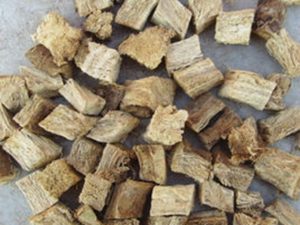
The fruit is subglobose, with a diameter of 0.8–2.3 cm. The outer surface is yellowish-brown or dark green and wrinkled. The pulp is relatively thin. The seeds are flattened ovoid, 1.1–1.4 cm long, 8–9 mm wide, and 3–4 mm thick; they are brown or brownish-yellow with irregular wrinkles. They have a faint odor and a pungent, slightly bitter taste.
Botanical Information
Botanical Classification
Huangpi (Citrus hystrix), a plant of the genus Citrus in the Rutaceae family.
Morphological Characteristics
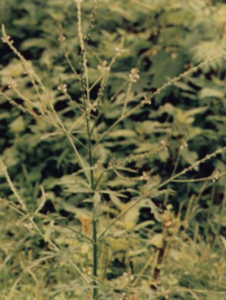
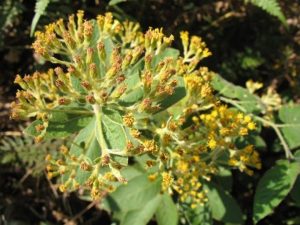
An evergreen shrub or small tree, reaching a height of up to 12 m. Young branches, flower stalks, leaf stalks, petioles, and the veins on the underside of young leaves are all covered with tufts of short and long hairs clustered together, which are fragrant.The leaves are odd-pinnate and alternate; petiolules are 4–8 mm long; there are 5–13 leaflets, with the terminal one being the largest and gradually decreasing in size toward the base; they are ovate or elliptic-lanceolate, 6–13 cm long and 2.5–6 cm wide, with an acute or shortly acuminate apex, a broadly cuneate, asymmetrical base, and margins that are shallowly undulate or shallowly bluntly toothed.Cymose panicles are terminal or axillary, with spreading flower branches and numerous flowers; sepals are 5, broadly ovate;petals 5, white, spatulate, not exceeding 5 mm in length, reflexed when open; stamens 10, of varying lengths; ovary superior, 5-chambered, densely hairy. Berries globose to oblate, 1.2–3 cm long, pale yellow to dark yellow, densely hairy. Seeds green. Flowering period: April–May; fruiting period: July–September.
Distribution Area
Distributed in Southwest China, as well as Fujian, Taiwan, Guangdong, Hainan, and Guangxi. Mostly cultivated.