Golden Thread Orchid is the name of a traditional Chinese medicine. It consists of the whole plants of Anectochilus roxburhii (Wall.) Lindl. and Anoectochilus formosanus Hayata, both members of the Orchidaceae family.Anectochilus roxburhii is distributed in southwestern China as well as Zhejiang, Fujian, Guangdong, Hainan, and Guangxi; Anoectochilus formosanus is found in Fujian and Taiwan. It has the effects of clearing heat, cooling the blood, removing dampness, and detoxifying. It is primarily used to treat lung-heat cough, hemoptysis due to pulmonary tuberculosis, hematuria, infantile convulsions, tetanus, edema caused by nephritis, rheumatic arthralgia, and trauma-induced injuries.
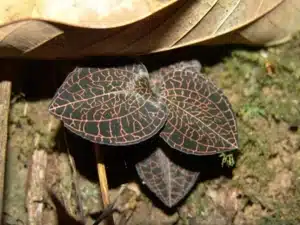
Golden Thread Orchid
Golden Thread Orchid is the name of a traditional Chinese medicine. It consists of the whole plants of Anectochilus roxburhii (Wall.) Lindl. and Anoectochilus formosanus Hayata, both members of the Orchidaceae family.Anectochilus roxburhii is distributed in southwestern China as well as Zhejiang, Fujian, Guangdong, Hainan, and Guangxi; Anoectochilus formosanus is found in Fujian and Taiwan. It has the effects of clearing heat, cooling the blood, removing dampness, and detoxifying. It is primarily used to treat lung-heat cough, hemoptysis due to pulmonary tuberculosis, hematuria, infantile convulsions, tetanus, edema caused by nephritis, rheumatic arthralgia, and trauma-induced injuries.
Chinese Name : 金线莲
Latin Name : Anectochilus roxburhii (Wall.) Lindl., Anoectochilus formosanus Hayata
Aliases : Golden Thread Orchid, Golden Thread, Golden Earrings, Bird Ginseng, Golden Thread Tiger-Head Banana, Golden Thread Bone-Healer, Moneywort, Golden Thread Stone Pine, Golden Stone Silkworm, Youth Red, Small-Leaf Golden Earrings, Hemp-Leaf Vegetable
Authentic Producing Area : Southwest China, Zhejiang, Fujian, Guangdong, Hainan, Guangxi, Fujian, Taiwan
Nature, Flavor & Meridian Tropism : Sweet in taste, cool in nature; enters the Lung, Liver, Kidney, and Bladder meridians
Benefits & Efficacy
Benefits
Clears heat and cools the blood; removes dampness and detoxifies.
Indications
Used for lung-heat cough, hemoptysis due to pulmonary tuberculosis, hematuria, infantile convulsions, tetanus, nephritis with edema, rheumatic arthralgia, and trauma.
Usage and Dosage
Internal use: Decocted as a soup, 9–15 g. External use: Apply an appropriate amount of the fresh plant, pounded and applied as a poultice.
Precautions
Not yet established.
Pharmacological Actions
It has hepatoprotective, anti-inflammatory, analgesic, and sedative effects.
Relevant Discussions
Whole herb: Sweet in taste, neutral in nature. It has the functions of cooling the blood, calming the liver, clearing heat, and detoxifying. Used for hemoptysis due to pulmonary tuberculosis, diabetes, nephritis, cystitis, infantile convulsions, and venomous snake bites. (*Xinhua Bencao Gangyao*)
Applications
Clinical Applications
1. For rheumatic and rheumatoid arthritis: Stew 30 g of Jinxianlian with 120 g of pork (without bones) until tender, then add an appropriate amount of rice wine. Take 1–2 times daily. Consume the entire portion over 2 days. (*Compendium of Chinese Herbal Medicines*)
2. For treating infantile convulsions: 3–9 g of Golden Thread Orchid and 3 g of Star Anise Lily. Decoct in water and take orally. (*Fujian Materia Medica*)
Processing & Preparation
Harvesting & Processing
Harvest in summer or fall; use fresh or sun-dry.
Storage Methods
Store in a well-ventilated, dry place; protect from moisture and insect infestation.
Crude Drug Identification
Properties of Crude Drugs
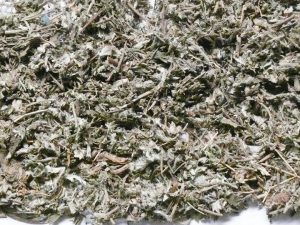
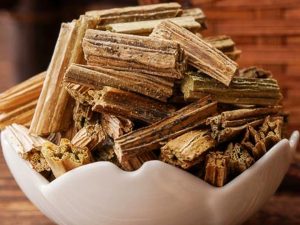
The rhizome is relatively slender, with distinct nodes, and is brownish-black in color. The upper surface of the leaves is blackish-purple with golden-yellow reticulate veins; the underside is dark red, with 3–7 main veins. The raceme is terminal, with the inflorescence axis covered in soft hairs; the sepals are pale purple. It has a faint odor and a bland taste.
Botanical Information
Botanical Classification
Orchidaceae: *Hua Ye Kai Chun Lan* and *Jin Xian Lan*.
Morphological Characteristics
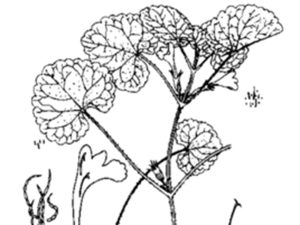
1. *Hua Ye Kai Chun Lan* (Cymbidium), a terrestrial plant, 10–18 cm tall. The rhizome is creeping and elongated.Leaves are alternate, with 2–4 leaves on the lower part of the stem; petioles are 4–10 mm long, expanded at the base to clasp the stem; the base is sheath-like; leaf blades are ovate-elliptic, 1.5–3.5 cm long and 1–3 cm wide, with an acute apex and a rounded base; the upper surface is blackish-purple with a golden-yellow reticulate venation, while the lower surface is pale purplish-red with 5–7 arcuate veins.The inflorescence is a raceme bearing 2–6 sparsely arranged flowers; the rachis is pubescent. The floral bracts are ovate-lanceolate, pale purple, 6–8 mm long, approximately two-thirds the length of the ovary, and tail-pointed at the apex. The flowers are pale purple and pubescent on the outside;the median sepal is ovate, concave inward, 6 mm long, with a blunt apex; the lateral sepals are oblong-elliptic, slightly oblique, longer and somewhat narrower, with a slightly pointed apex; the petals are nearly sickle-shaped, shorter than the sepals and fused with the median sepal to form a pouch;The labellum is bifid, forming a “Y” shape; the lobes are tongue-shaped and linear, with blunt tips, approximately 6 mm long and 1.5 mm wide; the claw is 5 mm long, with 6 fringed filaments on each side; the base bears a spur 6–7 mm long, the tip of which points toward the labellum, and a callus is present in the middle. Flowering period: September–October.
2. Golden-thread Orchid, a terrestrial plant, 4–10 cm tall. The rhizome is creeping, up to 4–5 cm long. Leaves are alternate, petiolate, and expanded at the base to clasp the stem; leaf blades are ovate, 2–5 cm long and 1–3 cm wide, with an acute apex and a rounded base; the upper surface has a fine, scale-like network of veins and is glossy, while the lower surface is dark red.The inflorescence is a raceme bearing 2–3 flowers; the floral bracts are ovate-lanceolate, approximately 1 cm long;flowers are pale red; the median sepal is rounded, initially acuminate, covered with long, stiff hairs on the outside, glabrous on the inside, deeply concave, and fused with the petals to form a helmet-like structure 7 mm long; the lateral sepals are ovate-oblong, highly asymmetrical, 8 mm long, with an acuminate apex, covered with long, stiff hairs on the outside, and glabrous on the inside;Petals are semi-ovate, extremely asymmetrical, 9 mm long, with an acute apex; the labellum is deeply bifid, forming a “Y” shape, with narrow-oblong lobes that are obtuse at the apex, approximately 5 mm long and 0.3 mm wide; the claw is 5–6 mm long, with tuft-like filaments on both sides; the spur is approximately 4 mm long, with two calli arising anteriorly at the base.Flowering period: August–September; fruiting period: September–October.
Distribution Area
1. Variegated Lip Orchid: Found in southwestern China, as well as Zhejiang, Fujian, Guangdong, Hainan, and Guangxi. 2. Golden-thread Orchid: Found in Fujian, Taiwan, and other areas.