Fabanxia is the name of a traditional Chinese medicine. It is a processed form of purified Pinellia tuber. It has the efficacy of drying dampness and resolving phlegm. It is primarily used to treat coughing and wheezing with excessive phlegm, dizziness and palpitations caused by phlegm-fluid retention, dizziness caused by wind-phlegm, and phlegm-induced syncope with headache.

Processed Pinellia
Fabanxia is the name of a traditional Chinese medicine. It is a processed form of purified Pinellia tuber. It has the efficacy of drying dampness and resolving phlegm. It is primarily used to treat coughing and wheezing with excessive phlegm, dizziness and palpitations caused by phlegm-fluid retention, dizziness caused by wind-phlegm, and phlegm-induced syncope with headache.
Chinese Name : 法半夏
Nature, Flavor & Meridian Tropism : Pungent in taste, warm in nature
Benefits & Efficacy
Benefits
Dries dampness and resolves phlegm.
Indications
Excessive phlegm with cough and wheezing; phlegm-fluid retention with dizziness and palpitations; wind-phlegm-induced dizziness; phlegm-induced syncope and headache.
Usage and Dosage
Take orally, in doses of 3–9 g.
Precautions
Should not be used in combination with Aconite-type herbs.
Chemical Constituents
Processed Pinellia primarily contains essential oils, such as anethole, citral, 1-octene, and β-elemene. In addition, it contains organic acids and other compounds.
Pharmacological Actions
Fabanxia has pharmacological effects including antitussive, expectorant, antiemetic, and antitumor properties.
Applications
Notes
Patients requiring treatment with traditional Chinese medicine should first consult a licensed TCM hospital, where a TCM practitioner will conduct a professional diagnosis and prescribe the appropriate herbal formula.
Processing & Preparation
Processing Methods
Take clean Pinellia tubers, sort them by size, soak them in water until the dry core inside is completely softened, then remove them;Separately, take an appropriate amount of licorice, decoct it twice with water, combine the decoctions, and pour the mixture into a lime solution prepared with an appropriate amount of water. Stir well, add the soaked Pinellia, and let it soak, stirring 1–2 times daily while maintaining the pH of the soaking solution above 12. Continue until the cross-section is uniformly yellow and a slight numbing sensation is felt on the tongue upon tasting. Remove, rinse thoroughly, and air-dry or oven-dry.
Crude Drug Identification
Properties of Crude Drugs
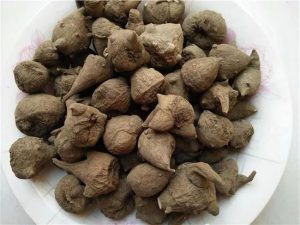
This product is subglobular or broken into irregular granules, pale yellowish-white, yellow, or brownish-yellow in color. It is relatively brittle or hard and brittle in texture; the cross-section is yellow or pale yellow, and the granules are slightly harder and more brittle. It has a faint odor, a bland, slightly sweet taste, and causes a slight numbing sensation on the tongue.
Botanical Information
Botanical Classification
Pinellia, genus Pinellia of the Araceae family.
Distribution Area
It is distributed throughout most regions of China.
Growth Habits
It prefers a mild, humid climate and shaded environments; it is sensitive to high temperatures, drought, and intense sunlight, but is cold-tolerant. It should be cultivated in deep, loose, fertile, well-drained sandy loam; heavy, clayey soils are unsuitable. Continuous cropping should be avoided; it can be intercropped or grown in rotation with fruit trees and other crops.
Propagation Methods
Propagation is carried out using tubers, seeds, and bulbils.
Cultivation Techniques
1. Tuber Propagation: Tuber propagation results in rapid weight gain, and tubers can be harvested in the same year; this method is generally the most commonly used. In late September, dig up the rhizomes and select tubers with a diameter of 0.5–11 cm as planting stock, at a planting rate of approximately 2,250 kg per hectare. Plant in the fall or spring, with row and plant spacing of 20 cm × 3 cm.
2. Bulbils Propagation: In May–June, select mature bulbils from beneath the leaf petioles for propagation. Plant them in furrows with a row spacing of 15 cm × 3 cm.
3. Seed Propagation: When seeds ripen in summer or fall, sow them immediately after harvest; alternatively, store them in moist sand for sowing the following spring. Sow in rows with a row spacing of 15 cm. Dig a 2-cm-deep furrow, scatter the seeds inside, and cover with soil.
Pest and Disease Control
1. Diseases: For leaf spot disease, spray with a 1:1:150 Bordeaux mixture or a 500-fold dilution of 65% zinc dithion. For tuber rot, spray with a 1,000-fold dilution of 50% carbendazim.
2. Pests: The red leaf beetle damages leaves; control by handpicking or spraying with a 90% crystal diazinon solution diluted 800–1,000 times. Other pests include wireworms and grubs.