White Peony is a blood-nourishing herbal medicine derived from the root of Paeonia lactiflora Pall., a plant in the genus Paeonia of the Ranunculaceae family.It has the effects of nourishing the blood and regulating menstruation, consolidating yin and stopping sweating, soothing the liver and relieving pain, and subduing liver yang. It is used to treat blood deficiency with pallor, irregular menstruation, spontaneous sweating, night sweats, pain in the flanks, abdominal pain, cramping pain in the limbs, headaches, and dizziness.

White Peony
White Peony is a blood-nourishing herbal medicine derived from the root of Paeonia lactiflora Pall., a plant in the genus Paeonia of the Ranunculaceae family.It has the effects of nourishing the blood and regulating menstruation, consolidating yin and stopping sweating, soothing the liver and relieving pain, and subduing liver yang. It is used to treat blood deficiency with pallor, irregular menstruation, spontaneous sweating, night sweats, pain in the flanks, abdominal pain, cramping pain in the limbs, headaches, and dizziness.
Chinese Name : 白芍
Latin Name : Paeoniae Radix Alba
Aliases : White Peony, Golden Peony
Authentic Producing Area : Mainly produced in Zhejiang and Anhui
Nature, Flavor & Meridian Tropism : Taste: bitter and sour; nature: slightly cold; enters the Liver and Spleen meridians
Benefits & Efficacy
Benefits
Nourishes blood and regulates menstruation; consolidates yin and stops sweating; soothes the liver and relieves pain; subdues liver yang.
Indications
Indicated for blood deficiency with sallow complexion, irregular menstruation, spontaneous sweating, night sweats, pain in the flanks, abdominal pain, cramping pain in the limbs, and headaches with dizziness.
Usage and Dosage
Decoct and take 6–15 g.
Precautions
1. White Peony Root is a cold and cooling herb; it should not be taken in large doses as a single herb in cases of external invasion by wind-cold, internal injury from raw or cold foods, spleen-stomach deficiency-cold, or kidney yang deficiency. Women with irregular menstruation due to deficiency-cold should not take large doses of this herb alone; it is contraindicated for those with spontaneous sweating due to qi deficiency or sweating due to yang deficiency. 2. White Peony Root is sour, cold, and astringent; it is contraindicated for shanghan (typhoid fever) with yang-congestion in the upper jiao or for rashes. 3. White Peony Root has a central nervous system depressant effect; it is contraindicated for patients in a coma. Infants, young children, and the elderly should not take large doses over an extended period. 4. Pregnant women and postpartum women should not take large doses of this herb alone. 5. White Peony Root is incompatible with softshell turtle shell and small thistle; it is contraindicated when combined with Lepidium. 6. It should not be used in combination with antihypertensive drugs to prevent conditions such as orthostatic hypotension. 7. It should not be used in combination with cardiac glycosides to avoid additive effects and increased toxicity. 8. Concomitant use with drugs such as heparin, warfarin, and aspirin may increase the risk of bleeding. 9. Theophylline can weaken the inhibitory effect of White Peony Root on intestinal contractions; therefore, they should not be used together.
Chemical Constituents
It primarily contains monoterpenoid components: paeoniflorin, paeoniflorin oxide, benzyl paeoniflorin, paeoniflorin A, paeoniflorin ketone, galloyl paeoniflorin,paeonolides A, B, and C; sterols: β-sitosterol; tannins: 1,2,3,6-tetra-galloylglucose, gallic acid, and (R)-catechin; phenolic compounds: paeonol.
Pharmacological Actions
This product has hepatoprotective, hematopoietic-promoting, anti-renal injury, sedative, antidepressant, gastrointestinal motility-regulating, anti-ischemic, and anti-inflammatory effects.
Relevant Discussions
1. *Shennong Bencao Jing*: “Treats abdominal pain caused by pathogenic factors, eliminates blood-related bi syndrome, breaks up hardened masses, alleviates fever and cold-induced hernias and masses, relieves pain, promotes urination, and tonifies qi.”
2. *Diannan Bencao*: “Relieves pain caused by counterflow of liver qi, regulates and nourishes blood in the heart, liver, and spleen meridians, relaxes the meridians and descends qi, and alleviates pain caused by liver qi.”
3. *Compendium of Materia Medica*: “White peony root (Bai Shaoyao) benefits the spleen and can drain wood energy within the earth element. Red peony root (Chi Shaoyao) dispels pathogenic factors and can resolve stagnation in the blood.”
Applications
Clinical Applications
1. For irregular menstruation, menorrhagia, and metrorrhagia: White peony root is often combined with Angelica sinensis, Ligusticum chuanxiong, and Rehmannia glutinosa to nourish blood and regulate menstruation, as in the Four Substances Decoction from the *Taiping Huimin Heji Jufang*. In cases of menorrhagia, hemostasis is the immediate priority; for example, in the *Jiyin Gangmu*, peony root is combined with lotus leaf to consolidate yin, clear the liver, cool the blood, and stop bleeding.Combining Paeonia with Platycladus leaf serves to consolidate the liver, cool the blood, and stop bleeding.
2. For external invasion by wind-cold, with superficial deficiency manifesting as spontaneous sweating and aversion to wind: White Peony Root nourishes yin and harmonizes the ying (nutritive) qi; when combined with Cinnamomum twig to release the muscles and induce sweating, they work together to harmonize the ying and wei (defensive) qi, as seen in the Cinnamomum Twig Decoction from the *Treatise on Cold Damage*.
3. For pain in the flanks, epigastric and abdominal pain, and cramping pain in the limbs caused by liver qi stagnation and blood deficiency: White Peony Root has the functions of soothing the liver, relieving spasms, and alleviating pain.To treat pain in the flanks, it is often combined with Angelica sinensis, Atractylodes macrocephala, and Bupleurum chinense, as in the Free and Easy Wanderer Decoction (Xiaoyao San); for postpartum abdominal pain accompanied by restlessness and fullness preventing sleep, it is combined with Zhi Shi, as in the Zhi Shi Shaoyao San from the *Essentials of the Golden Cabinet*;for treating women’s dysmenorrhea, such as Danggui Shaoyao San; in cases of disharmony between the liver and spleen causing cramping and pain in the epigastrium and abdomen, as well as stiffness and pain in the limbs due to blood deficiency, it is often combined with Glycyrrhiza (Gan Cao) to produce a synergistic effect, such as in Shaoyao Gancao Tang from the *Treatise on Cold Damage*; Cinnamomum cassia (Rou Gui) may be added for cold patterns, and Scutellaria baicalensis (Huang Qin) for heat patterns.White peony root also treats abdominal pain and diarrhea caused by liver hyperactivity and spleen deficiency, as seen in the Formula for Treating Pain and Diarrhea from *Danxi’s Heart Method*. Here, it is combined with Atractylodes macrocephala, Tangerine Peel, and Saposhnikovia root—which strengthen the spleen, regulate qi, and dispel wind—to soften the liver and alleviate pain. For heat-induced diarrhea with abdominal pain, it may be used in conjunction with Scutellaria baicalensis, as in the Scutellaria Decoction from *Treatise on Cold Damage*.
4. For conditions of liver yang hyperactivity, headache, and dizziness: White Peony Root nourishes yin and calms the liver; it is often combined with Raw Rehmannia, Achyranthes Root, and Hematite, as in the Jianling Decoction from *A Synthesis of Chinese and Western Medicine*. For accumulated heat that fails to dissipate, resulting in red, swollen, and painful eyes or the formation of corneal opacities, it is commonly used with Bupleurum, Cassia Seeds, and Blue Mustard Seeds.
Related Compatibility
1. White Peony Root Combined with Licorice: White Peony Root is sour and cold; it nourishes the blood, consolidates yin, soothes the liver, and relieves pain. Licorice is sweet and neutral; it strengthens the spleen, tonifies qi, and alleviates acute pain. When used together, these two herbs transform sour and sweet flavors into yin, soothe the liver, and relieve pain. This combination is suitable for epigastric and abdominal pain, as well as cramping and pain in the limbs caused by disharmony between the liver and spleen and insufficient nourishment of the tendons and vessels.
2. White Peony Root combined with Turtle Shell: White Peony Root excels at consolidating yin and dispersing heat, while Turtle Shell excels at nourishing yin and subduing yang. When used together, these two herbs enhance the effects of consolidating yin, subduing yang, soothing the liver, and calming wind. This combination is suitable for dizziness and headaches caused by liver-kidney deficiency and hyperactive liver yang; as well as spasms in the hands and feet caused by fluid depletion from febrile diseases and internal movement of deficiency wind.
3. White Peony Root combined with Oyster Shell: White Peony Root excels at nourishing blood and soothing the liver, while Oyster Shell excels at calming the liver and subduing Yang. When used together, these two herbs nourish liver Yin and calm liver Yang. This combination is suitable for conditions such as headaches and dizziness caused by Yin deficiency with hyperactive Yang.
4. White Peony Root (Bai Shao) combined with Wood Fragrance (Mu Xiang): White Peony Root excels at nourishing blood, soothing the liver, and relieving pain, while Wood Fragrance excels at regulating qi and relieving pain. When used together, these two herbs regulate qi and harmonize blood, alleviate spasms, and relieve pain. This combination is suitable for conditions such as abdominal pain and diarrhea caused by stagnation of qi and blood.
5. White Peony Root (Bai Shao) combined with Goji Berries (Gou Qi Zi): White Peony Root excels at nourishing blood, soothing the liver, and relieving acute pain; Goji Berries are effective at tonifying the kidneys, enriching essence, nourishing the liver, and improving vision. When used together, these two herbs nourish blood, soothe the liver, and tonify the kidneys to enrich essence. This combination is suitable for conditions such as dizziness, vertigo, and dry, sore eyes caused by deficiency of liver and kidney yin.
6. White Peony Root combined with Uncaria: White Peony Root excels at nourishing blood, soothing the liver, and subduing liver yang; Uncaria excels at clearing and calming the liver, subduing wind, and relieving spasms. When used together, these two herbs nourish the liver, consolidate yin, subdue wind, and relieve spasms. This combination is suitable for treating headaches, dizziness, irritability, and insomnia with frequent dreams caused by deficiency of liver yin and blood, coupled with hyperactivity of liver yang.
7. White Peony Root (Bai Shao) Combined with Bupleurum Root (Chai Hu): White Peony Root excels at nourishing blood, soothing the liver, and alleviating acute pain; Bupleurum Root excels at regulating the liver and relieving depression. When used together, these two herbs combine liver-soothing with liver-regulating effects, and harmonizing qi with harmonizing blood. This combination nourishes blood, soothes the liver, regulates the liver, and relieves depression, making it suitable for conditions such as distending pain in the flanks, breast distension and pain, and irregular menstruation caused by liver qi stagnation and disharmony of qi and blood.
8. White Peony Root (Bai Shao) combined with Ginger (Sheng Jiang): White Peony Root excels at nourishing blood and soothing the liver, while Ginger excels at warming the stomach and dispelling cold. When used together, this combination nourishes blood and dispels cold, making it suitable for conditions such as dysmenorrhea or postpartum abdominal pain caused by blood deficiency with cold.
9. White Peony Root combined with Cyperus Rhizome: White Peony Root excels at nourishing blood, consolidating yin, soothing the liver, and relieving pain; Cyperus Rhizome excels at regulating the liver, relieving depression, regulating menstruation, and alleviating pain. When used together, these two herbs regulate liver qi and nourish blood to regulate menstruation. They are suitable for treating irregular menstruation and dysmenorrhea caused by liver qi stagnation.
Medicinal Identification
1. Raw White Peony Root, Roasted White Peony Root, and Wine-Processed White Peony Root: These three are different processed forms of White Peony Root. Raw White Peony Root excels at nourishing blood, consolidating yin, and subduing liver yang; it is used for menstrual irregularities due to blood deficiency, dysmenorrhea, headaches, dizziness, as well as spontaneous sweating and night sweats.Fried White Peony Root has a slightly milder nature; its primary functions are to nourish the blood and harmonize the nutritive qi, as well as to consolidate yin and stop sweating. It is used for blood deficiency with sallow complexion, abdominal pain, cramping pain in the limbs, spontaneous sweating, and night sweats. Wine-processed White Peony Root has reduced sour and cold properties; it enters the blood system and excels at regulating menstruation and stopping bleeding, as well as soothing the liver and relieving pain. It is used for liver qi stagnation with blood deficiency, costal and abdominal pain, irregular menstruation, and cramping pain in the limbs.
2. White Peony Root (Bai Shao) and Red Peony Root (Chi Shao): Red Peony Root and White Peony Root belong to the same category but are two distinct varieties. The *Shennong Bencao Jing* collectively refers to them as “Peony” (Shaoyao). In the *Collected Notes on the Classic of Materia Medica* by Tao Hongjing of the Liang Dynasty, the two types—red and white—were first distinguished, and it was noted that the white variety is of superior quality, while the red variety has distinct therapeutic effects. Although both are slightly cold in nature, their therapeutic effects differ significantly.White peony root (Bai Shao) has a sour and bitter taste and enters the Liver and Spleen meridians. It is used to nourish blood, consolidate yin, calm the liver, and relieve pain. Its functions include nourishing blood, consolidating yin, softening the liver to alleviate pain, subduing liver yang, and reducing sweating. It is particularly suitable for those with yin and blood deficiency accompanied by hyperactive liver function. It is effective in treating dizziness and vertigo caused by blood deficiency and hyperactive liver function,liver-qi stagnation with costal pain, as well as pallor due to blood deficiency, cramping and pain in the limbs or epigastrium and abdomen, irregular menstruation and dysmenorrhea caused by blood deficiency, and night sweats due to yin deficiency.Red Peony Root (Chi Shaoyao) has a bitter taste and enters the Liver meridian; it is a herb that clears heat and promotes dispersion. It excels at clearing heat, cooling the blood, resolving blood stasis, and relieving pain. It is particularly suitable for conditions involving blood deficiency and blood heat or blood stasis. It effectively treats redness, swelling, and pain in the eyes caused by ascending Liver fire, as well as pain in the flanks resulting from Liver Qi stagnation transforming into fire. It also effectively treats heat invading the营血 (Ying Blood), blood-heat rashes, vomiting of blood, and nosebleeds,menstrual cessation due to blood stasis, dysmenorrhea, trauma, and sores caused by fire-toxin.
3. White Peony Root (Bai Shao) and Oyster Shell (Shi Jue Ming): Both herbs enter the Liver Meridian and possess the efficacy of calming the Liver and subduing Yang. They are used to treat headaches, dizziness, and other symptoms caused by Liver-Kidney Yin deficiency and excessive Liver Yang rising.However, White Peony Root (Bai Shao) is sour in nature and has astringent and tonifying properties; it nourishes the blood, consolidates yin, regulates menstruation, and alleviates pain. It can be used to treat a sallow complexion, dizziness, blurred vision, palpitations, and fatigue caused by blood deficiency in the Liver and Spleen, as well as irregular menstruation, metrorrhagia, menorrhagia, and menstrual cramps;White Peony Root also nourishes blood, consolidates yin, and stops sweating; as an excellent remedy for sweating, it is suitable for spontaneous sweating due to superficial deficiency resulting from disharmony between the Nutritive and Defensive Qi, as well as persistent night sweats caused by yin deficiency;White Peony Root also nourishes liver blood and consolidates liver yin; it has the functions of nourishing blood, soothing the liver, relieving spasms, and alleviating pain. It treats blood deficiency with liver hyperactivity, qi stagnation causing costal pain, disharmony between the liver and spleen resulting in abdominal cramping and pain, as well as liver blood deficiency leading to malnourished tendons and vessels causing cramping and pain in the limbs. It also treats spleen deficiency with liver excess, abdominal pain with diarrhea, and dysentery with pus and blood, accompanied by tenesmus and a sensation of incomplete evacuation.Shi Jue Ming, which is salty and cold in nature and enters the Liver meridian, can clear and drain Liver fire while nourishing Liver yin, thereby improving vision and removing corneal opacities. It is an essential herb for treating eye disorders and can be used in both deficiency and excess patterns.
Related Medicines
Enhanced Xiaoyao Pills, Si Ni San, Xintongkang Capsules, Weishuning Granules, and Gennianningxin Capsules.
Related Prescriptions
Peony Decoction (*Su Wen: Collection of Pathogenesis, Qi Principles, and Life-Preserving Methods*), Four Substances Decoction (*Secret Formulas for Treating Injuries and Continuation of the Dictyostelium, Transmitted by Immortals*), Four Reversals Powder (*Treatise on Cold Damage*), Cinnamon Twig Decoction (*Treatise on Cold Damage*), and Free and Easy Wanderer Powder (*Formulas of the Bureau of Harmonious Preparations*).
Medicinal Diet Therapy
A medicinal dish featuring White Peony Root is Fish Head Stewed with White Peony Root and Chuanxiong.
1. Effects: Regulates qi and nourishes blood; calms the mind and relieves pain; nourishes yin and tonifies the kidneys; strengthens the body; suitable for patients with intercostal neuralgia.
2. Ingredients: 10g White Peony Root,Chuanxiong 10g, Licorice 6g, 1 carp head (500g), cooking wine 20g, ginger 10g, scallions 15g, salt 4g.
3. Preparation: Soak the White Peony Root, Licorice, and Chuanxiong until softened, then slice them. Wash the carp head and remove the gills. Slice the ginger and cut the scallions into sections.Rub the carp head with cooking wine and salt, then place it in a stew pot. Add the white peony root, licorice, and Sichuan lovage, pour in 800 milliliters of water, and add the ginger and scallions. Bring the stew pot to a boil over high heat, then simmer over low heat for 20 minutes until done.
4. Usage: Once daily. Consume 50–100g of the carp head each time.
Notes
Patients requiring treatment with Chinese herbal medicine should first consult a licensed Traditional Chinese Medicine (TCM) hospital to receive a prescription following a professional TCM differential diagnosis.
Processing & Preparation
Harvesting & Processing
Harvest in summer or autumn; thoroughly remove soil and lateral roots; peel; soak in boiling water or briefly boil until evenly heated; sun-dry. Before use, moisten thoroughly and slice. Generally used raw, stir-fried with wine, or dry-stir-fried.
Processing Methods
1. White Peony Root: Wash thoroughly, moisten until pliable, slice thinly, and dry.
2. Fried White Peony Root: Take clean slices of White Peony Root and fry according to the dry-frying method (General Rules 0213) until they turn a pale yellow.
3. Wine-Fried White Peony Root: Take clean slices of White Peony Root and fry according to the wine-frying method (General Rules 0213) until they turn a pale yellow.
Storage Methods
Store in a well-ventilated, dry place to prevent insect infestation; store wine-roasted white peony root and vinegar-roasted white peony root in airtight containers.
Crude Drug Identification
Properties of Crude Drugs
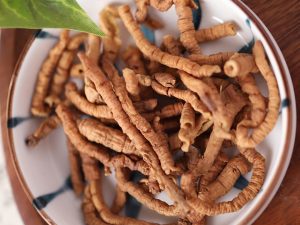
This product is cylindrical, straight or slightly curved, with flat ends, 5–18 cm long, and 1–2.5 cm in diameter. The surface is off-white or pale brownish-red, smooth or with longitudinal wrinkles and fine root scars; occasionally, remnants of brownish-red outer bark may be present.The texture is firm and difficult to break; the fracture surface is relatively flat, off-white or slightly brownish-red, with a distinct cambium ring and radially arranged rays. It has a faint odor and a slightly bitter, sour taste.
Properties of Processed Slices
1. White Peony Root: This product consists of thin, nearly circular slices. The surface is pale brownish-red or off-white and smooth. The cross-section is off-white or slightly brownish-red, with a distinct cambium ring and slightly raised vascular bundles arranged in a radial pattern. It has a faint odor and a slightly bitter, sour taste.
2. Roasted White Peony Root: This product resembles White Peony Root slices. The surface is slightly yellow or pale brownish-yellow, and some may show scorch marks. It has a faintly fragrant odor.
3. Wine-Processed White Peony Root: This product resembles White Peony Root slices. The surface is slightly yellow or pale brownish-yellow, and some may show scorch marks. It has a faint aroma of wine.
Botanical Information
Botanical Classification
Paeonia, a plant of the genus Paeonia in the Ranunculaceae family.
Morphological Characteristics
A perennial herb, 40–70 cm tall, glabrous.The root is swollen, spindle-shaped or cylindrical, and dark brown. The stem is erect, branched toward the top, with several sheath-like, membranous scales at the base. Leaves are alternate; petioles are up to 9 cm long, with those at the top of the stem being shorter; lower stem leaves are twice-ternate, while upper stem leaves are ternate;leaflets are narrowly ovate, elliptic, or lanceolate, 7.5–12 cm long and 2–4 cm wide, with an acuminate apex, a cuneate or oblique base, and margins bearing fine white cartilaginous teeth; both surfaces are glabrous, with the lower surface sparsely pubescent along the veins and nearly leathery.Flowers are bisexual, occurring in clusters at the stem apex and in leaf axils, 7–12 cm in diameter; bracts 4–5, lanceolate, of varying sizes; sepals 4, broadly ovate or nearly round, 1–1.5 cm long, 1–1.7 cm wide, green, persistent;petals 9–13, obovate, 3.5–6 cm long, 1.5–4.5 cm wide, white, sometimes with deep purple or pink patches at the base; cultivated varieties have petals of various colors and are double-flowered; stamens numerous, filaments 7–12 mm long, anthers yellow;The disk is shallowly cup-shaped, enclosing the base of the carpels, with bluntly rounded lobes at the apex; the carpels number 2–5, free, and glabrous. The capsule is ovate or ovoid, 2.5–3 cm long, 1.2–1.5 cm in diameter, with a beak at the apex. Flowering occurs from May to June; fruiting occurs from June to August.
Distribution Area
Distributed in Northeast China, North China, Shaanxi, and Gansu. Widely cultivated in cities, towns, and villages.
Growth Habits
It prefers a warm and humid climate, is tolerant of severe cold and drought, but is sensitive to waterlogging. It is best cultivated in loam or sandy loam soils that are well-drained, fertile, loose, and rich in humus, with ample sunlight and deep soil layers. It should not be planted in saline-alkali soils or waterlogged depressions. It should not be grown in the same field consecutively; instead, it can be rotated with safflower, chrysanthemum, and leguminous crops.
Propagation Methods
Propagation is by seed or root division.
Cultivation Techniques
1. Seed Propagation: Sow in late September. Make furrows in prepared beds for row sowing; the furrows should be 3 cm deep. Scatter the seeds evenly into the furrows, cover with 6–10 cm of soil, and firm the soil. The thousand-seed weight is 161.2 g, and the seeding rate is 52.5–60 kg per hectare. In April of the following year, remove part of the covering soil; seedlings will emerge in about half a month.
2. Propagation by root division: Cut the root at a point 3–4 cm below the base of the bud, split it open with a knife, and divide each clump into 3–5 plants, ensuring each plant has 1–2 buds. Plant in holes spaced (60–90) cm × 45 cm apart, placing 1–2 plants per hole. Cover the plants thoroughly with soil, water them, and hill up the soil to protect them over winter.Plant approximately 30,000 plants per 1 h㎡. To increase yield, apply an appropriate amount of farmyard manure.
Pest and Disease Control
1. Diseases include brown spot, damping-off, root rot, gray mold, and rust. Treat by spraying carbendazim or zinc mancozeb, or by digging up and burning the entire plant.
2. Pests include red spider mites, aphids, wireworms, and cutworms.