Toad, a name for a Chinese medicinal material. It consists of the entire body of the Chinese common toad (Bufo bufo gargarizans Cantor) or the black-eyed toad (Bufo melanostictus Schneider) from the family Bufonidae. It has the therapeutic effects of detoxifying and dispersing nodules, eliminating food stagnation and promoting diuresis, as well as killing parasites and eliminating malnutrition-related sores.It is primarily used to treat boils, carbuncles, back abscesses, scrofula, malignant sores, masses and accumulations, abdominal distension, edema, malnutrition in children, tetanus, and chronic cough and wheezing.

Toad
Toad, a name for a Chinese medicinal material. It consists of the entire body of the Chinese common toad (Bufo bufo gargarizans Cantor) or the black-eyed toad (Bufo melanostictus Schneider) from the family Bufonidae. It has the therapeutic effects of detoxifying and dispersing nodules, eliminating food stagnation and promoting diuresis, as well as killing parasites and eliminating malnutrition-related sores.It is primarily used to treat boils, carbuncles, back abscesses, scrofula, malignant sores, masses and accumulations, abdominal distension, edema, malnutrition in children, tetanus, and chronic cough and wheezing.
Chinese Name : 蟾蜍
Aliases : Chan Zhu, Qu Yi, Qu Fu, Chan, Ke Tuo, Le Xia Ma, Shi Bang, Le Xia Yan, Le Ha Ma, Le Ge Bao, Le Ba Zi, Qi Ha Ma, Qi Ba Zi
Authentic Producing Area : Mainly produced in Shandong, Hebei, Jiangsu, and Zhejiang
Nature, Flavor & Meridian Tropism : Pungent in taste, cool in nature; enters the Heart, Liver, Spleen, and Lung meridians
Benefits & Efficacy
Benefits
Detoxifies and disperses nodules; eliminates food stagnation and promotes diuresis; kills parasites and eliminates malnutrition.
Indications
Mainly used to treat boils, carbuncles, back abscesses, scrofula, malignant sores, masses and accumulations, abdominal distension, edema, malnutrition in children, tetanus, and chronic cough and wheezing.
Usage and Dosage
External use: Take an appropriate amount, burn until charred, grind into a powder, and apply as a poultice or ointment; or pound a live toad and apply the paste. Internal use: Decoct 1 toad in water; or incorporate 1–3 g into pills or powders.
Precautions
Pregnant and breastfeeding women should avoid consuming toads, as the active ingredients in toads may be transmitted to infants via the placenta or breast milk, causing adverse effects on the infant.
Chemical Constituents
1. The secretions from the parotid glands of the flower-backed toad (Bufovaddeistrauch) contain cholesterol, South American bufotoxin, Japanese bufotalin, Yuanhua bufotoxin, and Sha bufotoxin. 2. The volatile components in the parotoid gland secretions include nonanoic acid, decanoic acid, and small amounts of n-octadecane, n-nonadecane, n-tridecane, eicosane, and octadecadienoic acid.
Pharmacological Actions
1. Toad preparations can enhance myocardial contractility, increase cardiac output, reduce heart rate, and alleviate edema and dyspnea, exhibiting digitalis-like effects. 2. Pressor effect: This product produces a rapid and steady increase in blood pressure that is long-lasting and increases blood flow to the kidneys, brain, and coronary arteries, outperforming vasoconstrictors such as epinephrine. 3. Local anesthetic effect: In experiments using guinea pig corneas, equal doses of the drug were instilled into the eyes, followed by six stimulations every 5 minutes for a total of 30 minutes. The number of times the cornea showed no reaction during the 30-minute period was recorded, and the percentage of non-reactive responses was used as an indicator of the local anesthetic effect. The results showed that its local anesthetic effect was generally stronger than that of cocaine. 4. Antitumor Effects: Toad preparations increase the activity rate of splenic hemolytic plaque-forming cells (PECs) in mice, enhance the function of splenic macrophages, and raise serum lysozyme concentrations. Additionally, toads exert effects on the immune and circulatory systems.
Relevant Discussions
1. *Medicinal Animals of Shandong*: “Mainly used to treat chronic tracheitis, sore throat, edema, and difficulty urinating.”
2. *Collected Notes on the Classic of Materia Medica*: “For those suffering from febrile diseases with severe rashes, consume one or two fresh specimens.” “Burn to ash and apply to sores.”
3. *Treatise on the Nature of Medicinal Substances*: “Kills intestinal parasites; treats malignant ulcers caused by ‘rat-like’ sores.” ““Apply the ash to all types of parasitic, intensely itchy, and suppurating sores.”
4. *Supplements to the Materia Medica*: “For febrile diseases accompanied by rashes, take one toad, pound it raw, squeeze out the juice, and drink it; alternatively, burn it to ash and take the powder. For rabies bites causing delirium and near-fatal symptoms, prepare it as sashimi and consume it frequently over several meals.”
5. *Rihua Zi*: “Dissolves masses and knots; treats malnutrition and jaundice in children, as well as abdominal masses.”
6. *Manual of Shandong Medicinal Herbs*: “Cardiotonic, diuretic, and analgesic; treats edema and ascites.”
7. *Compendium of Materia Medica*: “Treats all five types of malnutrition and eight types of dysentery, swollen toxins, tetanus, and rectal prolapse.”
8. *Ben Cao Zheng*: “Dissolves stagnant qi and accumulations; breaks up hard masses and reduces swelling.”
9. *Ben Cao Bei Yao*: “Induces sweating to reduce fever; removes dampness and kills parasites.”
10. *Ben Cao Qiu Zhen*: “Dispels and purges heat; attacks pathogens both externally and internally.”
Applications
Clinical Applications
1. For treating boils, abscesses, and carbuncles: Grind a toad into a fine powder, mix with vinegar, and apply to the affected area. (*Manual of Shandong Herbal Medicine*)
2. For treating lip sores: Take a dried toad, burn it to ash, grind it into a fine powder, and apply it to the affected area. (*Shenghui Fang*)
3. For hemorrhoids: Take one toad, cut a square piece of brick to fit inside the toad, and secure it with mud. Calcine over a fire until the essence remains, then grind into a powder. Take a section of pig’s large intestine, tie both ends securely, boil until tender, chop finely, dip in the toad powder, and eat. Repeat this three or four times. (*Compendium of Materia Medica*)
4. For edema and ascites: 1 g of toad powder. Take once daily for 2–10 consecutive days. Reduce the dose appropriately for those with physical weakness; monitor blood pressure changes while taking this medication. (*Manual of Shandong Chinese Herbal Medicine*)
5. For swelling in children: One toad, gutted; 0.15 g of musk.First place the musk in the child’s navel, then cover the navel area with the toad and secure it tightly with a cloth. After the duration of burning one stick of incense, remove the preparation; the swelling will subside on its own. (Jiangxi *Manual of Herbal Medicine*)
6. For treating tinea: Burn a dried toad to ash, grind into a powder, and mix with lard to apply topically. (*Wai Tai*, citing *Shen Shi Fang*)
7. Treatment for phlebitis: 1 dried toad, 1 white flower snake, 90 g honeysuckle, 60 g Achyranthes root, and 30 g Aconite root. Soak in 1 kg of wine for 3 days, then heat in a water bath for 1.5 hours, allow to cool, and filter. Take 1 small cup twice daily. (*Hebei Chinese Herbal Medicine*)
Notes
Patients requiring treatment with Chinese herbal medicine should first consult a licensed Traditional Chinese Medicine (TCM) hospital to receive a prescription following a professional TCM differential diagnosis.
Processing & Preparation
Harvesting & Processing
Capture in summer or fall. After capture, first extract the toad secretion, then kill the toads and dry them directly in the sun.
Processing Methods
1. Dried Toad: Take the raw material, wash it thoroughly, and remove the head and claws (cut the head level with the eyebrows). Cut each toad into 4–6 pieces and dry.
2. Roasted Dried Toad: Heat iron sand in a wok until hot. Add the cleaned herbal material and stir-fry until the surface bulges slightly and a burnt odor is released. Remove immediately, sift out the sand, and allow to cool. In folk medicine, some use live toads coated with yellow clay, which are then baked in fire ash to preserve their vitality before being ground into a fine powder for medicinal use.
Storage Methods
Store in a dry container in a cool, dry place to prevent mold and insect infestation.
Crude Drug Identification
Properties of Crude Drugs
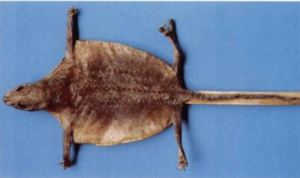
The entire body is shriveled and wrinkled, with angular ridges running lengthwise; the four legs vary in length. The surface is gray-green or greenish-brown. The inner surface of the abdominal cavity, after removal of the internal organs, is grayish-yellow, revealing the skeleton and dermal membranes. It has a faint fishy odor and a pungent taste.
Large, dry, and intact specimens are considered the best.
Properties of Processed Slices
See “Characteristics of Medicinal Materials” for details.
Botanical Information
Morphological Characteristics
1. Chinese Giant Toad: Body length generally exceeds 10 cm; the body is stout; the head is wider than it is long; the snout is rounded with a prominent snout ridge; the nostrils are near the tip of the snout; the distance between the eyes is greater than the distance between the nostrils; the eardrum is distinct; there are no palatine teeth, and neither the upper nor lower jaws have teeth.The forelimbs are long and stout; the fingers and toes are slightly flattened, with a faint marginal membrane on the sides of the fingers but no webbing; the finger lengths are, in order, 3, 1, 4, 2; the tubercles below the finger joints are mostly paired; there are two palmar tubercles, with the lateral one being larger.The hind limbs are stout and short; the tibio-tarsal joint extends forward to the shoulder level; the heels do not touch one another; the sides of the toes have marginal membranes, and the webbing is fairly well-developed; the medial metatarsal is elongated and large, while the lateral metatarsal is small and round.The skin is extremely rough; the top of the head is relatively smooth, with large, elongated parotid glands on both sides. The rest of the body is covered with round tubercles of varying sizes; those arranged more regularly are located behind the head, while those arranged obliquely run almost parallel to the parotid glands.In addition, the tubercles along the flanks are also arranged relatively regularly; those on the shins are larger; some specimens have indistinct tarsal folds; and the ventral skin is not smooth but covered with small tubercles.Color variation is considerable; during the breeding season, males are mostly blackish-green on the dorsal side, with pale markings on the flanks; females are paler on the dorsal side, with milky-yellow tubercles, and sometimes have oblique black longitudinal stripes extending from behind the eyes along the flanks; the ventral side is milky-yellow with fine brown or black patterns. Males are smaller and have black nuptial pads on the inner three toes, but lack vocal sacs.
2. Black-eyed Toad: Body length 7–10 cm; males are slightly smaller. The head is high, and its width exceeds its length. The snout is rounded with a distinct snout ridge; the nostrils are near the tip of the snout. The interorbital distance is greater than the intranasal distance. The eardrum is large; there are no palatine teeth; both the upper and lower jaws are toothless; and the posterior end of the tongue lacks a notch.The head features very distinct black bony ridges or black lines along the snout ridge, the upper edge of the eye sockets, the anterior margin of the eardrum, and the margins of the upper and lower jaws. The top of the head is distinctly concave, and the skin is tightly attached to the skull. The forelimbs are slender and long; the fingers and toes are slightly flattened, with black tips; the digit order is 3, 1, 4, 2;subphalangeal tubercles are mostly paired; the lateral metacarpal tubercle is large, while the medial one is slightly smaller, both brown in color; the hind limbs are short, with the tarsometatarsal joint extending to the rear of the shoulder; the heels do not touch one another; the feet are shorter than the tibia; the sides of the toes are connected by a membrane forming a semi-web; subphalangeal tubercles are not prominent; the medial metatarsal tubercle is slightly larger than the lateral one.The skin is extremely rough; except for the top of the head, which is wart-free, the rest of the body is covered with round warts of varying sizes, some of which bear black spots or spines; the sides of the head feature oblong parotid glands; near the midline, from the back of the head to the hindquarters, there are two relatively regular rows of large warts arranged longitudinally.The ventral surface of adult Black-eyed Toads is covered with small spines. Body coloration varies considerably during their active period, generally appearing yellowish-brown with faint reddish-brown markings. Males possess black nuptial pads on the medial sides of the bases of the first and second digits, and a single subglottal vocal sac.
Distribution Area
1. Chinese Giant Toad: Found in Northeast China, North China, East China, Central China, as well as Shaanxi, Gansu, Qinghai, Sichuan, and Guizhou. 2. Black-eyed Toad: Found in Zhejiang, Jiangxi, Fujian, Taiwan, Hunan, Guangdong, Guangxi, Sichuan, Guizhou, and Yunnan.