Humulus is the name of a traditional Chinese medicine. It refers to the whole plant of Humulus scandens (Lour.) Merr., a member of the Moraceae family. Harvested from September to October on a sunny day, the above-ground parts are cut, impurities removed, and the plant sun-dried. It is distributed throughout most regions of China, growing in wet areas along roadsides and ditches, on village fences, or in shrubbery at forest edges.It has a bitter and sweet taste, a cold nature, and enters the Lung and Kidney meridians. It has the effects of clearing heat and detoxifying, as well as promoting urination and relieving dysuria. It is primarily used to treat conditions such as cough due to lung heat, lung abscess, deficiency-heat with restlessness and thirst, heat-induced dysuria, edema, difficulty urinating, damp-heat diarrhea and dysentery, heat-toxin sores and ulcers, and skin itching.

Hops
Humulus is the name of a traditional Chinese medicine. It refers to the whole plant of Humulus scandens (Lour.) Merr., a member of the Moraceae family. Harvested from September to October on a sunny day, the above-ground parts are cut, impurities removed, and the plant sun-dried. It is distributed throughout most regions of China, growing in wet areas along roadsides and ditches, on village fences, or in shrubbery at forest edges.It has a bitter and sweet taste, a cold nature, and enters the Lung and Kidney meridians. It has the effects of clearing heat and detoxifying, as well as promoting urination and relieving dysuria. It is primarily used to treat conditions such as cough due to lung heat, lung abscess, deficiency-heat with restlessness and thirst, heat-induced dysuria, edema, difficulty urinating, damp-heat diarrhea and dysentery, heat-toxin sores and ulcers, and skin itching.
Chinese Name : 葎草
Aliases : Le Cao, Hei Cao, Ge Mu Man, Ge Le Man, Lai Du Cao, Ge Mu Cao, Se Luo Man, Ge Ren Teng, Ku Gua Teng, Jue Jue Teng, La La Teng, Wu Zhao Long, Da Ye Wu Zhao Long
Nature, Flavor & Meridian Tropism : Sweet, bitter, cold. Lung and Kidney meridians
Benefits & Efficacy
Benefits
Clears heat and detoxifies; promotes urination and relieves dysuria.
Indications
Mainly used for lung-heat cough, lung abscess, deficiency-heat with restlessness and thirst, heat-induced dysuria, edema, difficulty urinating, damp-heat diarrhea and dysentery, heat-toxin sores and ulcers, and skin itching.
Usage and Dosage
Internal use: Decoct 10–15 g (or 30–60 g of fresh herb); or extract the juice. External use: Apply an appropriate amount as a poultice; or decoct in water for steam baths or washing.
Precautions
Use with caution in patients without febrile conditions.
Pharmacological Actions
Ethanol extracts of the stems and leaves exhibit significant inhibitory effects against Gram-positive bacteria in test tubes. Humulone, similar to lupulone, also possesses antibacterial activity; it inhibits the growth of Gram-positive and Gram-negative bacteria, as well as certain fungi and yeasts. However, some reports indicate it is ineffective against Gram-negative bacteria and yeasts.Regarding its effect on Gram-negative bacteria, hupulone is 1/20 as potent as humulone; its effect on Mycobacterium tuberculosis is 1/10 that of humulone.Hopsone exerts a dinitrophenol-like effect on cats; intravenous injection of 3 mg/kg immediately doubles oxygen consumption, induces rapid breathing, and is followed by a rise in body temperature; it can be fatal due to excessive elevation of body temperature (45°C), with death occurring rapidly and accompanied by severe rigor mortis. High-dose injections may also cause glycosuria and hematuria. Its effects on rabbits are far weaker than those on cats.
Applications
Related Compatibility
1. For treating phlegm-type dysuria: Pound fresh Hops to extract 3 sheng of juice; mix with 2 he of vinegar. Combine and take in a single dose on an empty stomach; the urine will appear like white liquid.
2. For treating gravel-type dysuria: Use 4 to 5 liang of fresh Hops stems. Pound them into a paste, add an appropriate amount of boiling water, and grind to extract the juice; drink the mixture.
3. For acute and chronic malaria: One handful of Houttuynia cordata (with both ends removed; use dried in autumn and winter) and an equal part of powdered Hengshan root. Soak the herbs in two large bowls of diluted whey water; leave them exposed to starlight, moonlight, and dew overnight. At the fifth watch, decoct until reduced to one bowl; drink to induce vomiting of phlegm, which will cure the condition.
4. For chronic dysentery leading to wasting disease: Pound and sift dried Houttuynia cordata vines; measure the required amount and blow it into the anus through a tube.
5. For dysentery, painful and dribbling urination, or blood in the urine: 2 to 4 liang of fresh Hops. Decoct in water and take before meals, twice daily.
6. For leprosy with sores covering the entire body: One dan of Hops. Boil in 2 shi of water until reduced to 1 shi, then use the liquid to soak the sores.
7. For black leprosy: Two cheng of Hops (chopped and thoroughly rinsed) and one cheng of Motherwort (chopped and washed). Boil in two shi and five dou of water until reduced to one shi and five dou. Strain out the residue. Soak in a basin or jar for one chen before emerging; cover with a quilt or clothing, then soak again for another chen before emerging. Avoid exposure to drafts. Repeat the procedure the following day.If, after entering the bath, the entire body becomes unbearably itchy, have someone hold your hands to prevent scratching; the itching will gradually subside within a short while. Thereafter, bathe once every three days. Discard the medicinal water after two baths.
8. To treat skin itching: Use an appropriate amount of Hops, decoct in water, and use the steam for fumigation and washing.
9.For the initial stage of an abscess (skin color unchanged, hard swelling without pain): One handful of fresh Hops leaves. Wash thoroughly with cold boiled water, pound into a paste with brown sugar, heat, and apply as a poultice; change twice daily.
10. For scrofula: 2 liang of fresh Hops leaves, 2 liang of yellow wine, and 4 liang of brown sugar. Decoct in water and take in three divided doses after meals.
11.To treat impetigo in children: Boil cut “Ren Teng” (a type of vine) in water and use the decoction to wash the affected area once or twice daily. Avoid fishy foods and other trigger foods.
12. To treat snake and scorpion bites: One handful of fresh Houttuynia cordata leaves and one qian of realgar. Pound into a paste and apply as a poultice.
13. To treat hemorrhoids and rectal prolapse: Three liang of fresh Houttuynia cordata. Boil in water and use the steam to fumigate and wash the affected area.
Processing & Preparation
Harvesting & Processing
Harvest in September–October on a sunny day. Cut the above-ground parts, remove impurities, and sun-dry.
Processing Methods
Cleaning: Remove woody stems, root remnants, and impurities. Cutting: Remove impurities, woody stems, and root remnants; lightly moisten with water, cut into sections, sun-dry, and sift out ash and debris.
Crude Drug Identification
Identification
Characteristics of the herbal material: Leaves are shriveled into clusters. When a whole leaf is flattened, it is nearly reniform with a pentagonal shape, deeply palmately lobed into 5–7 segments with coarse serrations along the margins; both surfaces are covered with fine hairs, and the underside has small yellow glandular dots;The petioles are 5–20 cm long, with longitudinal grooves and reverse spines. The stems are round, with reverse spines and downy hairs. The material is brittle and easily broken; the stem cross-section is hollow and uneven, and the bark and wood are easily separated. Some specimens may contain inflorescences or fruit spikes. It has a faint odor and a bland taste.
Microscopic identification: Leaf cross-section: Epidermal cells in a single layer; both upper and lower epidermis contain non-glandular trichomes and crystal-bearing cells with stalactites. Stalactites are mostly found within short, swollen non-glandular trichomes. Thick-walled tissue is present on the inner side of the lower epidermis adjacent to the vascular bundle of the midrib; the palisade tissue consists of a single layer of cells, and the spongy tissue cells are relatively loose; the vascular bundle of the midrib is exarch.Parenchymatous cells contain clusters of calcium oxalate crystals.
Stem cross-section: Polygonal in shape. Epidermal cells arranged in a single layer; hooks and non-glandular trichomes are visible; sclerenchyma is present on the inner side of the ridges. The cortex is relatively narrow. Vascular bundles are exarch and arranged in a ring; the pith is broad. Parenchymatous cells contain clusters of calcium oxalate crystals.
Powder characteristics: Leaf powder is yellowish-green.① Upper epidermal cells are polygonal, with straight vertical walls and few stomata; lower epidermal cells have slightly curved vertical walls, with anamorphic stomata and 5–6 subsidiary cells. ② Non-glandular trichomes are unicellular, 50–612 μm long; some have curved or hooked tips, and wall warts are sometimes visible; others have a swollen, short base containing a stalactite, and are more commonly found on the upper epidermis.③ Spiral vessels have a diameter of 11–29 μm. ④ Fibers have a diameter of 21–35 μm and a wall thickness of 1–5 μm. ⑤ Calcium oxalate cluster crystals have a diameter of 7–32 μm and relatively short edges.
Botanical Information
Botanical Classification
Hops (Humulus lupulus), a member of the Moraceae family.
Morphological Characteristics
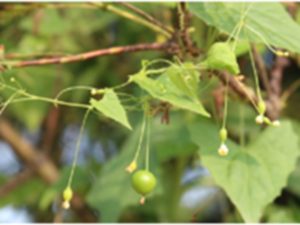
An annual or perennial climbing herb. Stems up to several meters long, pale green, with longitudinal ridges; the stem ridges and petioles are densely covered with short, backward-pointing hooked spines.Leaves are simple and opposite; petioles are 5–20 cm long, slightly 6-angled, and bear short, backward-pointing hooked spines; palmate leaves are deeply lobed into 5–7 segments, approximately 5–15 cm in diameter, with lobes that are ovate or ovate-lanceolate, acuminate or gradually tapering at the apex, serrate at the margins, bearing coarse bristles on the upper surface, fine oil dots on the lower surface, and stiff hairs along the veins.Flowers are unisexual; the plant is dioecious. Male inflorescences are panicles; female inflorescences are short spikes. Male flowers are small, with 5 perianth segments that are yellowish-green, and 5 stamens with short, thread-like filaments;Female flowers occur in pairs, each with one bract; the bract is ovate-lanceolate, covered with white spiny hairs and small yellow glandular dots; the perianth consists of a single, grayish-white segment that tightly encloses the pistil; the ovary is single, protruding at the top, and sparsely covered with fine hairs. The fruit spike is green and nearly spherical; the achenes are pale yellow and flattened-spherical. Flowering occurs from June to October, and fruiting from August to November.
Distribution Area
It is distributed throughout most of China.