Gentiana is the name of a traditional Chinese medicine. It refers to the dried roots and rhizomes of plants from the Gentianaceae family and Gentiana genus, specifically Gentiana manshurica Kitag. (striped-leaved gentian), Gentiana scabra Bge. (rough gentian), Gentiana triflora Pall. (three-flowered gentian), or Gentiana rigescens Franch. (Yunnan gentian). The first three are commonly known as “Gentiana,” while the latter is commonly known as “hard gentian.”It has the effects of clearing heat, drying dampness, and purging liver and gallbladder fire. It is primarily used to treat damp-heat jaundice, genital swelling and itching, leukorrhea, itchy eczema, red eyes due to liver fire, tinnitus and deafness, pain in the flanks and a bitter taste in the mouth, excessive sexual desire and nocturnal emissions, and convulsions caused by sudden fright.

Gentian
Gentiana is the name of a traditional Chinese medicine. It refers to the dried roots and rhizomes of plants from the Gentianaceae family and Gentiana genus, specifically Gentiana manshurica Kitag. (striped-leaved gentian), Gentiana scabra Bge. (rough gentian), Gentiana triflora Pall. (three-flowered gentian), or Gentiana rigescens Franch. (Yunnan gentian). The first three are commonly known as “Gentiana,” while the latter is commonly known as “hard gentian.”It has the effects of clearing heat, drying dampness, and purging liver and gallbladder fire. It is primarily used to treat damp-heat jaundice, genital swelling and itching, leukorrhea, itchy eczema, red eyes due to liver fire, tinnitus and deafness, pain in the flanks and a bitter taste in the mouth, excessive sexual desire and nocturnal emissions, and convulsions caused by sudden fright.
Chinese Name : 龙胆
Latin Name : Gentianae Radix Et Rhizoma
Aliases : Ditan Tou, Mo Ditan, Lu’ercao (Hainan)
Authentic Producing Area : Heilongjiang, Jilin, Liaoning, Inner Mongolia, Yunnan, Sichuan, Guizhou
Nature, Flavor & Meridian Tropism : Bitter in taste, cold in nature; enters the Liver and Gallbladder meridians
Benefits & Efficacy
Benefits
Clears heat and dries dampness; purges liver and gallbladder fire.
Indications
Damp-heat jaundice; genital swelling and itching; leukorrhea; itchy eczema; red eyes due to liver fire; tinnitus and deafness; costal pain and bitter taste in the mouth; persistent erection; convulsions and spasms.
Usage and Dosage
1. Internal use: Decoct 3–6 g in water; or incorporate into pills or powders. 2. External use: Use an appropriate amount; decoct in water for washing; or grind into a powder and apply topically.
Precautions
Not suitable for individuals with spleen-stomach deficiency-cold; use with caution in cases of yin deficiency with fluid depletion.
Chemical Constituents
This product primarily contains furanocoumarin glycosides such as gentianin, danggyao glycoside, danggyao glycoside A, gentianin ester glycoside, and danggyao ester glycoside, as well as alkaloids such as gentianine (Qinjiao alkaloid A) and gentianine yellow.
Pharmacological Actions
This product primarily exhibits antimicrobial, antipyretic, anti-inflammatory, hepatoprotective, and cholagogue effects.
Relevant Discussions
1. *Shennong’s Classic of Materia Medica*: “It treats alternating chills and fever in the bones, epileptic seizures caused by pathogenic factors, heals severed injuries, stabilizes the five viscera, and neutralizes poisonous spells.”
2. *Explanation of the Properties of Medicinal Substances*: “It specifically purges fire from the liver and gallbladder, and is primarily used to treat eye pain, neck pain, pain in the flanks, epileptic seizures caused by pathogenic factors, and malnutrition in children. It is remarkably effective for all conditions caused by pathogenic heat in the liver meridian.Its nature is heavy and sinking, making it highly effective at clearing damp-heat in the lower jiao. For conditions such as scrotal abscesses, fecal toxicity, lower jiao sores, and difficult urination; for men experiencing swelling and protrusion of the penis—whether accompanied by a glossy discharge of pus or itching and pain along the shaft; or for women suffering from pain or itching and sores caused by dysuria—treating these with Longdan Xiegan Decoction demonstrates the power of its bitter and cold nature to overcome heat.”
Applications
Clinical Applications
1. To treat damp-heat jaundice, it can be combined with Kushen, such as in the Kushen Pills (*Source and Course of Miscellaneous Diseases: A Rational Analysis*), or with herbs such as Gardenia, Rhubarb, and White Reed Root, as in the Longdan Powder (*Sacred Beneficial Formulas*).; for treating damp-heat descending to the lower burner—manifesting as genital swelling and itching, itchy eczema, or yellow, foul-smelling vaginal discharge—it is often combined with Alisma, Akebia, and Plantain Seed, as in the Longdan Xiegan Decoction (*Lan Shi Mi Cang*).
2. For treating headaches caused by liver fire, red eyes, deafness, pain in the flanks, and a bitter taste in the mouth, it is often combined with herbs such as Bupleurum, Scutellaria, and Gardenia, as in the Longdan Xiegan Decoction (*Lan Shi Mi Cang*).
3. To treat high fever, convulsions, and spasms caused by intense heat in the Liver Meridian—where extreme heat gives rise to wind—it is often combined with Niuhuang, Qingdai, and Huanglian, as in Liangjing Wan (from *Direct Decisions on Pediatric Medicines and Syndromes*), or with Huangbai, Da Huang, and Luhui, as in Danggui Luhui Wan (from *Xuanming Lunfang*).
Related Compatibility
1. Gentiana combined with Artemisia capillaris: Gentiana clears heat, dries dampness, purges liver fire, and promotes bile secretion; Artemisia capillaris dries dampness, promotes bile secretion, and alleviates jaundice. When used together, the effects of clearing heat, draining dampness, soothing the liver, and promoting bile secretion are enhanced. This combination is indicated for damp-heat jaundice caused by damp-heat in the liver and gallbladder leading to bile overflow.
2. Gentiana combined with Oyster Shell: Gentiana is bitter and cold, enters the Liver and Gallbladder meridians, and has a heavy nature; it can direct heat downward and is a key herb for subduing and purging excess fire in the Liver and Gallbladder. Oyster Shell is salty, cold, and heavy in nature; it enters the Liver meridian and is a key herb for clearing and purging Liver heat, as well as calming the Liver and subduing its yang.When used in combination, these two herbs enhance the ability to subdue Liver yang and clear Liver fire. They are indicated for dizziness, headache, redness, and swelling of the eyes caused by ascending Liver fire and hyperactive Liver yang, as well as convulsions and spasms of the hands and feet resulting from excessive Liver fire and heat-induced wind.
3. Gentiana combined with Sophora flavescens: Gentiana clears heat, dries dampness, and purges liver and gallbladder fire; Sophora flavescens clears heat, dries dampness, kills parasites, and promotes urination. When used together, the efficacy of clearing heat and drying dampness is enhanced. This combination is indicated for damp-heat jaundice and itchy vaginal discharge caused by damp-heat descending to the lower jiao.
Medicinal Identification
1. Gentiana, Scutellaria, Coptis, and Phellodendron: All four are heat-clearing and dampness-drying herbs; they are bitter and cold in nature, with effects of clearing heat, drying dampness, purging fire, and detoxifying. They can all treat various conditions caused by damp-heat and fire-toxin, such as damp-heat diarrhea and dysentery, damp-heat jaundice, heat-toxin abscesses and swellings, redness and swelling of the eyes, blood-heat-induced vomiting of blood and epistaxis, and other fire-heat syndromes affecting various organs and viscera.However, Gentiana primarily enters the Liver and Gallbladder meridians and excels at clearing damp-heat in the Lower Jiao; it is particularly effective at purging excess fire in the Liver and Gallbladder. It can be used for conditions such as eczema and blistering caused by damp-heat in the Lower Jiao, leukorrhea and turbid urine, genital swelling and itching, and damp-heat jaundice, as well as for symptoms of excess fire in the Liver and Gallbladder such as red eyes, headache, deafness, ear swelling, costal pain, and a bitter taste in the mouth. It also treats convulsions and spasms caused by Liver heat stirring wind.Scutellaria baicalensis excels at clearing damp-heat in the middle and upper Jiao and purging lung fire; it is frequently used for syndromes involving damp-heat in the middle and upper Jiao, as well as for lung-heat-induced cough and wheezing. It can also stop bleeding and stabilize the fetus, and is used for blood-heat-induced vomiting of blood and epistaxis, as well as fetal restlessness due to heat.Coptis (Huanglian), which is bitter and cold, excels at clearing damp-heat from the middle jiao and purging excess fire from the heart and stomach. It is the primary herb for treating damp-heat-induced diarrhea and dysentery, and is particularly used for gastrointestinal damp-heat, diarrhea, dysentery, and vomiting; feverish illnesses with mental confusion; restlessness and insomnia; stomach heat with thirst; and excessive hunger despite good digestion.Phellodendron (Huang Bai) is bitter and cold in nature with a descending action; it excels at eliminating damp-heat in the lower jiao and is particularly effective at purging “ministerial fire” and reducing deficiency heat. It is frequently used for swelling and pain in the feet and knees caused by damp-heat descending, dysuria with turbid urine and leukorrhea, eczema and toxic sores, as well as bone-steaming fever and tidal fever resulting from yin deficiency with yang hyperactivity.
2. Longdan and Xiakucao: Both are bitter and cold in nature and enter the Liver and Gallbladder meridians. They function to clear and drain fire from the Liver and Gallbladder and are both used to treat headaches, dizziness, tinnitus, red eyes, flank pain, and a bitter taste in the mouth caused by ascending Liver fire.However, Gentiana belongs to the category of herbs that clear heat and dry dampness; its nature is to descend and disperse, and it excels at purging excess fire in the Liver and Gallbladder. Therefore, it can be used for redness, swelling, and pain in the eyes; tinnitus and deafness; pain in the flanks and a bitter taste in the mouth; and erectile dysfunction caused by ascending Liver fire, as well as convulsions and spasms caused by Liver fire rising upward.Xiagucao belongs to the category of herbs that clear heat and purge fire; although it is not as effective as Longdancao at clearing liver fire, it also nourishes liver blood and can treat nocturnal eye pain caused by liver yin deficiency. It can also disperse stagnation and treat scrofula and goiters.
Related Medicines
Huanglian Yanggan Pills, Deafness Pills, Jinlong Shudan Granules, Yindan Pinggan Capsules, and Xiegan Anshen Pills.
Related Prescriptions
Longdan Xiegan Decoction (*Yifang Jijie*), Danggui Longhui Pills (*Xuanming Lunfang*), and Xieqing Pills (*Xiao’er Yaozheng Zhijue*).
Notes
Patients requiring treatment with Chinese herbal medicine should first consult a licensed Traditional Chinese Medicine (TCM) hospital to receive a prescription following a professional TCM differential diagnosis.
Processing & Preparation
Harvesting & Processing
Harvest in spring or autumn; wash thoroughly and dry.
Processing Methods
1. Gentiana: Take the raw herb, remove impurities and residual stems, wash thoroughly, steam until thoroughly moistened, cut into thick slices or segments, and dry.
2. Wine-Processed Gentiana: Take Gentiana slices or segments, sprinkle with yellow wine and mix evenly; after steaming briefly, place in a pot, heat over low heat, stir-fry until dry, then remove and allow to cool. Use 10 kg of yellow wine for every 100 kg of Gentiana.
3. Charred Gentian: Take Gentian segments, place them in a pan, and heat over high heat until the surface turns black and the interior becomes dark brown. Spray with clean water to extinguish all embers, then remove and allow to cool completely.
Storage Methods
Store in a dry container; keep Wine-Processed Gentian and Charred Gentian tightly sealed and place in a cool, dry location. Ensure Charred Gentian is well-ventilated to prevent reignition.
Crude Drug Identification
Properties of Crude Drugs
1. Gentiana: The rhizome is irregularly tuberous, 1–3 cm long and 0.3–1 cm in diameter; the surface is dark grayish-brown or dark brown, with a stem scar or residual stem base at the upper end, and numerous slender roots attached around the periphery and at the lower end. The roots are cylindrical, slightly twisted, 10–20 cm long, and 0.2–0.5 cm in diameter;the surface is pale yellow or yellowish-brown, with prominent transverse wrinkles on the upper part; the lower part is thinner, with longitudinal wrinkles and marks from lateral roots. It is brittle and breaks easily; the fracture surface is slightly flat, with the cortex yellowish-white or pale yellowish-brown, and the xylem lighter in color, arranged in dotted rings. It has a faint odor and a very bitter taste.
2. Jian Longdan: The surface has no transverse wrinkles; the outer bark is membranous and easily peels off; the wood is yellowish-white and easily separates from the bark.
Properties of Processed Slices
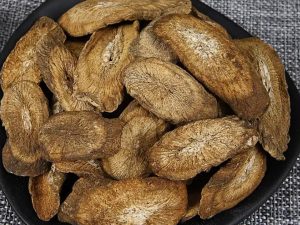
1. Gentiana: Irregular, thick, round slices or segments; the surface is yellowish-white or pale yellowish-brown; the center of the cross-section has faintly visible vascular dots and fissures. Slight odor; very bitter taste.
2. Wine-processed Gentiana: Resembles Gentiana slices or segments; the color is darker; has a faint odor of wine.
3. Charred Gentiana: Resembles Gentiana slices or segments; the surface is black; the interior is blackish-brown.
Botanical Information
Botanical Classification
Plants of the genus Gentiana in the family Gentianaceae, including Gentiana striata, Gentiana scabra, Gentiana triflora, and Gentiana yunnanensis.
Morphological Characteristics
1. Gentiana: A perennial herb, 30–60 cm tall. The rhizome is short, with numerous slender roots growing in tufts from it, up to 30 cm long. The flower stalk is solitary and unbranched. Leaves are opposite;sessile; lower leaves scale-like, fused at the base, 5–10 mm long; middle and upper leaves nearly leathery, leaf blades ovate or ovate-lanceolate, 2.5–7 cm long, 0.7–3 cm wide, apex acute or long-acuminate, base cordate or rounded, upper surface dark green, lower surface pale, margins revolute and rough; 3–5 veins.Flowers are numerous, clustered at branch tips and in leaf axils, sessile; each flower is preceded by two lanceolate or linear-lanceolate bracts, 2–2.5 cm long;The calyx is campanulate, 2.5–3 cm long, 5-lobed at the apex, often reflexed or spreading, and irregular; the corolla is tubular-campanulate, bluish-purple, 4–5.5 cm long, sometimes with numerous yellowish-green spots at the throat; the corolla is 5-lobed at the apex, with ovate lobes and triangular folds;There are 5 stamens, attached to the middle of the corolla tube, with broad filament bases; the ovary is narrowly elliptic or lanceolate, 1–1.4 cm long, with an ovary stalk approximately 1 cm long; the style is short, and the stigma is 2-lobed. The capsule is enclosed, oblong, and stalked.Seeds are numerous, brown, glossy, reticulate, and bear broad wings at both ends. Flowering period: August–September; fruiting period: September–October.
2. Linear-leaved Gentian: This species differs from Gentiana in that its leaves are thick, nearly leathery, and sessile; the upper leaves are linear-lanceolate to linear, with a blunt base and margins slightly revolute.Flowers: 1–2; calyx lobes linear-lanceolate, longer than or equal in length to the calyx tube; corolla lobes tapering to a point at the apex.
3. Three-flowered Gentian: This species differs from the previous two in that the middle and upper leaves are nearly leathery, linear-lanceolate to linear, with a rounded base. Flowers: 3, rarely 5; corolla lobes narrowly triangular, shorter than the calyx tube;the corolla lobes are bluntly rounded at the apex.
4. Yunnan Gentian: This species differs from the previous three in that it lacks a rosette of leaves; the cauline leaves are in multiple pairs and dimorphic, with the lower leaves comprising 2–4 pairs that are scale-like, while the middle and upper leaves are ovate-oblong, obovate, or ovate, with a cuneate base and margins slightly revolute.Flowers are numerous, clustered in capitate inflorescences at the branch tips, rarely axillary, and enclosed within a cluster of bract-like leaves at the very top; calyx lobes are uneven in size, with two large lobes that are obovate-oblong and narrowed at the base into a claw; stamens are attached to the lower part of the corolla tube. Seeds are yellowish-brown.
Distribution Area
1. Gentiana: Distributed in Northeast China, as well as Inner Mongolia, Hebei, Shaanxi, Xinjiang, Jiangsu, Anhui, Zhejiang, Jiangxi, Fujian, Hubei, Hunan, Guangdong, and Guangxi. 2. Linear-leaved Gentiana: Distributed in Northeast China, as well as Hebei, Shanxi, Shaanxi, Shandong, Jiangsu, Anhui, Zhejiang, Hubei, Hunan, Guangdong, and Guangxi. 3. Three-flowered Gentiana: Distributed in Northeast China, as well as Inner Mongolia and Hebei. 4. Yunnan Gentian: Found in Hunan, Guangxi, Sichuan, Guizhou, Yunnan, and other regions.
Growth Habits
It prefers a cool climate and is not particularly demanding regarding soil type, though light loam and humus-rich soils are most suitable. It is not suitable for cultivation in areas with high altitudes and dry conditions or intense direct sunlight.
Propagation Methods
Propagation is by root division or seed, though root division is more commonly used in commercial production.
Cultivation Techniques
Propagation can be carried out in both spring and fall, though fall is preferable. In August–September, select lateral roots growing beside vigorously developing plants as planting stock. Plant them at 15 cm intervals, cover the base of the rhizome with soil, and lightly tamp down the soil. If planting in spring, it should be done in March–April; approximately 150,000 planting stock plants are required per hectare.
Pest and Disease Control
1. Diseases include leaf spot, which can be controlled by spraying a 1,000-fold dilution of 50% Thiram or a 1:1:100 Bordeaux mixture. Prevention can also be achieved by applying a 600-fold dilution of 70% methyl thiophanate about half a month before the onset of the disease, repeating every half month for a total of six consecutive applications. Other diseases include white mold and root rot.
2. Pests include aphids and others.