Burdock root is the root of Arctium lappa, a plant of the genus Arctium in the Asteraceae family, produced in Jilin, Liaoning, Heilongjiang, Zhejiang, and other regions.This herb has a bitter and slightly sweet taste, a cool nature, and enters the Lung and Heart meridians. It has the effects of dispersing wind-heat and reducing swelling caused by toxins. It is primarily used to treat wind-heat colds, headaches, coughs, facial swelling due to heat toxins, sore throat, swollen and painful gums, rheumatic arthralgia, masses and lumps, boils, abscesses, and malignant sores, as well as hemorrhoids and rectal prolapse.

Burdock root
Burdock root is the root of Arctium lappa, a plant of the genus Arctium in the Asteraceae family, produced in Jilin, Liaoning, Heilongjiang, Zhejiang, and other regions.This herb has a bitter and slightly sweet taste, a cool nature, and enters the Lung and Heart meridians. It has the effects of dispersing wind-heat and reducing swelling caused by toxins. It is primarily used to treat wind-heat colds, headaches, coughs, facial swelling due to heat toxins, sore throat, swollen and painful gums, rheumatic arthralgia, masses and lumps, boils, abscesses, and malignant sores, as well as hemorrhoids and rectal prolapse.
Chinese Name : 牛蒡根
Aliases : E Shigen, Shu Nian Gen, Niu Cai
Authentic Producing Area : Native to Jilin, Liaoning, Heilongjiang, Zhejiang, and other regions
Nature, Flavor & Meridian Tropism : Taste: bitter with a slight sweetness; nature: cool; enters the Lung and Heart meridians
Benefits & Efficacy
Benefits
Burdock root has the effects of dispersing wind-heat and reducing swelling.
Indications
Burdock root is primarily used to treat wind-heat colds, headaches, coughs, facial swelling caused by heat toxins, sore throat, swollen and painful gums, rheumatic arthralgia, masses and lumps, boils, abscesses, and malignant sores, as well as hemorrhoids and rectal prolapse.
Usage and Dosage
1. Internal use: Decoct 6–15 g in water; or extract the juice; or grind into a powder; or soak in wine. 2. External use: Apply an appropriate amount as a poultice; or prepare a paste for application; or wash with a decoction.
Precautions
*Supplement to the Materia Medica*: Avoid using the root when it is still fresh; steam and sun-dry it first; otherwise, it may induce nausea.
Applications
Clinical Applications
1. For residual fever following an epidemic that refuses to subside, accompanied by restlessness, thirst, weakness in the limbs, and inability to eat or drink: Pound burdock root to extract the juice, and drink one small cup. (*Shenghui Fang*)
2. For heat attacking the heart, causing restlessness and confusion: Pound burdock root to extract one sheng of juice. Divide into three doses to be taken after meals. (*Shiyi Xinjing*)
3. For sudden swelling of the head and face caused by internal heat, toxins, or wind; or for redness and swelling of the hands, feet, head, and face accompanied by pain upon touch: Wash burdock root seeds, grind them into a paste, and simmer with wine to form a paste. Spread the paste on paper and apply it to the swollen area. Additionally, take one dose mixed with hot wine; the swelling will subside and the pain will lessen. (*Formulas from Doumen*)
4. For heat-induced swelling of the throat: One sheng of sliced burdock root. Boil in five sheng of water until reduced to three sheng; divide into three or four warm doses. Avoid garlic and wheat flour. (*Secret Records for Prolonging Life*)
5. For throat swelling in children: Pound burdock root to extract its juice and swallow it slowly. (*Formulas for Universal Relief*)
Notes
Patients requiring treatment with traditional Chinese medicine should first consult a licensed TCM hospital, where a TCM practitioner will conduct a professional diagnosis and prescribe the appropriate herbal formula.
Processing & Preparation
Harvesting & Processing
Harvest roots that are at least two years old in October, wash them thoroughly, and sun-dry them.
Processing Methods
Remove impurities, wash thoroughly, moisten thoroughly, slice, and dry.
Storage Methods
Store in a cool, dry place.
Crude Drug Identification
Properties of Crude Drugs
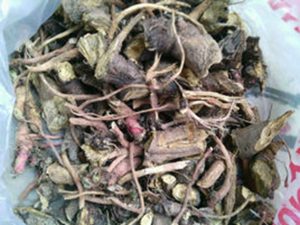
The root is spindle-shaped, fleshy, and erect. The outer bark is dark brown and wrinkled; the interior is yellowish-white. It has a slightly bitter taste and a sticky texture.
Properties of Processed Slices
This product consists of irregular slices. The outer surface is dark brown and wrinkled; the cross-section is yellowish-white. It has a slightly bitter taste and a sticky texture.
Botanical Information
Botanical Classification
Arctium lappa, a plant of the genus Arctium in the Asteraceae family.
Morphological Characteristics
A biennial herb, 1–2 m tall. The root is stout, fleshy, and conical. The stem is erect, heavily branched toward the top, purplish-brown, and has longitudinal ridges. Basal leaves are large, clustered, and long-petiolate; cauline leaves are alternate;leaf blades are long-ovate or broadly ovate, 20–50 cm long and 15–40 cm wide, with a blunt apex bearing a spiny tip; the base is often cordate, with entire margins or irregular, slightly wavy, minute teeth; the upper surface is green or dark green, sparsely hairy, while the lower surface is densely covered with grayish-white short tomentum.Capitula are clustered at the stem apex or arranged in corymbs, 2–4 cm in diameter; peduncles are 3–7 cm long, with shallow grooves on the surface and densely covered with fine hairs;The involucre is globose, with numerous bracts arranged in an imbricate pattern; the bracts are lanceolate or linear-lanceolate, with hooked apices; the flowers are small, reddish-purple, all tubular, and bisexual; the corolla is shallowly 5-lobed at the apex; there are 5 stamens with fused anthers, arranged alternately with the corolla lobes, and the anthers are yellow; the ovary is inferior, unilocular, with a disc-like apex bearing short, bristly pappus;The style is slender and elongated, with a 2-lobed stigma. The achene is oblong or oblong-obovate, grayish-brown, with longitudinal ridges, and bears a short, spiny pappus that is pale yellowish-brown. Flowering occurs from June to August, and fruiting from August to October.
Distribution Area
It is distributed in Northeast, Northwest, Central-South, and Southwest China, as well as in Hebei, Shanxi, Shandong, Jiangsu, Anhui, Zhejiang, Jiangxi, and Guangxi.
Growth Habits
It prefers a warm and humid climate, is cold- and drought-tolerant, but is sensitive to waterlogging. The optimal temperature for seed germination is 20–25°C, with a germination rate of 70%–90%. It is best cultivated in deep, loose, fertile, well-drained sandy loam.
Propagation Methods
Propagation is by seed.
Cultivation Techniques
Sowing takes place in the south during the fall (August–September) and in the north during the spring (March–April); sowing is also possible in the summer. In case of drought, seedlings may not emerge uniformly; if fall sowing is too late, the plant will not flower or set fruit the following year.Both direct seeding and seedling transplanting methods are used, with direct seeding being the primary method. Before sowing, soak the seeds in warm water (30–40°C) for 24 hours. Dig holes with a row spacing of 70 cm and a plant spacing of 50 cm, each 10 cm deep. Apply well-rotted manure or compost to the bottom of each hole, cover with a thin layer of fine soil, sow 5–6 seeds per hole, water, cover with 3–5 cm of soil, and lightly firm the soil.Seed rate: 15–30 kg per hectare. Seedlings emerge approximately 10 days after sowing. For the seedling transplanting method, start seedlings in early March and transplant them in early May.
Pest and Disease Control
1. Diseases
(1) Powdery mildew: At the onset of the disease, spray with a 1,000-fold dilution of 50% methyl thiophanate.
(2) Brown spot disease: Occurs from May to June; spray with a 600-fold dilution of 65% zinc dithion wettable powder.
(3) Others: Mosaic virus may also cause damage.
2. Pests
Pests include seed-eating insects, aphids, red spider mites, as well as the silver-striped night moth and cutworms.