Drynaria, a traditional Chinese medicine, is the dried rhizome of Drynaria fortunei (Kunze) J.Sm., a plant belonging to the genus Drynaria in the family Polypodiaceae.This product has the therapeutic effects of healing injuries and relieving pain, tonifying the kidneys and strengthening bones, and dispelling wind and removing spots (for external use). It is primarily used to treat falls, blows, sprains, and strains; fractures and bone injuries; lower back pain due to kidney deficiency; weakness and atrophy of tendons and bones; tinnitus and deafness; loose teeth; alopecia areata; and vitiligo.

Drynaria
Drynaria, a traditional Chinese medicine, is the dried rhizome of Drynaria fortunei (Kunze) J.Sm., a plant belonging to the genus Drynaria in the family Polypodiaceae.This product has the therapeutic effects of healing injuries and relieving pain, tonifying the kidneys and strengthening bones, and dispelling wind and removing spots (for external use). It is primarily used to treat falls, blows, sprains, and strains; fractures and bone injuries; lower back pain due to kidney deficiency; weakness and atrophy of tendons and bones; tinnitus and deafness; loose teeth; alopecia areata; and vitiligo.
Chinese Name : 骨碎补
Latin Name : Drynariae Rhizoma
Aliases : Monkey Ginger, Macaque Ginger, Stone-hair Ginger, Mountain-crossing Dragon, Stone-liang Ginger, Rock-climbing Ginger, Stone-rock Ginger, Sui Bu, Tree Centipede, Ground Centipede, Yellow Mountain-climbing Tiger, Hemp Chicken Wing, Mountain-searching Tiger, Fleshy Sui Bu, Monkey-palm Ginger, Stone-lian Ginger, Stone Palm, Hairy Ginger, Shen Ginger, Rock Ginger
Authentic Producing Area : Hubei, Jiangxi, Sichuan
Nature, Flavor & Meridian Tropism : Warm in nature, bitter in taste; enters the Liver and Kidney meridians
Benefits & Efficacy
Benefits
Heals injuries and relieves pain; tonifies the kidneys and strengthens bones; dispels wind and removes spots (for external use).
Indications
Mainly used for falls, blows, sprains, and strains; fractures and injuries to tendons and bones; lower back pain due to kidney deficiency; weakness and atrophy of tendons and bones; tinnitus and deafness; loose teeth; alopecia areata; and vitiligo.
Usage and Dosage
1. Internal use: Decoct 10–20 g; or incorporate into pills or powders. 2. External use: Apply an appropriate amount, either pounded and applied as a poultice or ground into a powder and mixed with a carrier; or soak in alcohol and apply topically.
Precautions
Use with caution in cases of yin deficiency with internal heat or in the absence of blood stasis.
Chemical Constituents
Contains naringin, Dihydroflavonol glycoside of Dipsacus, and Dipsacus acid, among others.
Pharmacological Actions
This herb possesses pharmacological effects such as promoting fracture healing, preventing osteoporosis, protecting against kidney damage, and regulating lipid levels.
Relevant Discussions
1. *Lei Gong’s Treatise on Medicinal Preparation*: “Treats tinnitus and can also alleviate various types of pain.”
2. *Kaibao Materia Medica*: “Primarily used to disperse blood stasis, stop bleeding, and treat injuries and fractures.”
3. *Illustrated Compendium of Materia Medica*: “Treats sprains, fractures, and injuries to tendons and bones.”
4. *Compendium of Materia Medica*: “Treats tinnitus, chronic diarrhea due to kidney deficiency, and toothache.”
Applications
Clinical Applications
1. Used for lower back and knee soreness due to kidney deficiency, as well as weakness and limpness in the lower limbs. It is often combined with Rehmannia glutinosa (dried), Eucommia ulmoides, Cuscuta chinensis, and Achyranthes bidentata to tonify the liver and kidneys and strengthen tendons and bones. If accompanied by internal rheumatism and impaired blood circulation, it should be combined with Angelica pubescens, Clematis chinensis, and Milettia reticulata to tonify the kidneys, dispel wind, invigorate the meridians, and relieve pain.Currently, this herb is commonly combined with Weilingxian to make a decoction for treating lumbar muscle strain, joint pain, and intercostal neuralgia; it is also combined with Shu Dihuang, Roucongrong, Luxiancao, Xianlingpi, and Jixueteng for treating hypertrophic spondylitis, cervical spondylosis, and bone spurs.
2. It is used for deafness and tinnitus, as well as loose, painful teeth or bleeding gums, resulting from liver and kidney yin deficiency with excessive ascending yang. To treat deafness and tinnitus, it is often combined with Rehmannia glutinosa (Shu Di Huang), Cornus officinalis (Shan Zhu Yu), Dioscorea opposita (Shan Yao), and Alisma orientale (Ze Xie) to tonify the liver and kidneys and reduce internal heat.It is currently commonly used in clinical practice to prevent and treat deafness and tinnitus resulting from streptomycin toxicity and allergic reactions, with demonstrable efficacy. For loose, painful teeth or bleeding gums, Dipsacus asper can be used alone or combined with rock salt and Sophora japonica pods; the mixture is stir-fried, ground into a powder, and applied to the teeth to strengthen them, relieve pain, and stop bleeding.
3. For chronic diarrhea and dysentery caused by deficiency of both the spleen and kidneys, grind Dipsacus ashi into a powder, stuff it into a pig’s kidney, braise until tender, and consume. Alternatively, combine it with Myristica fragrans, Chinese yam, Poria cocos, and Schisandra chinensis to tonify the kidneys, strengthen the spleen, and astringe the intestines.
4. For trauma and fractures, Dipsacus asper can be used both internally and externally. For internal use, it is often steeped in wine, or ground into a powder after being combined with natural copper, myrrh, and turtle shell, as in the Dipsacus asper Powder formula from the *Taiping Shenghui Fang*; for external use, the single herb can be ground into a powder and applied to the affected area, or ground together with natural copper, dragon’s blood, frankincense, and myrrh to form a paste for application to the injury.
5. A wine infusion of Dipsacus asper applied to the affected area can treat alopecia areata, stubborn dermatitis, corns, and warts.
Related Compatibility
1. Dipsacus asper combined with Myrrh: Dipsacus asper promotes blood circulation, heals injuries, and relieves pain; myrrh promotes blood circulation, reduces swelling, and relieves pain. When used together, these two herbs enhance the effects of promoting blood circulation, reducing swelling, and relieving pain. This combination is suitable for conditions such as trauma, blood stasis with swelling and pain, or pain from fractures.
2. Dipsacus asper combined with Psoralea corylifolia: Dipsacus asper is bitter and warm in nature, entering the Liver and Kidney meridians; it warms and tonifies Kidney yang, and strengthens tendons and bones. Psoralea corylifolia is bitter and pungent, warm in nature, entering the Spleen and Kidney meridians; it tonifies the Kidney and assists yang, and warms Spleen yang. When used together, these two herbs enhance the effects of tonifying the Kidney, warming yang, and strengthening tendons and bones. They are suitable for conditions such as lower back pain due to Kidney deficiency, weakness in the feet and knees, and loose teeth.
Medicinal Identification
1. Raw Dipsacus and Scorched Dipsacus: These are two different processed forms of Dipsacus.Raw Dipsacus asper is primarily effective for promoting blood circulation and mending injuries; when used externally, it dispels wind and removes spots. It is mainly used for conditions such as falls, blows, sprains, and strains, vitiligo, and alopecia areata. Processed Dipsacus asper has a reduced bitter and purgative nature and enhanced warming and tonifying properties. It is primarily effective for tonifying the kidneys and strengthening the bones, and is mainly used for kidney deficiency-induced low back pain, weakness and flaccidity of tendons and bones, tinnitus, deafness, and loose teeth.
2. Dipsacus asper and Natural Copper: Both have the effects of promoting blood circulation, healing injuries, and relieving pain, and are commonly used for contusions, fractures, and tendon injuries. However, Dipsacus asper enters the Liver and Kidney meridians and can also tonify the kidneys and strengthen the bones; it is frequently used for kidney deficiency-induced low back pain and weakness in the legs. Natural Copper excels at mending bones and is frequently used for fractures accompanied by swelling and pain.
Related Medicines
Bone-Setting Seven-Li Tablets.
Related Prescriptions
Dipsacus Powder (from *Shenghui Fang*).
Medicinal Diet Therapy
Tendon-Strengthening and Bone-Nourishing Soup:
1. Benefits: Nourishes the liver and kidneys, promotes blood circulation, and unblocks meridians. Beneficial for tendons and bones; suitable for elderly individuals suffering from aching tendons and bones.
2. Ingredients: 9g of Dipsacus asper, 9g of Chinese yam, 6g of Ophiopogon, 9g of goji berries, 3g of Ligusticum chuanxiong, 6g of Cinnamomum cassia, 9g of Astragalus,9g jujubes, 300g pork ribs, salt to taste.
3. Preparation: Thoroughly wash all the herbs and pork ribs and set aside. Blanch the pork ribs to remove blood and scum, then set aside. Place all the herbs and pork ribs into a pot, add an appropriate amount of water, and simmer until the ribs are tender.
4. Usage: Consume as appropriate.
Notes
Patients requiring treatment with Chinese herbal medicine should first consult a licensed Traditional Chinese Medicine (TCM) hospital, where a TCM practitioner will conduct a professional pattern differentiation and prescribe an herbal formula.
Processing & Preparation
Harvesting & Processing
It can be harvested year-round. Remove dirt and sand, dry it, or singe it to remove the fine hairs (scales).
Processing Methods
1. Dipsacus: Take the raw herb, remove impurities, wash thoroughly, moisten thoroughly, cut into thick slices, and dry.
2. Roasted Dipsacus: Place sand in a frying pan and heat over high heat until it becomes smooth and easy to stir. Add the Dipsacus slices, stir constantly, and roast until they puff up. Remove from heat, sift out the sand, allow to cool, and knock off the hairs.
Storage Methods
Store in a dry place.
Crude Drug Identification
Identification
1. Cross-section of this product: The epidermis consists of a single layer of cells with slightly thickened outer walls. The scales are attached at their bases to depressions in the epidermis and are composed of 3–4 layers of cells; they contain a brownish-red pigment. The vascular bundles are perivascular and consist of 17–28 bundles arranged in a ring; each vascular bundle has an endodermis at its periphery, with Kayser’s dots visible; the tracheids in the xylem are polygonal.The powder is brownish-red. Scale fragments are brownish-yellow or brownish-red; body cells are elongated or irregular in shape, with a diameter of 13–86 μm; their walls are slightly curved or straight, often with hair-like projections along the edges; two cells are fused at the base but separate at the apex; stalk cells are irregular in shape. Cells of the ground tissue are slightly lignified, with distinct pore canals, and a diameter of 37–101 μm.
2. Take 0.5 g of the powdered sample, add 30 mL of methanol, heat and reflux for 1 hour, allow to cool, filter, and evaporate the filtrate to dryness. Dissolve the residue in 1 mL of methanol to prepare the test solution. Separately, take a reference standard of naringin and dissolve it in methanol to prepare a solution containing 0.5 mg per mL as the reference solution.Perform the test according to the Thin-Layer Chromatography method (General Chapter 0502). Pipette 4 μL of each of the two solutions and apply them separately onto the same silica gel G plate. Develop the plate using the upper layer of the mobile phase consisting of toluene–ethyl acetate–formic acid–water (1:12:2.5:3). Remove the plate, allow it to air-dry,spray with aluminum trichloride solution, and examine under a UV lamp (365 nm). In the test sample chromatogram, fluorescent spots of the same color appear at positions corresponding to those in the reference standard chromatogram.
Properties of Crude Drugs
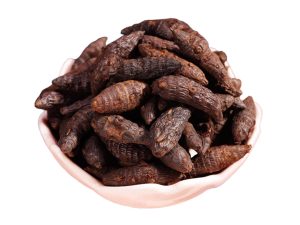
This product is flat and elongated, often curved and branched, 5–15 cm long, 1–1.5 cm wide, and 0.2–0.5 cm thick.The surface is densely covered with small, dark brown to blackish-brown scales, soft and hair-like; when singed, it appears brownish or dark brown. Both sides and the upper surface bear raised or sunken circular leaf scars; a few specimens retain remnants of petioles and fibrous roots.It is light in weight, brittle, and breaks easily; the fracture surface is reddish-brown, with vascular bundles appearing as yellow dots arranged in a ring. It has a faint odor and a bland, slightly astringent taste.
Properties of Processed Slices
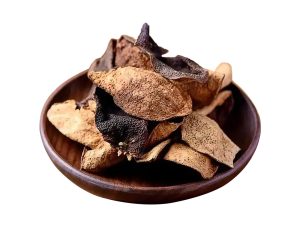
1. Dipsacus asper: This product consists of irregular, thick slices. The surface is dark brown to brownish-black, often with small brown scales remaining; some may show circular leaf scars. The cross-section is reddish-brown, with yellow vascular bundles arranged in a ring of dots. It has a faint odor and a bland, slightly astringent taste.
2. Scalded Dipsacus: This product resembles Dipsacus or is in slices; the surface is yellowish-brown to dark brown. The body is swollen and bulging; it is light in weight and crumbly.
Botanical Information
Botanical Classification
It is derived from *Pteris*, a genus of ferns in the family Polypodiaceae.
Morphological Characteristics
An epiphytic herb, 20–40 cm tall. The rhizome is fleshy and robust, long and creeping, densely covered with brownish-yellow, linear-chisel-shaped scales.Leaves are dimorphic: the vegetative leaves are thick and leathery, reddish-brown or grayish-brown, ovate, sessile, 5–6.5 cm long, 4–5.5 cm wide, with shallow pinnately lobed margins, closely resembling oak leaves;spore leaves are green, with short, winged petioles; the leaf blades are oblong or oblong-elliptic, 20–37 cm long and 8–18.5 cm wide, deeply pinnately lobed with 6–15 pairs of pinnae,broadly lanceolate or oblong, 4–10 cm long and 1.5–2.5 cm wide, with an acute or obtuse apex, margins often bearing irregular, shallow, wavy teeth, the basal 2–3 pairs of pinnae reduced to ear-like structures, both surfaces glabrous, veins prominent, with fine veins forming 4–5 rows of rectangular mesh patterns.The sporangia are round, yellowish-brown, arranged in 2–4 rows on either side of the midrib, with one sporangium attached to each rectangular mesh of the venation; they lack indusia.
Distribution Area
It is distributed in Zhejiang, Fujian, Taiwan, Guangdong, Guangxi, Jiangxi, Hubei, Sichuan, Guizhou, Yunnan, and other areas.