
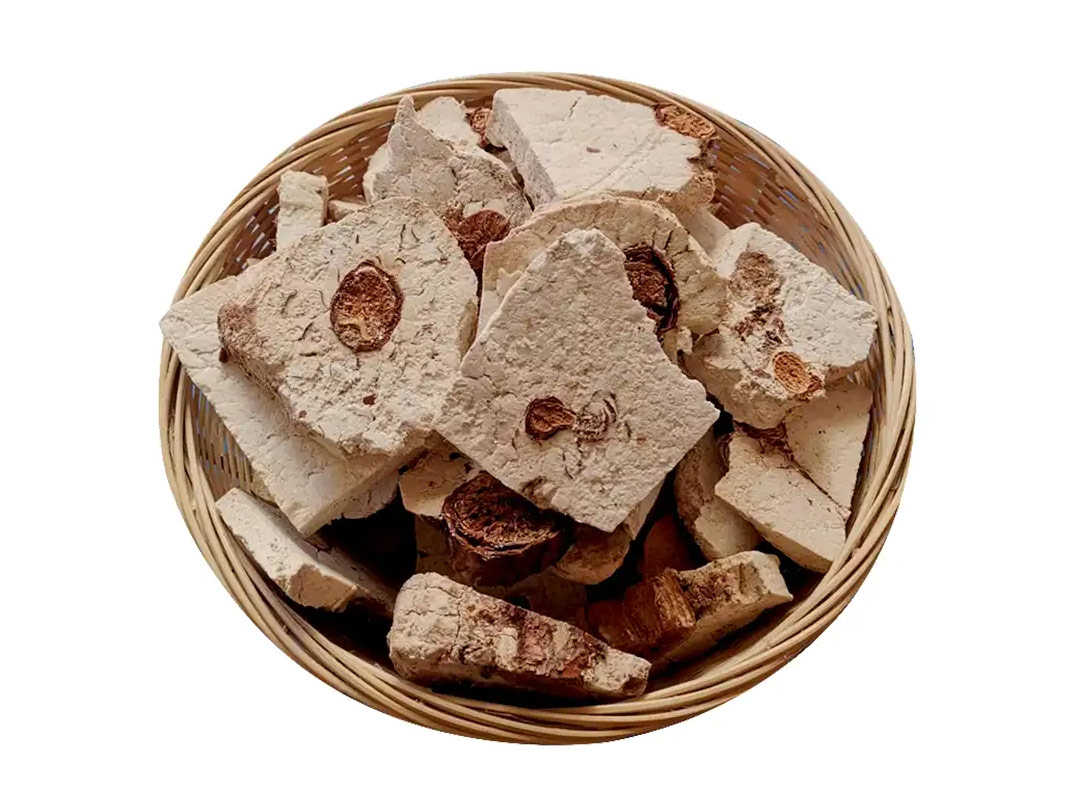
Fushen is the name of a traditional Chinese medicine. It consists of the portion of the sclerotium of Poria cocos (Schw.) Wolf—a fungus belonging to the genus Poria in the Polyporaceae family—that contains pine root in its center. It has the effect of calming the mind and soothing the spirit. It is primarily used to treat palpitations, anxiety, forgetfulness, and insomnia.
Poria
Fushen is the name of a traditional Chinese medicine. It consists of the portion of the sclerotium of Poria cocos (Schw.) Wolf—a fungus belonging to the genus Poria in the Polyporaceae family—that contains pine root in its center. It has the effect of calming the mind and soothing the spirit. It is primarily used to treat palpitations, anxiety, forgetfulness, and insomnia.
Chinese Name : 茯神
Latin Name : Poria with Pine Root
Aliases : Fushen
Authentic Producing Area : Yunnan, Anhui, Hubei
Nature, Flavor & Meridian Tropism : Sweet and bland in taste; neutral in nature; enters the Heart and Spleen meridians
Benefits & Efficacy
Benefits
Calms the mind and soothes the spirit.
Indications
Palpitations, anxiety, forgetfulness, and insomnia.
Usage and Dosage
Internal use: Decocted as a soup, 9–15 g; or incorporated into pills or powders.
Precautions
Use with caution in cases of kidney deficiency with difficulty urinating or urinary incontinence, or in cases of deficiency-cold with seminal emission.
Chemical Constituents
The main active ingredients of Poria Sclerotium are poria acid and poria polysaccharides.
Pharmacological Actions
Fu Shen possesses sedative, hypnotic, and calming effects and can counteract caffeine-induced excitement.
Relevant Discussions
1. *Compendium of Materia Medica*: “*Shennong’s Classic of Materia Medica* mentions only Poria; *The Supplementary Records of Famous Physicians* first added Poria Spirit, though their main indications are the same. Later generations have invariably used Poria Spirit to treat heart disorders; thus, Zhang Jiegu stated that vertigo and heart deficiency cannot be alleviated without Poria Spirit, though Poria itself is certainly not ineffective for treating heart disorders.”
2. *Commentary on the Classic of Materia Medica*: “Fu Shen grows from the heartwood of trees, which distinguishes it from Poria. The *Supplement to the Record of Famous Physicians* describes Fu Shen as neutral. In summary, its flavor, aroma, and nature should be identical to those of Poria; Poria is primarily used to treat the spleen and kidneys, while Fu Shen is primarily used to treat the heart.”
3.*The Interpretation of Medicinal Substances*: “Fu Shen is heavy in nature; its heaviness dispels timidity. Its nature is warm and tonifying; its tonifying action dispels weakness. Dai Ren said, ‘The heart is inherently hot; when deficient, it becomes cold.’ For instance, in cases of deficient and timid heart qi, where the spirit fails to remain in its proper abode, leading to palpitations, anxiety, a dazed and bewildered state of mind, fatigue, timidity, and forgetfulness—all such conditions require the warm nourishment of the heart and spirit; without this, they cannot be treated.”
Applications
Clinical Applications
1. For restlessness of the mind, confusion, and melancholy: 2 liang of Fu Shen (peeled) and half a liang of Agarwood. Grind both into a fine powder, mix with refined honey to form pills the size of small beans. Take thirty pills each time, after meals, with ginseng decoction. (Zhuque Pills from *A Selection of One Hundred and One Prescriptions*)
2. For heart deficiency with blood deficiency, the spirit not remaining in its proper place, frequent startles and confusion, and restless sleep:Ginseng (root tip removed), Poria Sclerotium (wood removed), Astragalus (honey-fried), Prepared Rehmannia Root (washed, dried), Angelica Root (washed, dried), Sour Jujube Seed (husk removed, stir-fried), Cinnabar (ground separately; half for the formula, half for coating).Take equal parts of each ingredient, grind into a fine powder, and mix with refined honey to form pills the size of a Paulownia seed. Take thirty pills per dose, washed down with decocted ginseng soup. (Fushen Pills from *Yang’s Family Prescriptions*)
3. For treating consumptive disorders with restlessness and insomnia: Fushen (with wood removed) and ginseng, each one liang; jujube seeds (roasted, hulled, and ground separately), five liang.Coarsely pound the three ingredients and sift them. Take three qian per dose; add one zhan of water and half a fen of fresh ginger (crushed), then decoct until reduced to seven-tenths of the original volume. Strain out the residue and take warm on an empty stomach—twice daily and once at night. (*Shengji Zonglu*: Fu Shen Decoction)
Related Compatibility
1. Combining Poria (Fuling) with Poria Slices (Fushen): Poria (Fuling) and Poria Slices (Fushen) originate from the same source and share similar properties and effects. However, Poria (Fuling) is primarily used to regulate the Spleen and Kidney meridians, while Poria Slices (Fushen) is primarily used to regulate the Heart meridian. Poria (Fuling) primarily facilitates the flow of Heart Qi to the Kidneys and expels damp-heat through urination, whereas Poria Slices (Fushen) primarily nourishes the Heart and calms the spirit.When used together, these two herbs complement each other and also serve to direct the meridian pathways. In addition to enhancing the effects of strengthening the spleen, tonifying qi, promoting diuresis, and reducing edema, they can also enter the Heart meridian to regulate heart qi and calm the spirit.
2. Gynostemma pentaphyllum Combined with Fu Shen: Gynostemma pentaphyllum excels at tonifying qi and yin, nourishing the heart, and calming the spirit; Fu Shen excels at strengthening the spleen, draining dampness, and calming the heart and spirit.When combined, these two herbs enhance the effects of tonifying qi and yin, as well as nourishing the heart and calming the spirit. This combination is suitable for conditions resulting from desk work-related fatigue, deficiency of heart qi, deficiency of heart yin, and overwork-induced damage to the heart and spleen leading to dual deficiency of qi and blood—manifesting as palpitations, insomnia, forgetfulness, frequent dreaming, and fatigue.
Medicinal Identification
1. Fu Shen and Poria: Both have the efficacy of calming the heart and soothing the spirit, and are used to treat symptoms such as palpitations, insomnia, forgetfulness, and frequent dreaming.However, Poria (Fu Ling) primarily enters the Heart and Spleen meridians; it nourishes the Heart and Spleen to calm the mind and soothe the spirit, and is primarily used to treat palpitations and insomnia caused by deficiency of both the Heart and Spleen. With a sweet and bland taste, it excels at promoting diuresis to reduce edema and strengthening the Spleen to drain dampness, making it a key herb for treating various types of edema—whether caused by cold or heat, deficiency or excess—as well as phlegm-fluid retention syndromes. In contrast, Poria Sclereota (Fu Shen) specializes in calming the mind and soothing the spirit, specifically treating restlessness of the mind, palpitations, and forgetfulness.
2. Fu Shen and Fu Shen Mu: The white portion of Poria containing pine roots is used medicinally as Fu Shen, also known as Bao Mu Shen. Its primary function is to calm the heart and soothe the spirit; it is frequently used to treat heart palpitations due to heart deficiency, forgetfulness, insomnia, and epilepsy;The pine root portion within the sclerotium is known as “Fushenmu” when used medicinally. It has a sweet and neutral nature and is particularly effective at calming the liver and soothing the spirit. It is used to treat palpitations, forgetfulness, aphasia following a stroke, and leg cramps caused by beriberi, and is most suitable for conditions involving heat in the Liver Meridian or internal Liver wind.
Related Medicines
Ginseng and Aconite Brain-Nourishing Capsules, Tianzhi Granules, Suojing Pills (Suojing Dan), and Rapid Hypertension-Lowering Pills.
Related Prescriptions
Tiao Yuan San (from *Huo You Xin Shu*), Ming Mu Di Huang Tang (from *Shen Shi Yao Han*), Sang Piaoxiao San (from *Ben Cao Yan Yi*), Zhen Jing Wan (from *Yi Zong Jin Jian*), and Bai Zi Yang Xin Wan (from *Ti Ren Hui Bian*).
Notes
Patients requiring treatment with Chinese herbal medicine should first consult a licensed Traditional Chinese Medicine (TCM) hospital, where a TCM practitioner will conduct a professional pattern differentiation and prescribe an herbal formula.
Processing & Preparation
Harvesting & Processing
Take Poria cocos, remove the white Poria, and select pieces containing pine roots in the center; then sun-dry them.
Processing Methods
1. Fu Shen: Take the raw material, remove impurities, cut into chunks, and sun-dry.
2. Zhu Fu Shen: Take the Fu Shen chunks, spray with clean water, let them sit briefly to moisten slightly, add fine cinnabar powder, sprinkle evenly, and turn frequently until the surface of the Fu Shen is completely coated with cinnabar, then air-dry.
Storage Methods
Store in a dry container in a cool, dry place to prevent mold growth.
Crude Drug Identification
Properties of Crude Drugs
This product consists of Poria blocks with firm, fine pine roots embedded within. Commercially available products are typically cut into thin, square slices; they are firm in texture with a powdery quality. The cut pine roots are brownish-yellow, and annual growth rings are visible on the cross-section. It has a faint odor and a bland taste.
Properties of Processed Slices
1. Fu Shen: Thick, square-shaped slices with a white to off-white surface; the center or one side contains a yellowish-white or grayish-yellow woody core. The texture is firm yet brittle, and the fracture surface is rough. It has a faint odor and a bland taste.
2. Zhu Fu Ling: Resembles Fu Shen in shape but is vermilion in color.
Botanical Information
Botanical Classification
It is derived from the fungus Poria, belonging to the genus Poria in the family Polyporaceae.
Morphological Characteristics
The sclerotium is spherical, ovoid, elliptical, or irregular in shape, 10–30 cm long or longer, with varying weights, generally ranging from 500 to 5,000 g.The exterior is covered by a thick, deeply wrinkled rind that is dark brown in color; it is soft when fresh but hardens upon drying. The interior is white or pale pink and powdery. The fruiting body grows on the surface of the sclerotium; it is completely flat, 3–8 cm thick, white, and fleshy, turning light brown when mature or dried.The hyphae are dense, 2–3 mm long, with thin walls; the pore openings are round, polygonal, or irregular in shape, 0.5–1.5 mm in diameter, and the margins are often fissured into teeth. Spores are rectangular to nearly cylindrical, smooth, with an oblique apex, measuring (7.5–9) μm × (3–3.5) μm.
Distribution Area
It is distributed in Jilin, Anhui, Zhejiang, Fujian, Taiwan, Henan, Hubei, Guangxi, Sichuan, Guizhou, and Yunnan.
Growth Habits
Poria is a facultative parasite that grows wild in the rhizosphere of tree species such as Pinus massoniana, Pinus hwangshanensis, Pinus koraiensis, Pinus yunnanensis, and Pinus thunbergii on dry, sun-facing slopes in mountainous areas at elevations of 600–1,000 m.Spores germinate at 22–28°C; hyphae grow at 18–35°C, with rapid growth occurring at 25–30°C; fruiting bodies differentiate and grow at 18–26°C and produce spores. It grows best in mountainous sandy soil with a log moisture content of 50%–60%, soil moisture content of 20%, a pH of 3–7, and a slope of 10°–35°.Conditions with a large diurnal temperature range are conducive to the growth of Poria cocos.
Propagation Methods
Poria can be cultivated on logs, tree stumps, and pine needles, but log cultivation remains the primary method today.
Cultivation Techniques
Select middle-aged pine trees with a diameter of 10–45 cm. After felling, make alternating vertical cuts 3 cm wide at 3–7 cm intervals, penetrating 0.5 cm into the wood—a process known as “peeling the bark while leaving the sapwood intact.” When the cut surface of the pine log stops exuding resin and produces a hollow sound when tapped, saw the log into segments 65–85 cm long. Place these segments in a well-ventilated, sunny location,and stacked in a “well” pattern for later use. Select a gentle slope that is sheltered from the wind, sunny, and has slightly acidic, sandy soil. Dig pits 90 cm in diameter and 50–65 cm deep, with a vertical spacing of 33 cm and horizontal spacing of 17 cm between pits, and dig drainage ditches around the perimeter.Take 3–5 wood segments of varying thicknesses and layer them in the pit. The inoculum, also known as the starter, comes in three types: mycelium starter, flesh starter, and wood starter; mycelium starter is most commonly used today. Isolate a pure strain from the sclerotium tissue using PDA medium. For the cultivation medium, use 76% pine sawdust, 22% wheat bran,1% each of gypsum and sucrose, with a moisture content of 65%. This is placed in wide-mouth bottles, sterilized, and inoculated with the pure strain. It is then cultured for half a month at 25–28°C, after which the bottles are inverted and cultured for another half month at 22–24°C to produce the mycelium starter.For the “flesh starter,” fresh sclerotia are harvested and used as the starter within half a month before inoculation. For the “wood starter,” two months before inoculation, select log sections with a diameter of 4–10 cm and knot-free tips; saw them into 50-cm-long segments. Stack five segments in a pile in two layers, attach 250 g of fresh sclerotia to the bark side of each segment, cover with 3 cm of soil, and after about 60 days, the mycelium will have fully colonized the logs.Inoculation takes place in early spring (March–April). When using mycelium starters, select a sunny day to sharpen the ends of the thin wood segments from the pit and insert them into the cultivation bottles. Place the thicker wood segments against the sides of the bottles and cover them with 3 cm of soil. When inoculating with flesh starters, use a knife to split the Poria sclerotium open, pressing the flesh side against the upper cross-section or side of the log substrate, with the skin facing outward.Wooden inoculation sticks can be sawed into 5–6 cm lengths and placed against the upper cross-section of the log, or sawed into two or three sections and inserted into the middle of the log.
Pest and Disease Control
Black-winged termites often infest pine logs; when selecting a cultivation site, avoid areas where termites are present. When digging, be sure to remove rotten tree roots, or set up bait pits around the cultivation site, burying pine wood or sugarcane bagasse to lure the termites into the pits, where they can be captured and killed.At the same time, you can introduce termite predators—termite-destroying fungi. Once a single termite in the colony is infected, the entire nest will be wiped out, achieving a 100% eradication rate.