Konjac is the name of a traditional Chinese medicinal material. It refers to the tubers of the following plants in the genus Amorphophallus of the Araceae family: Amorphophallus rivieri Durieu, Amorphophallus sinensis Belval, Amorphophallus variabilis Bl., andDongchuan konjac (Amorphophallus mairei Lévl.). It has the effects of resolving phlegm and eliminating food stagnation, detoxifying and dispersing nodules, and promoting blood circulation to relieve pain. It is primarily used to treat phlegm-related coughs, food stagnation, malaria, scrofula, masses and masses, trauma, boils, carbuncles, erysipelas, scalds and burns, and snake bites.

Konjac
Konjac is the name of a traditional Chinese medicinal material. It refers to the tubers of the following plants in the genus Amorphophallus of the Araceae family: Amorphophallus rivieri Durieu, Amorphophallus sinensis Belval, Amorphophallus variabilis Bl., andDongchuan konjac (Amorphophallus mairei Lévl.). It has the effects of resolving phlegm and eliminating food stagnation, detoxifying and dispersing nodules, and promoting blood circulation to relieve pain. It is primarily used to treat phlegm-related coughs, food stagnation, malaria, scrofula, masses and masses, trauma, boils, carbuncles, erysipelas, scalds and burns, and snake bites.
Chinese Name : 魔芋
Aliases : Konjac, Konjac Root, White Konjac, Devil’s Taro, Devil’s Head, Flower-Stem Lotus, Zhu Taro, Black Taro, Flower-Stem Lotus, Tiger’s Paw, Flower Umbrella Handle, Snakehead Grass Root, Hemp Taro, Snake Six Grains, Thunder Star, Devil’s Candle, Snakehead Seed, Heavenly Six Grains, Star Taro
Nature, Flavor & Meridian Tropism : Pungent and bitter in taste; cold in nature
Benefits & Efficacy
Benefits
Resolves phlegm and eliminates food stagnation; detoxifies and disperses nodules; promotes blood circulation and relieves pain.
Indications
Phlegm-related cough, food stagnation, malaria, scrofula, masses and masses, trauma, boils, carbuncles, erysipelas, scalds and burns, snake bites.
Usage and Dosage
1. Internal use: Decoct 9–15 g in water (requires prolonged decoction for at least 2 hours). 2. External use: Apply an appropriate amount as a pounded poultice; or grind with vinegar and apply.
Precautions
1. Do not consume raw. 2. Do not exceed the recommended dosage when taken internally. 3. Accidental ingestion of raw or processed konjac, or excessive consumption, may cause symptoms of poisoning: burning sensation, itching, pain, and swelling of the tongue and throat.
Chemical Constituents
1. Konjac contains glucurono-mannan, mannan, glycerol, citric acid, ferulic acid, cinnamic acid, methyl palmitate, eicosene, β-sitosterol, and 3,4-dihydroxybenzaldehyde glucoside. It also contains various amino acids, crude protein, and lipids. 2. Spiny konjac contains various amino acids, crude protein, lipids, and polysaccharides. 3. Wild konjac contains glucomannan.
Pharmacological Actions
This product has anticancer, anti-inflammatory, antibacterial, laxative, lipid-lowering, weight-loss, and blood-glucose-lowering effects.
Relevant Discussions
1. *Kaibao Bencao*: “Mainly treats abscesses, swellings, and wind-toxin; apply topically to swollen areas. Pound into a paste, boil with lye to form cakes, and season with five flavors to eat as a dish. It has a cold nature and is used to treat diabetes.”
2. *Bencao Huibian*: “Treats parotid abscesses.”
3. *Ben Cao Hui Yan*: “Apply topically to treat abscesses and swellings caused by wind-toxin; treats consumptive diseases.”
4. *Yi Lin Zuan Yao: Medicinal Properties*: “Dispels cold from the lungs. Treats phlegm-induced cough.”
5. *Cao Mu Bian Fang*: “Aids digestion, eliminates stagnant food, mass accumulations, and chronic malaria.”
Applications
Clinical Applications
1. For treating intermittent malaria: Cut 7 pieces (each about the size of a Paulownia seed) from a konjac tuber. Swallow them with cold water 2 hours before the onset of a malaria attack. (*Guizhou Herbal Medicine*)
2. For treating epidemic parotitis: Take one piece of konjac. Grind it with vinegar to form a thick paste and apply to the affected area 4–5 times daily. (Southern Medicinal Herbs, *Chinese Herbal Medicine*)
3. For abdominal masses: 60 g of konjac tubers; place them in a pig’s stomach and stew until tender. (From *Guizhou Herbal Medicine*)
4. For cervical lymph node tuberculosis: 9–15 g of konjac; boil in water for at least 3 hours, strain to remove the residue, and drink the liquid (do not consume the residue to avoid poisoning). (From *Chinese Materia Medica* [Southern Medicinal Herbs])
5. For swelling and pain from contusions, sprains, and strains: An appropriate amount of fresh konjac, along with a small amount each of Chinese chives, white part of green onions, and sweet rice wine. Pound them together into a paste and apply to the affected area; replace when dry. (*Anhui Chinese Herbal Medicine*)
6. For leg cramps: An appropriate amount of konjac tuber, pounded into a fine paste, then stir-fried with wine until hot; rub onto the affected area; then wrap the area with the resulting residue.(*Guizhou Herbal Medicine*)
7. For early-stage boils and carbuncles: Equal parts konjac and raw licorice. Grind into a fine powder and mix with vegetable oil (or sesame oil) to form a poultice. (*Anhui Chinese Herbal Medicine*)
8. For erysipelas: An appropriate amount of konjac, pounded into a paste, mixed with soft tofu, and applied externally. (*Southern Chinese Herbal Medicine*)
9. For treating scalds and burns: An appropriate amount of konjac root. Sun-dry and grind into a fine powder; mix with sesame oil and apply to the affected area. (*Jiangxi Herbal Medicine*)
10. For treating venomous snake bites: Pound fresh konjac tubers with salt into a paste and apply externally to the wound. Alternatively, grind a konjac tuber with strong tea to extract juice, then dip a chicken feather in the mixture and apply it to the swollen area.
11. For athlete’s foot: Rub slices of the konjac tuber on the affected area. (Recipes 10–11 are from *Commonly Used Folk Herbs of Zhejiang*)
Notes
Patients requiring treatment with traditional Chinese medicine should first consult a licensed TCM hospital, where a TCM practitioner will conduct a professional pattern differentiation and issue a prescription.
Processing & Preparation
Harvesting & Processing
Harvest from October to November by digging up the tubers; use them fresh, or wash them, slice them, and sun-dry them.
Processing Methods
Take the raw herb, remove impurities, wash thoroughly, moisten thoroughly, cut into thick slices, dry, and sift out any dust or debris.
Storage Methods
Store in a dry container in a cool, well-ventilated place to prevent insect infestation.
Crude Drug Identification
Properties of Crude Drugs
This product is flattened and spherical in shape. The surface is light brown and relatively smooth, with tiny round dots and root scars at the apex. It is hard and difficult to break; the fracture surface is uneven, grayish-white, and powdery, with numerous tiny vascular bundle dots, and the edges are dark reddish-brown. It has a faint odor and produces a slight numbing sensation on the tongue.
Properties of Processed Slices
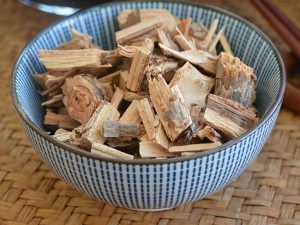
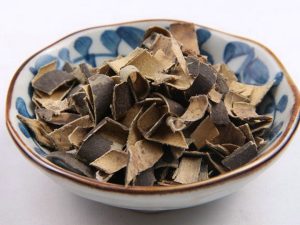
Thick, flattened-round slices; the cross-section is grayish-white with numerous fine vascular bundle dots, and the periphery is dark reddish-brown. It has fine round dots and root scars; the texture is hard and powdery, with a slight numbing sensation on the tongue.
Botanical Information
Botanical Classification
Arisaema species of the Araceae family: Arisaema, sparsely hairy Arisaema, wild Arisaema, and Dongchuan Arisaema.
Morphological Characteristics
1. Konjac: A perennial herb. The tuber is flattened-spherical, 7.5–25 cm in diameter, with a slightly concave central depression at the top and a dark reddish-brown color; numerous fleshy roots and fibrous fibrous roots grow around the neck.Petiole 45–150 cm long, 3–5 cm thick at the base, yellowish-green, smooth, with greenish-brown or white patches; 2–3 membranous basal scales, lanceolate, 7.5–20 cm long;The leaf blade is green, 3-lobed; the primary lobes have petioles 50 cm long and are dichotomously divided; the secondary lobes are twice pinnately or twice dichotomously divided; the small lobes are alternate, of varying sizes, 2–8 cm long, oblong-elliptic, abruptly narrowing to a point, with a broad cuneate base that extends downward on the outer side to form wings;Numerous lateral veins, slender and parallel, joining near the margin to form a collective vein. Inflorescence stalk 50–70 cm long, 1.5–2 cm thick, same color as the petiole. Spathe funnel-shaped, 20–30 cm long, rolled back at the base; tube 6–8 cm long, 3–4 cm wide, pale green with dark green patches;the spathic limb is 15–20 cm long and about 15 cm wide, cordate-orbicular, with undulate margins; the outer surface is green, and the inner surface is deep purple. The spadix is twice as long as the spathe; the female inflorescence is cylindrical, about 6 cm long and about 3 cm thick, purple; the male inflorescence follows immediately (sometimes interspersed with a few hermaphroditic flowers), about 8 cm long and about 2 cm thick;The appendage is conical, 20–25 cm long, hollow, and deep purple; the stamens are 1 mm long, with anthers 2 mm long; the ovary is pale green or purplish-red, 2-chambered, with a style nearly as long as the ovary and a 3-lobed stigma. The berries are spherical or flattened-spherical, turning yellowish-green when ripe. Flowering occurs from April to June, and fruiting from August to September.
2. Sparsely-haired Konjac: This species differs from konjac in that the appendage is somewhat hairy, bearing scattered, stiff purple hairs approximately 10 mm long; the spathe margin is ovate-oblong, with a wavy edge, pale green on the outside, and bearing white patches; the ovary is spherical, the style is absent, the stigma is shallowly bifid, and the ovary is 2-chambered. The berry is red, turning blue later. Flowering period: May.
3. Wild Konjac: This species differs from Konjac in that the style is shorter than the ovary; the spathe is spotted on the outside, with rose-red margins and a white interior. Flowering period: July.
4. Dongchuan Konjac: This species differs from konjac in that the style is longer than the ovary, reaching up to 5 mm; the spathe lacks spots. Flowering period: March.
Distribution Area
1. Konjac: Distributed from Shaanxi, Ningxia, and Gansu to areas south of the Yangtze River basin. 2. Sparsely-haired Konjac: Distributed in Jiangsu, Zhejiang, Fujian, and other regions. 3. Wild Konjac: Distributed in Jiangxi, Fujian, Guangdong, and other provinces and regions. 4. Dongchuan Konjac: Distributed in Yunnan.
Growth Habits
Prefers a warm and humid climate. It is not tolerant of cold temperatures, dislikes direct sunlight, and is resistant to sprouting. It is best cultivated in light sandy loam or under forest canopies with deep, loose soil that is well-aerated, well-drained, and rich in organic matter.
Propagation Methods
Propagated by seeds and corms.
Cultivation Techniques
1. Seed sowing and transplanting of young tubers: Harvest mature seeds in summer, store them in sand over winter, and sow in spring; or sow in November of the same year, broadcasting or sowing in rows in a nursery bed. After one year of cultivation, dig up the developed underground tubers in the following spring and plant them in holes spaced 60 cm × 40 cm apart.
2. Propagation by tubers: In March–April, cut larger tubers into pieces, ensuring each piece has one bud; smaller tubers do not need to be divided. Plant them in holes prepared as described above.
Pest and Disease Control
1. Diseases
(1) Soft Rot: Affects the entire plant. Control by spraying with a 1,000-fold dilution of 50% mancozeb; or by drenching the roots with a 1,000-fold dilution of Dithane.
(2) Wilt: Affects the entire plant. Control by drenching the roots with a 600-fold dilution of 60% Benlate.
(3) White Mould: Affects the roots, stem bases, and tubers. Apply a 1,000-fold dilution of 50% ammonium thiobate to the soil around the base of the leaf petioles.
2. Pests
(1) Bean Moth, Taro Double-lined Moth: These pests damage the leaves. Spray with an 800-fold dilution of 90% diazinon to control them.
(2) Wireworms: These pests damage underground tubers. Apply a 90% diazinon solution diluted 800 times to the root zone to kill them.