Ziqi Guanzhong is the name of a traditional Chinese medicine. It consists of the rhizomes and leaf petiole remnants of Osmunda japonica Thunb., a plant belonging to the genus Osmunda in the family Osmundaceae. It has the effects of detoxifying, removing blood stasis, stopping bleeding, and killing parasites.It is primarily used to treat influenza, meningitis, Japanese encephalitis, mumps, boils and abscesses, measles, chickenpox, dysentery, hemoptysis, epistaxis, hematochezia, metrorrhagia, leukorrhea, and intestinal parasitic diseases such as pinworms, tapeworms, and hookworms.

Purple Osmunda
Ziqi Guanzhong is the name of a traditional Chinese medicine. It consists of the rhizomes and leaf petiole remnants of Osmunda japonica Thunb., a plant belonging to the genus Osmunda in the family Osmundaceae. It has the effects of detoxifying, removing blood stasis, stopping bleeding, and killing parasites.It is primarily used to treat influenza, meningitis, Japanese encephalitis, mumps, boils and abscesses, measles, chickenpox, dysentery, hemoptysis, epistaxis, hematochezia, metrorrhagia, leukorrhea, and intestinal parasitic diseases such as pinworms, tapeworms, and hookworms.
Chinese Name : 紫萁贯众
Aliases : Daguancong, Wei Guanzhong, Large-leaved Wolf’s-cloak, Daguanzhong, Yue’er, Purple Fern, Mi Fern
Nature, Flavor & Meridian Tropism : Bitter in taste, slightly cold in nature. Enters the Spleen and Stomach meridians
Benefits & Efficacy
Benefits
Detoxifies, removes blood stasis, stops bleeding, and kills parasites.
Indications
Influenza, meningitis, Japanese encephalitis, mumps, abscesses, boils, and toxic swellings; measles; chickenpox; dysentery; hemoptysis; epistaxis; hematochezia; metrorrhagia and menometrorrhagia; leukorrhea; and intestinal parasitic diseases such as pinworms, tapeworms, and hookworms.
Usage and Dosage
1. Internal use: Decoct 3–15 g; or extract the juice; or incorporate into pills or powders. 2. External use: Pound fresh material and apply as a poultice; or grind into powder and apply as a paste.
Precautions
Use with caution in patients with spleen and stomach deficiency-cold.
Chemical Constituents
The rhizome contains northeastern guanzhongin and various lactone components: purpurin lactone, 5-hydroxy-2-hexenoic acid 4-lactone, 5-hydroxyhexanoic acid 4-lactone, 3-hydroxyhexanoic acid 5-lactone,glucosyl purpuric lactone, dihydroisoglucosyl purpuric lactone, and 2-deoxy-2-furanosyl lactone.It also contains sorbic acid glycosides, methyl 5-hydroxy-3-(β-D-glucopyranosyl)hexanoate, maltol, 5-hydroxymethyl-2-furanol, glycerol, Acanthopteris acuminata sterol A, ecdysterone, ecdysone, and polysaccharides.
Pharmacological Actions
1. Anthelmintic effect: An in vitro decoction prepared from the rhizomes and petiole bases of Polygonatum odoratum exhibits inhibitory and relaxing effects on the proglottids of Ascaris suum, thereby suppressing the motility of Ascaris suum. The extract can expel intestinal nematodes from the human body. 2. Antiviral Effects: A diluted aqueous extract of Polygonatum odoratum can counteract the attack of adenovirus type 3 on cultured HeLa monolayer cells; it can also counteract the attack of herpes simplex virus type I on Hep2 liver cancer cells. 3. Effects on Blood Clotting: Oral administration of the aqueous extract to rabbits shortens their prothrombin time. Polygonatum odoratum extract has an anticoagulant effect.
Relevant Discussions
1. *Folk Medicines of Guizhou*: “Removes blood stasis, promotes blood circulation, and detoxifies. Used to treat blood stasis caused by overwork and injuries, as well as bites from rabid dogs.”
2. *Flora of Medicinal Plants of Tianmu Mountain*: “Used in folk medicine to treat abdominal distension and pain, constipation, jaundice with emaciation, and the presence of small, white worms (pinworms) in the anus.”
3. *Herbal Medicine of Jiangxi*: “Detoxifies and removes blood stasis. (Main indications) Unexplained swellings and abscesses; intercostal neuralgia.”
4. *Manual of Shandong Herbal Medicine*: “Clears heat, detoxifies, stops bleeding, and kills parasites. (Indications) Mumps, measles, incomplete eruption of chickenpox, epistaxis, postpartum hemorrhage, metrorrhagia, hematochezia, and expulsion of tapeworms, hookworms, and pinworms.”
5. *Hunan Pharmacopoeia*: “Dispels wind and drains dampness; expels parasites; promotes lactation. Prevents and treats encephalitis; (treats) pain in tendons and bones, and chest pain.”
6. *Compendium of Chinese Herbal Medicines*: “Main indications: dysentery, metrorrhagia and metrorhoagia, leukorrhea.”
7. *Flora of Medicinal Plants of Xijiang*: “(Main indications) epidemic Japanese encephalitis, influenza.”
Applications
Related Compatibility
1. Prevention and treatment of encephalitis: 15–30 g of *Ziqi* root, 15 g of Isatis leaf. Decoct in water and take orally. (*Hunan Materia Medica*)
2. Treatment of measles and chickenpox that have not fully erupted: 3 g of *Guanzhong*, 6 g of red peony root, 3 g of Cimicifuga root, 9 g of reed root. Decoct in water and take orally.
3. For treating bloody stools: Charred Guanzhong, charred Di Yu, and charred Huai Hua in equal parts. Grind into a fine powder; take 3g three times daily, washed down with yellow wine. (Formulas 2 and 3 are from *Manual of Shandong Herbal Medicine*)
4. For treating leukorrhea: 5–6 tender rhizomes of *Ziqi* (with scales removed); decoct in water and mix with white sugar before drinking.(*Commonly Used Folk Herbs of Zhejiang*)
5. To expel hookworms: 6 g of *Ziqi*, 3 g each of *Langdu* and *Baibu*. Grind into a powder and swallow; take one dose daily. (*Commonly Used Folk Herbs of Zhejiang*)
6. To treat fistulas: Pound fresh *Ziqi* rhizomes with cooked rice into a paste and apply externally to the affected area.Alternatively, take 30 g of (Purple Smilax) rhizome, steam it with rice wine, and consume.
7. To treat cellulitis of the soles: Take 15 g of (Purple Smilax) rhizome (peeled), pound it with salt into a paste, and apply externally. If the area has already ulcerated, add white sugar, pound into a paste, and apply externally.
8. To treat Tripterygium poisoning: Take 3–6 g of tender rhizomes of (Ziqi), add cold boiled water, pound to extract the juice, and drink. (Recipes 6–8 are from *Commonly Used Folk Herbs of Zhejiang*)
9. To treat blood stasis due to overwork: Soak 15 g of Cat Fern in 120 g of wine. Take 15–30 g each time. (*Folk Medicines of Guizhou*)
Processing & Preparation
Harvesting & Processing
Harvest the rhizomes in spring or fall; trim off the petioles and fibrous roots, then sun-dry or use fresh.
Crude Drug Identification
Properties of Crude Drugs
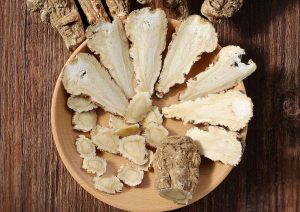
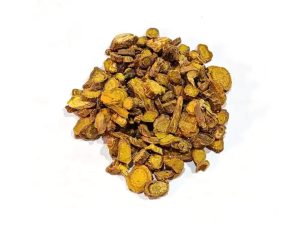
Conical, nearly spindle-shaped, globose, or irregularly ovoid, slightly curved, with a blunt apex, sometimes branched, and a relatively pointed base. 10–30 cm long, 4–8 cm in diameter. Surface is brownish-black, densely covered with obliquely arranged petiole bases and black fibrous roots; no scales.The leaf petiole remnants are flattened-cylindrical, with a long axis of 0.7 cm and a short axis of 0.35 cm; the abaxial surface is slightly convex, the margins are bluntly rounded, and the auriculate wings are easily detached, often absent or torn. The texture is hard; the fracture surface is crescent-shaped or flattened-circular, mostly hollow, with a visible “U”-shaped central column. The odor is faint but distinctive; the taste is bland with a slight astringency.
Botanical Information
Botanical Classification
Polygonum, a plant of the genus Polygonum in the Polygonaceae family.
Morphological Characteristics
A perennial herb, 30–100 cm tall. The rhizome is robust, decumbent or obliquely ascending, and lacks scales.Leaves are dimorphic and densely covered with tomentum when young; those below the apex are twice pinnate, with leaflets oblong or oblong-lanceolate, bearing uniform, dense, fine, blunt teeth along the margins. Spore-bearing leaves are strongly reduced; the leaflets are linear, with sporangia densely arranged on both sides of the midrib, forming long, large, dark brown sporangial spikes that wither upon maturity.
Distribution Area
It is distributed in Jiangsu, Zhejiang, Anhui, Fujian, Jiangxi, Shandong, Henan, Hubei, Hunan, Guangdong, Guangxi, Sichuan, Guizhou, Yunnan, Gansu, and other regions.