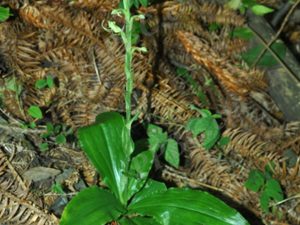
Stone-vein Grass, a name in traditional Chinese medicine. It refers to the whole plant or the roots of Pileaplataniflora C.H. Wright, a plant in the Urticaceae family.It is distributed in Shaanxi, Gansu, Taiwan, Hubei, Hainan, Guangxi, Sichuan, Guizhou, Yunnan, and other regions. It has the effects of relaxing tendons and activating meridians, promoting diuresis, and detoxifying. It is used to treat wind-cold-dampness arthralgia, pain in tendons and bones, numbness in the hands and feet, trauma, edema, difficulty urinating, urinary retention, jaundice, dysentery, abscesses and swellings, and burns.

Stone-vein Grass
Stone-vein Grass, a name in traditional Chinese medicine. It refers to the whole plant or the roots of Pileaplataniflora C.H. Wright, a plant in the Urticaceae family.It is distributed in Shaanxi, Gansu, Taiwan, Hubei, Hainan, Guangxi, Sichuan, Guizhou, Yunnan, and other regions. It has the effects of relaxing tendons and activating meridians, promoting diuresis, and detoxifying. It is used to treat wind-cold-dampness arthralgia, pain in tendons and bones, numbness in the hands and feet, trauma, edema, difficulty urinating, urinary retention, jaundice, dysentery, abscesses and swellings, and burns.
Chinese Name : 石筋草
Aliases : Stone Celery, Stone Rice Grass, Stone Flower, Dog’s Knee, Soft-Stemmed Three-Strand Tendon, Herbaceous Three-Strand Tendon, June Cold, Three-Qian Grass, Toxin-Extracting Grass, Blood-Tong Grass, Overlord’s Whip, Snake Ankle Joint.
Nature, Flavor & Meridian Tropism : Taste: pungent and sour; nature: slightly warm. Enters the Liver Meridian
Benefits & Efficacy
Benefits
Relaxes tendons and activates meridians; promotes urination; detoxifies.
Indications
Used for wind-cold-damp bi syndrome, pain in tendons and bones, numbness in the hands and feet, trauma, edema, difficulty urinating, urinary retention, jaundice, dysentery, sores, abscesses, and toxic swellings, and burns.
Usage and Dosage
Internal use: Decocted as a soup, 6–15 g; or steeped in wine. External use: Apply an appropriate amount, pounded and applied as a poultice.
Precautions
Patients requiring treatment with this product should first consult a licensed Traditional Chinese Medicine (TCM) hospital to receive a TCM prescription following a professional TCM differential diagnosis.
Relevant Discussions
*Compendium of Chinese Herbal Medicines*: “Treats nephritis-induced edema and urinary retention.”
Applications
Related Compatibility
1. For wind-cold-damp bi syndrome, pain in tendons and bones, and numbness in the hands and feet: Equal parts of Stone Tendon Grass, Goat’s Tripe Ginseng, Papaya, Achyranthes, and Mistletoe. Steep in liquor and consume. (*Herbal Medicine of Southern Yunnan*)
2. For hepatitis: 9–15 g of Dog’s Bone Joint. Decoct in water and drink. (*Commonly Used Folk Herbs of Kunming*)
Processing & Preparation
Harvesting & Processing
The whole plant is harvested in summer and fall, washed, and used fresh or sun-dried. The roots are dug up in fall and winter, washed, and sun-dried.
Crude Drug Identification
Botanical Information
Botanical Classification
A plant of the Urticaceae family, known as Shijincao.
Morphological Characteristics
Stone-vein Grass is also known as Hengchun Coldwater Hemp, Skew-leaved Coldwater Hemp, Southwest Coldwater Flower, and Entire-margined Coldwater Flower.A perennial herb, glabrous, with a long, creeping rhizome that is more or less lignified, rooting, and fibrous. The stem is fleshy, 10–70 cm tall, 1.5–5 mm thick, often more or less lignified at the base; when dry, it takes on a bluish-green hue and is usually covered with a grayish-white waxy coating, with the lower part bare; internodes are 0.5–3 cm apart; the plant is branched or nearly unbranched.Leaves are thin, papery, or nearly membranous; opposite pairs are unequal or nearly equal in size, with great variation in shape and size: ovate, ovate-lanceolate, elliptic-lanceolate, ovate, or obovate-oblong, 1–15 cm long and 0.6–5 cm wide, with a caudate-acuminate or long caudate-acuminate apex; the base is often oblique;rounded, shallowly cordate, or cordate, sometimes narrowing to nearly wedge-shaped; margin slightly thickened, entire, sometimes undulate; when dry, upper surface dark green or bluish green, lower surface pale green, often finely honeycombed, sparsely dotted with glandular dots; stalactites fusiform, 0.3–0.4 mm long, conspicuous on the upper surface;with 3(-5) basal veins; the pair of lateral veins are arcuate, extending to near the apex where they anastomose or disappear; lateral veins are numerous, often forming an irregular reticulate pattern; outward-directed secondary veins anastomose with one another far from the margin; secondary veins are sometimes indistinct; petiole 0.5–7 cm long; stipules very small, triangular, ca. 1–2 mm long, gradually falling off.Flowers are monoecious or dioecious; sometimes, male and female flowers are on the same inflorescence. Inflorescences are corymbose-paniculate, sometimes with only a few branches, appearing racemose; male inflorescences are slightly longer than the leaves or nearly as long; peduncles are long and slender, with loose corymbs borne on the flower branches;in dioecious plants, the female inflorescences are often corymbose-paniculate, nearly as long as or slightly shorter than the leaves; the peduncles are long and slender, with corymbs attached more densely to the flower branches; in monoecious plants, they often have only a few branches, forming racemes that are nearly as long as the petioles, with shorter peduncles.Male flowers are greenish-yellow or purplish-red, nearly sessile, and about 1.5 mm long when in bud; perianth segments are 4, fused to the middle, obovate, concave, with short horn-like projections on the outer surface near the apex; stamens are 4; the rudimentary pistil is extremely small and conical; female flowers are greenish and nearly sessile;the perianth consists of 3 segments of unequal size; at fruiting, the central segment is ovate-oblong, thickened on the back and slightly keel-shaped, extending to half the length of the fruit or longer; the two lateral segments are triangular, slightly thickened, and half the length of the longer segment or longer; the rudimentary stamens are elliptic-oblong, extending slightly beyond the shorter perianth segments.The achene is ovate, slightly oblique at the apex, biconvex and lens-shaped, 0.5–0.6 mm long, dark brown when ripe, and bearing fine wart-like dots. Flowering period: (April–) June–September; fruiting period: July–October.
Distribution Area
Distributed in Shaanxi, Gansu, Taiwan, Hubei, Hainan, Guangxi, Sichuan, Guizhou, Yunnan, and other areas.