Mountain Yellow Chrysanthemum, a name in traditional Chinese medicine. It refers to the flower of Anisopappuschinensis (L.) Hook. et Arn., a plant in the genus Anisopappus of the Asteraceae family. The plant is distributed in Fujian, Guangdong, Guangxi, and Yunnan provinces in China. It has the effects of clearing heat and resolving phlegm. It is primarily used to treat common cold with fever, cough due to lung heat, and sore throat.

Mountain Yellow Chrysanthemum
Mountain Yellow Chrysanthemum, a name in traditional Chinese medicine. It refers to the flower of Anisopappuschinensis (L.) Hook. et Arn., a plant in the genus Anisopappus of the Asteraceae family. The plant is distributed in Fujian, Guangdong, Guangxi, and Yunnan provinces in China. It has the effects of clearing heat and resolving phlegm. It is primarily used to treat common cold with fever, cough due to lung heat, and sore throat.
Chinese Name : 山黄菊
Latin Name : Anisopappuschinensis (L.) Hook. et Arn.
Aliases : Twining Honeysuckle, Golden Chrysanthemum
Authentic Producing Area : Fujian, Guangdong, Guangxi, and Yunnan
Nature, Flavor & Meridian Tropism : Bitter in taste, cool in nature. Enters the Lung Meridian
Benefits & Efficacy
Benefits
Clears heat and resolves phlegm.
Indications
Common cold with fever, lung-heat cough, sore throat.
Usage and Dosage
Internal use: Decoct 5–10 g.
Precautions
Not yet established.
Relevant Discussions
*Selected Compendium of Guangxi Materia Medica*: “Clears heat and resolves phlegm.”
Applications
Processing & Preparation
Harvesting & Processing
Harvested in summer and fall; sun-dried.
Crude Drug Identification
Properties of Crude Drugs
This plant crumbles easily; intact capitula are hemispherical, 0.8–1.5 cm in diameter. The involucral bracts consist of 2–3 rows of linear-lanceolate bracts, the outer surfaces of which are densely covered with fine hairs.The ray flowers are arranged in a single row; they are yellow, oblong, and 3–4-lobed at the apex. The disk flowers are densely clustered on a convex receptacle, approximately 4 mm long, with 4–6 awn-like pappus bristles. Each disk flower is accompanied at its base by a herbaceous bract, approximately equal in length to the disk flower and persistent. It has a faintly fragrant odor and a slightly bitter taste.
Botanical Information
Botanical Classification
A plant of the genus *Huangju* (Asteraceae).
Morphological Characteristics
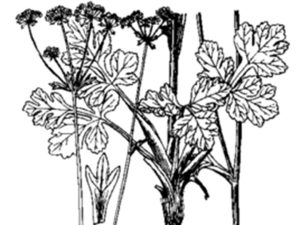
Shanhuangju, also known as Taojianju (*Chinese Plant Family and Genus Index*) and Hanshanju (*Illustrated Guide to Chinese Higher Plants*). An annual herb, 40–100 cm tall. The root is stout, 5–12 mm in diameter. The stem is erect, solitary, rarely clustered, finely striated, and densely covered with rust-colored soft hairs.Mid-stem leaves are ovate-lanceolate or narrowly oblong, 3–6 cm long and 1–2 cm wide, pubescent on both surfaces with denser hairs along the veins; the base is truncate or broadly cuneate, the margin is bluntly serrate, and the venation is ternate or ternate and basally divergent; upper leaves are progressively smaller.Capitula are solitary or arranged in terminal corymbs; the peduncle is densely covered with rust-colored soft hairs; the involucre is hemispherical; the involucral bracts are in three layers, lanceolate or broadly linear, densely covered with appressed soft hairs on the outer surface; the receptacle is keel-shaped, membranous, 5 mm long; the female flowers are ligulate, yellow, with ligules oblong-triangular, 3-lobed at the apex;hermaphroditic flowers are tubular, with the apex 5-lobed. Achenes are cylindrical, sparsely pubescent; achenes of female flowers are 2 mm long, while those of hermaphroditic flowers are slightly flattened and bear 4 longitudinal ribs; pappus is off-white, membranous, consisting of 4–5 segments, each with a slender awn 1 mm long at the apex. Flowering and fruiting occur from August to November.
Distribution Area
Distributed in Fujian, Guangdong, Guangxi, Yunnan, and other regions of China.