
Canna, a name in traditional Chinese medicine. It refers to the rhizomes and flowers of Canna indica L., a plant belonging to the genus Canna in the family Acanthaceae. Canna is widely cultivated throughout China; it also grows wild in moist grasslands. It has the effects of clearing heat, draining dampness, calming the mind, and lowering blood pressure.It is primarily used to treat jaundice-type acute infectious hepatitis, neurosis, hypertension, menorrhagia, and leukorrhea; externally, it is used to treat contusions, bruises, and abscesses.
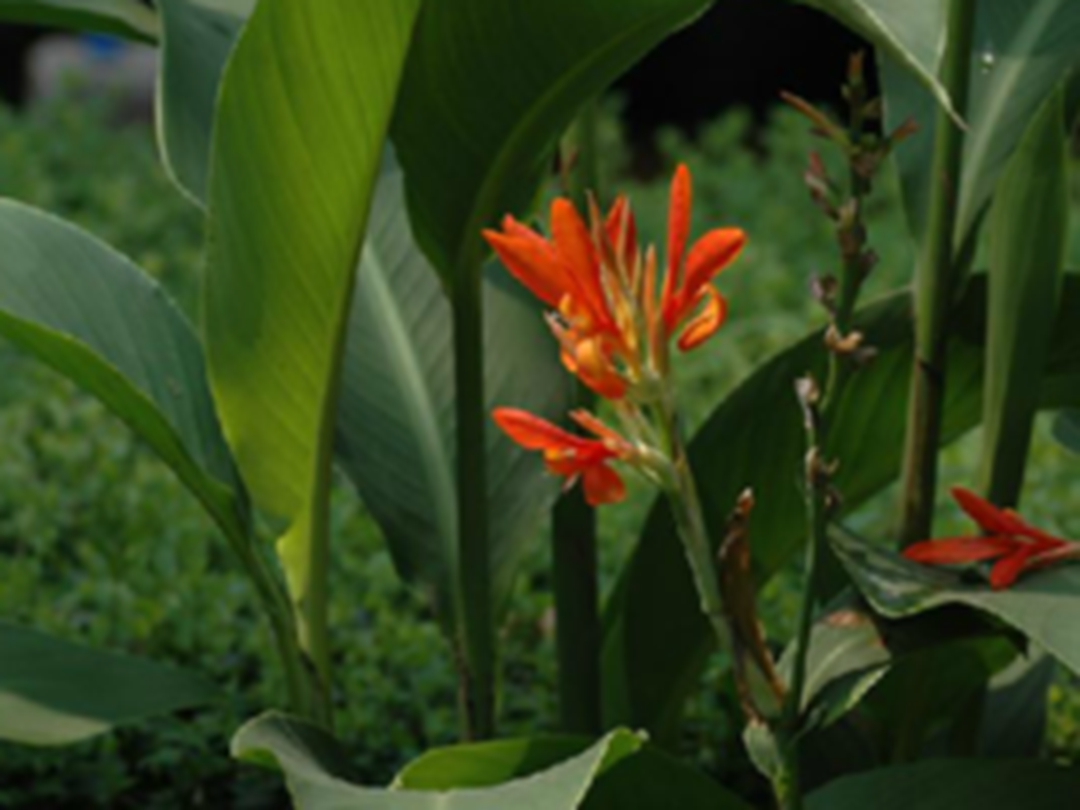
Canna
Canna, a name in traditional Chinese medicine. It refers to the rhizomes and flowers of Canna indica L., a plant belonging to the genus Canna in the family Acanthaceae. Canna is widely cultivated throughout China; it also grows wild in moist grasslands. It has the effects of clearing heat, draining dampness, calming the mind, and lowering blood pressure.It is primarily used to treat jaundice-type acute infectious hepatitis, neurosis, hypertension, menorrhagia, and leukorrhea; externally, it is used to treat contusions, bruises, and abscesses.
Chinese Name : 美人蕉
Aliases : Phoenix Tail Flower, Small Banana, Five-Vein Grass, Blood-Breaking Red
Nature, Flavor & Meridian Tropism : Sweet and bland in taste; cool in nature
Benefits & Efficacy
Benefits
Clears heat and drains dampness; calms the mind and lowers blood pressure.
Indications
Acute infectious hepatitis with jaundice, neurosis, hypertension, menorrhagia, and leukorrhea; for external use to treat contusions, bruises, sores, and abscesses.
Usage and Dosage
Internal use: 30–60 g; fresh roots: 60–120 g. External use: an appropriate amount of fresh roots, pounded into a paste and applied to the affected area.
Precautions
Use with caution in individuals with allergies.
Applications
Related Compatibility
For acute jaundice-type hepatitis: 90 g of Canna lily, 30 g each of Lu Ying root and Iron Horsewhip. Decoct in water and divide into 3 doses. Avoid fish, shrimp, spicy foods, meat dishes, and animal fats while taking this medication. (Compendium of Chinese Herbal Medicines)
Processing & Preparation
Harvesting & Processing
Can be harvested year-round; use fresh or sun-dried.
Crude Drug Identification
Botanical Information
Botanical Classification
Canna, a plant of the genus Canna in the family Acanthaceae.
Morphological Characteristics
Canna,also known as “Orchid Banana” (*Six Books on Agriculture*), “Water Banana” (*Essentials of the Nature of Raw Herbs*), “Tiger-Head Banana” (*Supplements to the Compendium of Materia Medica*), “Lotus Banana” (*Chronicles of Taiwan Prefecture*), “Tanhua” (*Medicinal Garden Revival*), “Small Plantain” (*Chronicles of Sichuan Medicinal Herbs*), “Foreign Plantain” and “Blood-Breaking Red” (*Catalog of Medicinal Plants of Jiangxi*), and “Safflower Banana”in *Catalog of Medicinal Plants of Guangdong*. A perennial herb reaching up to 1.5 m in height; the entire plant is green, glabrous, and covered with a waxy white powder. It has a tuberous rhizome. Above-ground stems grow in clumps. Leaves are simple and alternate; they have sheathing petioles; the leaf blades are ovate-oblong, 10–30 cm long, with an acute apex, entire or slightly wavy margins, and a broadly cuneate to rounded base.Inflorescence racemose; flowers solitary or in pairs; each flower with 1 bract, ovate, about 1.2 cm long; sepals 3, greenish-white with a reddish tip, about 1 cm long; corolla mostly red, tube about 1 cm long, corolla lobes lanceolate, about 3 cm long;The outer whorl consists of 2–3 reduced stamens, bright red, oblanceolate, about 4 cm long; the labellum is lanceolate, about 3 cm long, curved; the anthers of the developed stamens are slightly curved at the junction with the filaments; the ovary is inferior, 3-chambered, with a single style. The fruit is a capsule, oblong, green, with soft spines, 1.2–1.8 cm long.Flowering and fruiting period: March–December.
Distribution Area
Native to India.