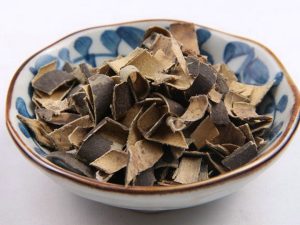
Niuteng is the name of a traditional Chinese medicine. It consists of the stems and roots of Stauntonia hexaphylla (Thunb.) Decne. or Stauntonia hexaphylla Decne. var. urophylla Hand.-Mazz., plants of the Lardizabalaceae family. Niuteng is distributed in Taiwan, Guangdong, Guangxi, and other regions.Stauntonia hexaphylla var. urophylla is distributed in Zhejiang, Jiangxi, Fujian, Hunan, Guangdong, Guangxi, and other regions. It has the effects of dispelling wind and removing blood stasis, relieving pain, and promoting urination to reduce swelling. It is primarily used to treat rheumatic arthralgia, pain from falls and blows, various types of neuropathic pain, difficulty urinating, and edema.

Niu Teng
Niuteng is the name of a traditional Chinese medicine. It consists of the stems and roots of Stauntonia hexaphylla (Thunb.) Decne. or Stauntonia hexaphylla Decne. var. urophylla Hand.-Mazz., plants of the Lardizabalaceae family. Niuteng is distributed in Taiwan, Guangdong, Guangxi, and other regions.Stauntonia hexaphylla var. urophylla is distributed in Zhejiang, Jiangxi, Fujian, Hunan, Guangdong, Guangxi, and other regions. It has the effects of dispelling wind and removing blood stasis, relieving pain, and promoting urination to reduce swelling. It is primarily used to treat rheumatic arthralgia, pain from falls and blows, various types of neuropathic pain, difficulty urinating, and edema.
Chinese Name : 牛藤
Aliases : Wild Papaya, Seven Sisters Vine, Six-Leaf Wild Papaya, Stone Moon, Yu Zi
Nature, Flavor & Meridian Tropism : Bitter in taste, cool in nature; enters the Liver and Bladder meridians
Benefits & Efficacy
Benefits
Dispels wind and removes blood stasis; relieves pain; promotes urination and reduces swelling.
Indications
Cow Vine is primarily used to treat rheumatic arthralgia, trauma-induced pain, various types of neuropathic pain, difficulty urinating, and edema.
Usage and Dosage
Internal use: Decocted as a soup, 15–30 g; or incorporated into pills or powders.
Precautions
Patients requiring treatment with Chinese herbal medicine should first consult a licensed Traditional Chinese Medicine (TCM) hospital to receive a prescription following a professional TCM differential diagnosis.
Relevant Discussions
1. *Pharmacology of Chinese Medicinal Herbs*: “Acts as a cardiotonic and diuretic.”
2. *Selected Compendium of Guangxi Materia Medica*: “Clears heat and drains dampness; relieves pain and detoxifies. Primarily used for rheumatic joint pain, postoperative pain, pain associated with leprosy reactions, and painful, scanty urination due to damp-heat.”
3. *Compendium of Chinese Herbal Medicines*: “Dispels blood stasis and relieves pain; promotes diuresis and reduces edema. Indicated for rheumatoid arthritis, trauma, various types of neuropathic pain, edema, difficulty urinating, and irregular menstruation.”
Applications
Clinical Applications
1. For rheumatic bone pain: 30 g each of Cowhage and Stinking Jasmine, and 15 g of Full-Mountain Fragrance. Decoct in water and take orally. (*Wuzhou Chinese Herbal Medicine*)
2. For pain caused by surgical procedures: 3–9 g of the whole plant of Duckfoot Lily (Tail-Leaf Liana). Decoct in water and take orally. (*Compendium of Chinese Herbal Medicine*)
Notes
References: 1. *Chinese Materia Medica, Vol. 3* 2. *Encyclopedia of Chinese Medicinal Herbs*
Processing & Preparation
Harvesting & Processing
Harvest in summer or fall. For the vine stems, remove branches and leaves; for the roots, remove fibrous roots. Wash thoroughly, allow to soak until thoroughly moistened, cut into sections or slices, and sun-dry.
Crude Drug Identification
Botanical Information
Botanical Classification
A species of the genus Nartheca (family Lardizabalaceae), such as Nartheca or Nartheca caudata.
Morphological Characteristics
1. Na-teng: An evergreen vine. Palmate compound leaves are alternate; petioles are long; there are 3–7 leaflets, with petiolules 3 cm long; leaflets are oblong to oblong-ovate, leathery, with a short acuminate apex and a rounded base, 4–9 cm long and 2–2.5 cm wide, entire-margined, smooth on the upper surface, and whitish on the lower surface.Racemose or umbellate inflorescences consist of 3–7 flowers; the plant is monoecious; flowers are 1.5–2 cm in diameter, white, pale red, or with a bluish-purple halo;Male flowers have 3 outer sepals, broadly lanceolate, about 13 mm long; 3 inner sepals, linear, slightly longer; and 6 stamens; female flowers are larger but fewer in number, with 3 inner sepals, lanceolate and shorter than the outer ones, 6 staminodes, and mature ovaries that are ovate and purple.The berries are ovoid, red, 6–7 cm long, with white flesh containing numerous black seeds. Flowering occurs in May, and fruiting in September–October.
2. Tail-leaved Nandina: Also known as tail-leaved wild papaya, duckfoot lotus, or tail-leaved wild papaya. A climbing shrub. The entire plant is glabrous. Twigs are grayish-brown. Leaves are palmately compound; leaflets number 3–7 and are leathery;leaf shapes vary greatly, ranging from obovate to oblong-oblanceolate, 3.8–8 cm long and 1–3 cm wide, with a long, tail-like tip; the apex often bears a short, easily breakable filiform tip; the base is broadly cuneate or nearly rounded; the upper surface is bright green, the lower surface is yellowish-green, sometimes with white spots; lateral veins and reticulate veins are often distinctly sunken on the upper surface and slightly raised on the lower surface.Flowers are monoecious, often arranged in loose racemes; the raceme peduncle is 3–8 cm long, and the florets’ pedicels are 1–3 cm long; male flowers have 6 sepals: the outer whorl consists of 3 oblong-lanceolate sepals with slightly acute or obtuse apices, while the inner whorl is smaller and narrower, with linear-lanceolate sepals and obtuse apices;no petals; 6 stamens, all filaments fused, with an anther connective bearing a convex tip approximately 1 mm long, much shorter than the anthers; the sepals of the female flowers are similar to those of the male flowers but larger, with 3 carpels. The berry is ovoid, containing several glossy black seeds. Flowering period: March–May.
Distribution Area
1. Naten: Found in Taiwan, Guangdong, Guangxi, and other areas. 2. Tail-leaved Naten: Found in Zhejiang, Jiangxi, Fujian, Hunan, Guangdong, Guangxi, and other areas.