Job’s Tears, a traditional Chinese medicine, is the dried, mature seed kernel of Coix lacryma-jobi L. var. ma-yuen (Roman.) Stapf, a plant belonging to the genus Coix in the Poaceae family. It is primarily produced in Fujian, Hebei, and Liaoning. This product has the effects of promoting diuresis and draining dampness, strengthening the spleen and stopping diarrhea, relieving arthralgia, draining pus, and detoxifying and dispersing nodules. It is primarily used to treat edema, beriberi, difficulty urinating, spleen-deficiency diarrhea, damp-arthralgia with stiffness and spasms, lung abscess, intestinal abscess, skin tags, and cancerous tumors.
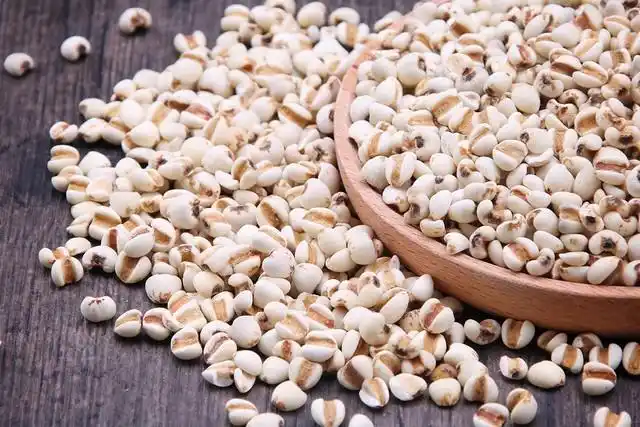
Job’s Tears
Coix Seed, a traditional Chinese medicine, is the dried, mature seed kernel of Coix lacryma-jobi L. var. ma-yuen (Roman.) Stapf, a plant belonging to the genus Coix in the Poaceae family. It is primarily produced in Fujian, Hebei, and Liaoning. This product has the effects of promoting diuresis and draining dampness, strengthening the spleen and stopping diarrhea, relieving arthralgia, draining pus, and detoxifying and dispersing nodules. It is primarily used to treat edema, beriberi, difficulty urinating, spleen-deficiency diarrhea, damp-arthralgia with stiffness and spasms, lung abscess, intestinal abscess, skin tags, and cancerous tumors.
Chinese Name : 薏苡仁
Latin Name : Coicis Semen
Aliases : Job's tears
Authentic Producing Area : Fujian, Hebei, Liaoning
Nature, Flavor & Meridian Tropism : It has a cool nature, a sweet and bland taste, and enters the Spleen, Stomach, and Lung meridians.
Benefits & Efficacy
Benefits
Promotes diuresis and drains dampness; strengthens the spleen and stops diarrhea; relieves arthralgia; drains pus; detoxifies and disperses nodules.
Indications
It is primarily used to treat edema, athlete’s foot, difficulty urinating, diarrhea due to spleen deficiency, stiffness and spasms caused by dampness, lung abscess, intestinal abscess, skin tags, and cancerous tumors.
Usage and Dosage
Oral use: Decoct and take 9–30 g; or use in powder form.
Precautions
1. Use with caution during pregnancy. 2. Do not cook with alkali.
Chemical Constituents
It contains fatty oils, coix seed esters, coixin, coix seed lactones, as well as coix polysaccharides A, B, and C, amino acids, vitamin B1, and other components.
Pharmacological Actions
This product helps regulate gastrointestinal function, lower cholesterol, lower blood sugar, relieve pain, and modulate the immune system.
Relevant Discussions
1. *Shennong Bencao Jing*: “It treats muscle stiffness and spasms that prevent flexion and extension, rheumatic arthralgia, and helps to regulate qi.”
2. *The Correct Herbal*: “job’s tears has a sweet and bland taste, a slightly cool nature, and a slightly descending and permeating action; therefore, it can dispel dampness and promote diuresis. Because it dispels dampness, it can relieve joint stiffness, eliminate beriberi, treat atrophy, weakness, stiffness, and damp-bi syndrome, alleviate pain caused by edema, promote urination in cases of heat-induced dysuria, and also kill roundworms. Because of its slightly descending nature, it also treats coughs with purulent sputum, relieves diaphragmatic congestion, and stimulates the appetite. Due to its cool nature, it clears heat, alleviates restlessness and thirst, and relieves shortness of breath. However, its effects are quite gradual; when used as an auxiliary or messenger herb, the dosage should be doubled.”
3. *Compendium of Materia Medica*: “job’s tears is a Yangming herb that strengthens the spleen and nourishes the stomach. In cases of deficiency, one should tonify the ‘mother’ organ; thus, it is used for pulmonary atrophy and lung abscesses. For diseases of the tendons and bones, treatment must be based on regulating the Yangming meridian; therefore, it is used for muscle spasms, tendon stiffness, and wind-induced arthralgia. Since Earth overcomes Water and dispels dampness, it is used for diarrhea and edema.”
4. *Treatise on the Nature of Medicinal Substances*: “When decocted and taken orally, it dispels toxic swelling.”
Applications
Clinical Applications
1. *Treatise on the Differentiation of Warm Diseases*: job’s tears, white cardamom, apricot kernel, bamboo leaf, akebia, talc, pinellia, and magnolia bark. Used to treat the early stage of warm diseases characterized by headache, aversion to cold, heaviness and body aches, a white tongue coating without thirst, chest tightness without hunger, and fever in the afternoon.
2. *Formulas of the Bureau of Harmonious Preparations*: Used in combination with ginseng, Poria, Atractylodes macrocephala, etc.; for example, the Ginseng-Poria-Atractylodes Powder (Shenling Baizhu San) can drain spleen dampness, strengthen the spleen, and stop diarrhea.
3. *Thousand Gold Prescriptions*: Used in combination with reed stems, winter melon seeds, peach kernels, etc.; for example, Reed Stem Decoction (Weijing Tang) can treat chest pain caused by lung abscess and coughing up purulent sputum.
Related Compatibility
1. Coix Seed Combined with Winter Melon Rind: Coix seed excels at strengthening the spleen and promoting diuresis; winter melon rind excels at promoting diuresis and reducing swelling. When used together, these two herbs work to strengthen the spleen, promote diuresis, and reduce swelling. They are used to treat edema and scanty urination caused by excessive damp-heat combined with spleen deficiency.
2. Coix Seed Combined with Atractylodes: Coix Seed excels at promoting diuresis and draining dampness; Atractylodes excels at tonifying qi, strengthening the spleen, and drying dampness. When used together, these two herbs enhance the effects of strengthening the spleen and eliminating dampness. They are used to treat loose stools and fatigue caused by spleen deficiency with excessive dampness.
3. Coix Seed combined with Ephedra: Coix Seed excels at eliminating dampness and relieving bi syndrome; Ephedra excels at inducing sweating, resolving exterior syndromes, and promoting diuresis. When used together, these two herbs work to dispel wind, disperse cold, and eliminate dampness. They are used to treat bi syndrome characterized by wind-dampness in the exterior, generalized body pain, and stiffness of the tendons and meridians.
Medicinal Identification
1. Raw Coix Seed and Wheat Bran-Fried Coix Seed: Both are different processed varieties of Coix seed; due to their distinct processing methods, their therapeutic effects also differ in emphasis. Raw coix seed has a cold and cool nature and excels at promoting diuresis and draining dampness, clearing heat and expelling pus, relieving arthralgia, and detoxifying and dispersing nodules; it is particularly suitable for beriberi-induced edema, difficulty urinating, damp-arthralgia with stiffness and spasms, intestinal abscesses, lung abscesses, skin tags, and tumors; When used for edema, its dampness-draining effect is relatively mild, so it is best suited for mild cases. Wheat-bran-fried coix seed has a relatively neutral nature and excels at strengthening the spleen and stopping diarrhea; it is often used for diarrhea caused by spleen deficiency with dampness. Clinically, coix seed is primarily used in its raw form; the raw variety is particularly suitable for lower-limb bi syndrome caused by damp-heat. The fried form is mostly used to strengthen the spleen; since its effect is weaker, a larger dosage is recommended.
2. Coix Seed and Poria: Both can strengthen the spleen and drain dampness, and both enter the Spleen Meridian; for conditions of spleen deficiency with excessive dampness, they are often used in combination. However, Coix Seed has a mild action and requires a large dosage to be effective; it also enters the Lung and Stomach Meridians, has a cold nature, and can eliminate bi syndrome, expel pus, detoxify, and disperse nodules; it is commonly used for damp-bi-induced stiffness and contractures, lung abscess, intestinal abscess, skin tags, and tumors. Poria, on the other hand, has a neutral and mild nature and is a key herb for promoting diuresis and draining dampness; its ability to promote diuresis, drain dampness, and strengthen the spleen is stronger than that of coix seed. For edema, regardless of whether the condition is due to cold, heat, deficiency, or excess, it can be combined with other herbs. Owing to its diuretic and spleen-strengthening properties, it is commonly used to treat dizziness, palpitations, and cough associated with phlegm-fluid retention, making it a key herb for such conditions; it also has a calming effect on the heart and mind, and is frequently used to treat palpitations, anxiety, insomnia, and excessive dreaming.
Related Medicines
Si Miao Pills, Feng Tong An Capsules, Shen Ling Jian Pi Wei Granules, and Qian Lie Shu Pills.
Related Prescriptions
Shenling Baizhu San (from *Heji Jufang*), Sanren Tang (*Wenbing Tiaobian*), Weijing Tang (from *Wai Tai Mi Yao*, citing *Gujin Luoyan Fang*), and Yiyi Fuzhi Baijiang San (*Jingui Yaolue*).
Medicinal Diet Therapy
Chicken Stewed with Job’s Tears:
1. Benefits: Boosts physical strength and replenishes vital energy.
2. Ingredients: 1 chicken, 20g Job’s tears, Shaoxing wine, salt, chopped scallions, shredded ginger, and pepper to taste, 1 orange.
3. Instructions: Pluck the chicken and remove the innards, then rinse thoroughly. Cut the chicken, bones and all, into cubes of about 3 cm. Place the chicken in a deep pot, add about 10 cups of water, and add the coix seeds. Bring to a boil over high heat, then simmer over low heat for 2 hours until the chicken is tender and falls off the bone. Just before removing from the heat, add the prepared Shaoxing wine, salt, chopped scallions, shredded ginger, pepper, and orange juice to season, then serve.
4. Usage: Serve as a side dish with meals.
Processing & Preparation
Harvesting & Processing
In September and October, when the stems and leaves turn yellow and the fruits turn brown, and most of the fruits have ripened (approximately 85% ripe), the plants are cut down. They are then stacked upright for 3–4 days before threshing. The stems, leaves, and other debris are sifted out, and the grains are sun-dried or oven-dried. The pericarp and seed coat are removed using a dehulling machine, yielding coix seeds.
Processing Methods
1. Coix Seed
Take the raw herb, remove the husks and impurities, rinse thoroughly, dry, and sift out any dust or debris.
2. Roasted Coix Seed
(1) Lightly Roasted: Sort the cleaned coix seeds by size, place them in a pan, and heat over low heat. Roast until they turn a light yellow color and release a fragrant aroma, then remove and let cool.
(2) Roasted until Charred: Place the cleaned coix seeds in a hot wok and roast over high heat until they turn a charred brown. Sprinkle a small amount of water to extinguish any remaining embers, then remove, let cool, and sun-dry.
3. Wheat Bran-Roasted Coix Seed
Take clean wheat bran and sprinkle it into a hot wok. Heat over medium heat until smoke rises, then pour in the cleaned coix seeds. Roast until the surface turns yellow and puffs up, then remove, sift out the wheat bran, and let cool. Use 10 kg of wheat bran for every 100 kg of coix seeds.
4. Earth-Roasted Coix Seeds
Place fine “Fulonggan” powder in a pan and roast over low heat until hot. Add the cleaned coix seeds and stir-fry until they take on an earthy color. Remove from heat, sift out the earth powder, and let cool. Use 20 kg of “Fulonggan” powder for every 100 kg of coix seeds.
5. Steamed Coix Seed
Soak the cleaned coix seeds in water for 24 hours, then steam for 3–4 hours. Once thoroughly steamed, sun-dry them (in winter, allow them to be exposed to frost and dew for 1–2 days before sun-drying); or soak for 1–2 days and nights, then steam over high heat for 4 hours, sprinkling water during steaming (approximately once per hour). After steaming, remove and air-dry.
Storage Methods
Store in a well-ventilated, dry place to prevent moth damage.
Crude Drug Identification
Identification
This product is broadly ovate or oblong, 4–8 mm long and 3–6 mm wide. The surface is milky white and smooth, occasionally with remnants of yellowish-brown seed coat; one end is bluntly rounded, while the other end is wider and slightly concave, with a pale brown, dot-like seed scar. The dorsal surface is convex, and the ventral surface has a relatively wide and deep longitudinal groove. It is firm in texture, with a white, powdery fracture surface. It has a faint odor and a slightly sweet taste.
Properties of Crude Drugs
1. Raw Coix Seed: See the “Medicinal Materials” section.
2. Roasted Coix Seed: Resembles raw Coix Seed, with a light yellow surface, occasional scorch marks, and a faint roasted aroma.
3. Bran-Roasted Coix Seed: Resembles raw Coix Seed, slightly puffed, with a bran-like aroma.
4. Earth-roasted Coix Seed: Resembles raw Coix seed, with a fine, earthy-yellow powder coating the surface.
5. Steamed Coix Seed: Resembles raw Coix seed, with a cracked, horn-like surface.
Botanical Information
Botanical Classification
Coix lacryma-jobi, a plant in the genus Coix of the family Poaceae.
Morphological Characteristics
An annual or perennial herb, 1–1.5 m tall. The fibrous roots are relatively thick, reaching up to 3 mm in diameter. The culms are erect, with approximately 10 nodes. The leaves are linear-lanceolate, up to 30 cm long and 1.5–3 cm wide, with rough margins; the midrib is thick and prominent on the underside. The leaf sheaths are smooth, with the upper ones shorter than the internodes; The leaf sheath is stiff, about 1 mm long. Racemes are borne in clusters from the axils; female spikelets are located in the lower part of the inflorescence and are enclosed by a bony, rosary-like involucre, which is approximately as long as the spikelet; in fertile spikelets, the lower part of the first glume is membranous, while the upper part is thick papery, with a blunt apex; the second glume is navicular and enclosed within the first glume; the second lemma is shorter than the first lemma; the palea is similar to the lemma but smaller; There are 3 stamens, which are reduced; the pistil has a long style; sterile spikelets are reduced to tubular glumes; male spikelets are usually 2–3 in number and borne on the first node; in sessile spikelets, the first glume is flattened, folded inward on both sides to form ridges with wings of unequal width, and the second glume is boat-shaped, with both the inner and outer glumes being thin and membranous; There are 3 stamens; pedicellate spikelets resemble sessile spikelets but are smaller or more reduced. The caryopsis is enclosed by a hard involucre and is ovate or ovoid-globose. Flowering occurs from July to September; fruiting occurs from September to October.
Distribution Area
It is found in most parts of China.