Gan Tai, a name in traditional Chinese medicine. It refers to the algal thalli of plants in the family Enteromorpha, including Enteromorpha prolifera (Muell.) J.Ag., Enteromorpha clathrata (Roth) Grev., Enteromorpha compressa (L.) Grev., and Enteromorpha linza (L.) J.Ag.It is distributed along the entire Chinese coastline, with particularly abundant growth along the coasts of Zhejiang and Fujian. It has the therapeutic effects of softening hardness and dispersing nodules, resolving phlegm and eliminating food stagnation, and detoxifying and reducing swelling. It is used to treat goiters, scrofula, abscesses, boils, food stagnation, parasitic infestations, epigastric and abdominal distension and fullness, and epistaxis.

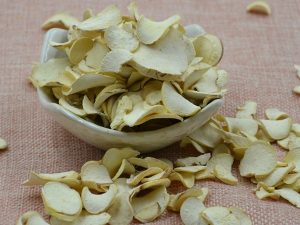
Dried Enteromorpha
Gan Tai, a name in traditional Chinese medicine. It refers to the algal thalli of plants in the family Enteromorpha, including Enteromorpha prolifera (Muell.) J.Ag., Enteromorpha clathrata (Roth) Grev., Enteromorpha compressa (L.) Grev., and Enteromorpha linza (L.) J.Ag.It is distributed along the entire Chinese coastline, with particularly abundant growth along the coasts of Zhejiang and Fujian. It has the therapeutic effects of softening hardness and dispersing nodules, resolving phlegm and eliminating food stagnation, and detoxifying and reducing swelling. It is used to treat goiters, scrofula, abscesses, boils, food stagnation, parasitic infestations, epigastric and abdominal distension and fullness, and epistaxis.
Chinese Name : 干苔
Aliases : Stoneweed, Sea Lichen, Sea Lichen Vegetable, Lichen Vegetable, Sea Green Vegetable, Sea Vegetable
Nature, Flavor & Meridian Tropism : Salty, cold. Enters the Kidney, Lung, and Spleen meridians
Benefits & Efficacy
Benefits
Softens hardness and disperses nodules; transforms phlegm and eliminates food stagnation; detoxifies and reduces swelling.
Indications
Used for goiters, scrofula, abscesses, boils, food stagnation, parasitic infestations, epigastric and abdominal distension and fullness, and nosebleeds.
Usage and Dosage
Internal use: Decoct 15g in water. External use: Apply an appropriate amount of fresh seaweed, pounded into a paste; or sun-dry, char, grind into powder, and apply as a poultice.
Precautions
Excessive consumption may harm the spleen and stomach; use with caution in cases of spleen-stomach deficiency-cold or cough due to phlegm and fluid retention.
Pharmacological Actions
Hutai has the effect of lowering total serum cholesterol.
Relevant Discussions
*Compendium of Materia Medica*: “Zhang Bo’s *Records of Wu* states: ‘Jianglin grows in seawater; it is a deep blue, resembling tangled hair, and is a type of seaweed.Su Gong’s classification of this as ‘water moss’ differs from this. Water moss is not very salty.” It further states: “According to *Hong Shi’s Yijian Zhi*: ‘Monks at a temple in Henan all suffered from goiter. A monk from Luoyang shared quarters with them; for several months, he would take seaweed jerky with every meal, and the monks’ goiters all disappeared. Thus, it is known that all marine products can cure this disease.’”
Applications
Related Compatibility
1. For nosebleeds: Burn two liang of dried seaweed into ash. Blow a small amount into the nostrils, and the bleeding will stop immediately. (*Shenghui Fang*)
2. For paronychia and swollen cervical lymph nodes: 15g each of Hutao and sea wormwood seeds; 9g each of summer枯草, Isatis leaf, and Scutellaria root. Decoct and drink.
3. For treating abscesses on the hands and back, as well as boils and carbuncles—to reduce swelling and drain pus: Mix fresh Hutao with an appropriate amount of tung oil and borneol, then pound into a paste. Apply topically. (Recipes 2–3 are from *Medicinal Marine Organisms of China*)
Processing & Preparation
Harvesting & Processing
Harvest in winter or spring; wash thoroughly and sun-dry.
Crude Drug Identification
Properties of Crude Drugs
1. Ulva: The thallus is bright green or dark green, growing in clusters, and is tubular or flattened. The main stem is distinct, with significant variation in length and diameter; it generally reaches over 1 m in length and bears numerous branches. It has a faint fishy odor and a bland, slightly salty taste.
2. Striped Ulva: The thallus can reach a length of about 40 cm; it has many slender branches, some of which are hair-like or relatively broad.
3. Flat Ulva: The thallus is flat and strip-like; the main stem and branches are similar in appearance, measuring 15–30 cm in length.
4. Marginated Ulva: The thallus is relatively broad, sheet-like, and lanceolate, measuring 10–30 cm in length.
Botanical Information
Botanical Classification
Species of the family Ulvaceae: Ulva, Ulva longifolia, Ulva flaccida, and Ulva marginata.
Morphological Characteristics
1. Ulva, also known as: rotten seaweed, seaweed strands. The thallus is bright green to dark green, growing in clumps, with a distinct main stem and numerous slender branches; it generally reaches a height of 0.5–1 m, and can even grow up to 2 m. In young plants, cells are arranged in longitudinal rows; this pattern gradually becomes less distinct as the plant matures.In surface view, cells are polygonal to nearly square, 10–12 μm wide and 12–18 μm long. Each cell contains a single chloroplast and one starch granule. 2. Sargassum striatum, also known as “striped sargassum” or “rotten strands.” The thallus is bright green or dark green, tubular and membranous, 20–40 (–80) cm tall.It is highly branched, typically two to three times, with linear or relatively broad branches. Both single-row and multi-row branches can be observed on the same thallus, and a single row of cells arranged longitudinally is visible at the branch tips. Cells appear rectangular or square in surface view, 20–33 μm long and 30–50 μm in diameter; each cell contains a single chloroplast and 2–3 (–4) starch grains.The thallus is 26–70 μm thick. 3. Flat Ulva: The thallus is bright green or dark green, tubular and slightly flattened, membranous, approximately 15–40 cm tall and 1–2 cm wide. Branching is relatively dense at the base; the lower part is narrow and slender, while the upper part extends into a flattened tubular shape.Cells are round to polygonal, not arranged in longitudinal rows, 10–27 μm in diameter, with one starch granule; plastids are not fully filled. 4. Marginal Tubular Ulva: The thallus is pale yellow to dark green, lanceolate or linear-lanceolate, unbranched, and approximately 10–30 (–90) cm tall.The stalk is tubular and hollow, flattened at the upper part; the thallus consists of a single layer of cells with wavy, wrinkled margins; the hollow margin of the thallus is formed by two connected layers of cells arranged irregularly, with a diameter of 10–20 μm, containing cup-shaped chloroplasts and one starch grain.