Alpine Lepisorus, a name in traditional Chinese medicine. It refers to the whole plant of Alpine Lepisorus (Lepisorus seilophyllus (Diels) Ching), a species of the genus Lepisorus in the family Polypodiaceae. It is distributed in Shaanxi, Gansu, Hubei, Sichuan, Yunnan, Guizhou, Tibet, and other regions. It has the therapeutic effects of dispelling wind and dampness, and stopping bleeding. It is used to treat rheumatic pain, low back pain, difficulty urinating, metrorrhagia and menorrhagia, leukorrhea, and epistaxis.

Alpine Lepisorus
Disclaimer: These statements have not been evaluated by the Food and Drug Administration (FDA). This product is not intended to diagnose, treat, cure, or prevent any disease. All references in this article to TCM syndrome differentiation, herbal medicines, teas, and decoctions are intended to promote TCM culture and are provided solely for educational and reference purposes.
Alpine Lepisorus, a name in traditional Chinese medicine. It refers to the whole plant of Alpine Lepisorus (Lepisorus seilophyllus (Diels) Ching), a species of the genus Lepisorus in the family Polypodiaceae. It is distributed in Shaanxi, Gansu, Hubei, Sichuan, Yunnan, Guizhou, Tibet, and other regions. It has the therapeutic effects of dispelling wind and dampness, and stopping bleeding. It is used to treat rheumatic pain, low back pain, difficulty urinating, metrorrhagia and menorrhagia, leukorrhea, and epistaxis.
Chinese Name : 高山瓦韦
Aliases : Stone Cowpea, Stone Small Bean
Nature, Flavor & Meridian Tropism : Mild and slightly astringent in taste; neutral in nature. Enters the Spleen and Bladder meridians
Benefits & Efficacy
Benefits
Dispels wind and dampness; stops bleeding.
Indications
Rheumatic pain, low back pain, difficulty urinating, metrorrhagia and menorrhagia, leukorrhea, and epistaxis.
Usage and Dosage
6–9 g; or steeped in wine.
Applications
Related Compatibility
For menorrhagia and leukorrhea: 12 g each of Stone Cowpea and Three-Hundred-Herbs, 9 g each of Tai Bai Hua, Golden Ribbon, and Red Notoginseng, and 6 g of Bupleurum. Decoct in water and take orally; use sweet wine as a vehicle. (From *Shaanxi Chinese Herbal Medicine*)
Processing & Preparation
Harvesting & Processing
Harvest the whole plant in summer or fall; dry in the shade before use.
Crude Drug Identification
Properties of Crude Drugs
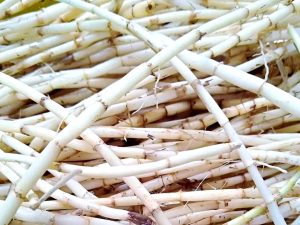
Leaves are narrow and linear, with a slightly pointed apex, approximately 20 cm long and 0.3 cm wide. Leaves have almost no petioles; the margins are curled, the upper surface is smooth and yellowish-green, and the lower surface bears spores along both sides of the midrib in the middle to upper regions; they are nearly leathery and break easily. Slight odor, bland taste, and slightly astringent.
Botanical Information
Botanical Classification
Alpine Polypodium, a plant of the genus Polypodium in the family Polypodiaceae.
Morphological Characteristics
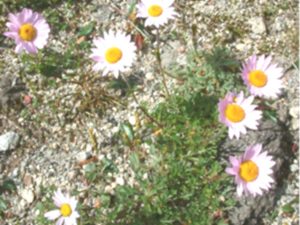
A perennial herb, 20–30 cm tall. The rhizome is prostrate and densely covered with blackish-brown scaly hairs.Leaves are simple, stem-borne, and nearly sessile; the leaf blade is thick and leathery, narrowly oblong, with margins curled back toward the adaxial surface, almost reaching the midrib. Spore clusters are ovoid or oblong, distributed on both sides of the midrib in the middle to upper part of the adaxial surface, attached at the junctions of fine veins, and covered by the curled leaf margins; the clusters are enclosed by shield-shaped septa.
Distribution Area
It is distributed in Shaanxi, Gansu, Hubei, Sichuan, Yunnan, Guizhou, Tibet, and other provinces.
Copyright: Excerpt from Internet, Copyright belongs to the Original Author and all original sources, This article was shared by DeDe on August 2, 2026, Please credit the source and include a link to the original article when reposting.
Terminology Proofreading: [Cheng Bo] | August 2, 2026 Reviewed by: [Wang Zhongxiang, Associate Chief TCM Physician (China)] | August 2, 2026
Correct Content Errors: Errors may occur during the writing, editing, translation, and publication of website content. If you find any errors or inaccurate information in this article, please feel free to Contact Us to report them, and we will correct them promptly.
FDA Disclaimer: The descriptions of the efficacy of Chinese herbal medicines, herbal teas, decoctions, and formulas, as well as the content on Traditional Chinese Medicine (TCM) diagnostic theory and traditional TCM therapies contained on this site, are intended solely for the purpose of popularizing TCM culture and serving as an educational reference; they do not constitute medical diagnosis or treatment advice. Please do not attempt to use these products on your own without proper guidance. These statements have not been evaluated by the Food and Drug Administration. This product is not intended to diagnose, treat, cure, or prevent any disease. If you are experiencing any physical discomfort, please consult a licensed healthcare professional and seek treatment at a reputable medical institution. This platform assumes no responsibility for any consequences resulting from the use of herbs or formulas by any individual based on the information provided on this site. Please read Medical Disclaimer.