Lantern Grass is a name used in traditional Chinese medicine. It refers to the whole plant of Physalis peruviana L. (Chinese lantern), a member of the Solanaceae family. It has the efficacy of clearing heat and detoxifying, and is primarily used to treat colds, sore throats, coughs, mumps, and pemphigus.

Chinese Lantern
Lantern Grass is a name used in traditional Chinese medicine. It refers to the whole plant of Physalis peruviana L. (Chinese lantern), a member of the Solanaceae family. It has the efficacy of clearing heat and detoxifying, and is primarily used to treat colds, sore throats, coughs, mumps, and pemphigus.
Chinese Name : 灯笼草
Aliases : Exploding Ball Herb, Lantern Bubble, Ghost Lantern, Water Lantern Herb, Bitter Lantern Herb, Lotus Ball Herb, Forehead Bubble, Heavenly Bubble Fruit, Ringing Bell, Earth Lantern, Mother Cannon Herb, Cannon Seed Herb
Nature, Flavor & Meridian Tropism : Bitter in taste, cool in nature
Benefits & Efficacy
Benefits
Clears heat and detoxifies.
Indications
Mainly used to treat colds, sore throats, coughs, mumps, and pemphigus.
Usage and Dosage
Internal use: Decoct 9–15 g. External use: Apply an appropriate amount as a poultice or wash with a decoction.
Precautions
1. While taking Lantern Grass, avoid concurrent use of large amounts of warming or heating herbs, such as deer antler, cinnamon, or ginger, to prevent interference with its heat-clearing effects. 2. This herb may interact with other medications, affecting efficacy or compromising health. It is recommended to consult a doctor or pharmacist before combining it with other medications.
Chemical Constituents
The roots of Lantern Grass contain organic acids, amino acids, flavonoid glycosides, phenolic compounds, and sugars; the leaves contain chlorogenic acid; and the fruits are rich in carotenoids.
Pharmacological Actions
Lantern Grass possesses anticancer and antimicrobial properties.
Relevant Discussions
1. *Lu Chuan Materia Medica*: Promotes the flow of qi, relieves bloating, and promotes urination. Used to treat abdominal distension, testicular inflammation, and hernias.
2. *Nanning Medicinal Plant Compendium*: Clears heat, kills parasites, relieves pain, and reduces swelling. Used to treat eye inflammation, sore throat, and cough; applied topically to treat toxic sores, and used for fumigation and washing to treat scrotal swelling.
3. *Manual of Raw Herbs*: Taken internally to treat typhoid fever or small intestine hernia. Used as a topical wash to treat pemphigus.
4. *Illustrated Compendium of Chinese Medicinal Plants*: Has the same effects as Physalis.
5. Guangzhou Air Force *Manual of Common Chinese Herbs*: Treats common cold with fever, mumps, bronchitis, herpes, boils, and hernia pain.
Applications
Notes
Patients requiring treatment with traditional Chinese medicine should first consult a licensed TCM hospital, where a TCM practitioner will conduct a professional pattern differentiation and issue a prescription.
Processing & Preparation
Harvesting & Processing
Harvest from June to October; use fresh or sun-dry.
Storage Methods
Store in a dry, well-ventilated place.
Crude Drug Identification
Properties of Crude Drugs
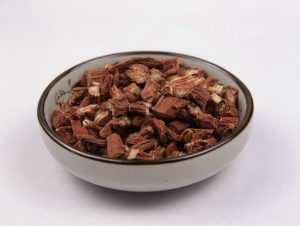
The whole plant grows to 25–60 cm in length. The stem is slightly flattened and quadrangular, with ridges; its surface is grayish-yellowish-white or grayish-blue, densely covered with white downy hairs. The leaves are shriveled and curled; when flattened, they are ovate, with an acute apex, a wedge-shaped or slightly cordate base, and margins that are nearly entire or bear irregular, sparse, coarse teeth. They are dark green or yellowish-green, covered with white downy hairs on both surfaces, and have long petioles.At the leaf axils are swollen, lantern-like calyces; some are flattened, pale yellowish-green, thin and papery, translucent, and covered with soft hairs; inside are dark yellowish-green, nearly round berries. It has a faint odor and a sweet, bitter taste.
Botanical Information
Botanical Classification
A lantern-shaped fruit of a Solanaceae plant.
Morphological Characteristics
A perennial herb, 45–90 cm tall. It has a creeping rhizome and an erect stem covered with short soft hairs.Leaves are simple and alternate, or clustered in pairs; petioles are 2–5 cm long and densely pubescent; leaf blades are ovate to oblong, 6–15 cm long and 4–10 cm wide, with a short, acuminate apex, a symmetrical cordate base, entire margins or with a few inconspicuous sharp teeth, and densely pubescent on both surfaces.Flowers are solitary in the leaf axils, with a pedicel approximately 1.5 cm long; the calyx is broadly campanulate and green, shallowly 5-lobed, with lanceolate lobes bearing short tomentum; the corolla is broadly campanulate, 1.2–1.5 cm long, yellow, with purple markings at the throat, shallowly 5-lobed, with nearly triangular lobes;There are 5 stamens, attached near the base of the corolla; the filaments and anthers are bluish-purple; there is 1 pistil with a superior ovary that is 2–3-chambered. The berry is globose, 1–1.5 cm in diameter, and yellow when ripe; the persistent calyx swells into a lantern-like structure during fruiting, enclosing the berry but remaining separate from it. The seeds are yellow and disc-shaped. It flowers and fruits in summer.
Distribution Area
Cultivated in Fujian, Guangdong, Guangxi, and Yunnan, China; may also occur wild along roadsides or in river valleys at elevations of 1,200–2,100 m.