Schefflera venulosa, a name in traditional Chinese medicine. It refers to the stems and leaves of Schefflera venulosa (Wight & Arn.) Harms, a plant belonging to the genus Schefflera in the Araliaceae family. Schefflera venulosa is distributed in Hunan, Guangxi, Guizhou, Yunnan, Tibet, and other regions. It has the effects of dispelling wind and relieving pain, as well as promoting blood circulation and reducing swelling.It is primarily used to treat rheumatic pain, epigastric pain, swelling from contusions and bruises, fractures, and bleeding from external injuries.
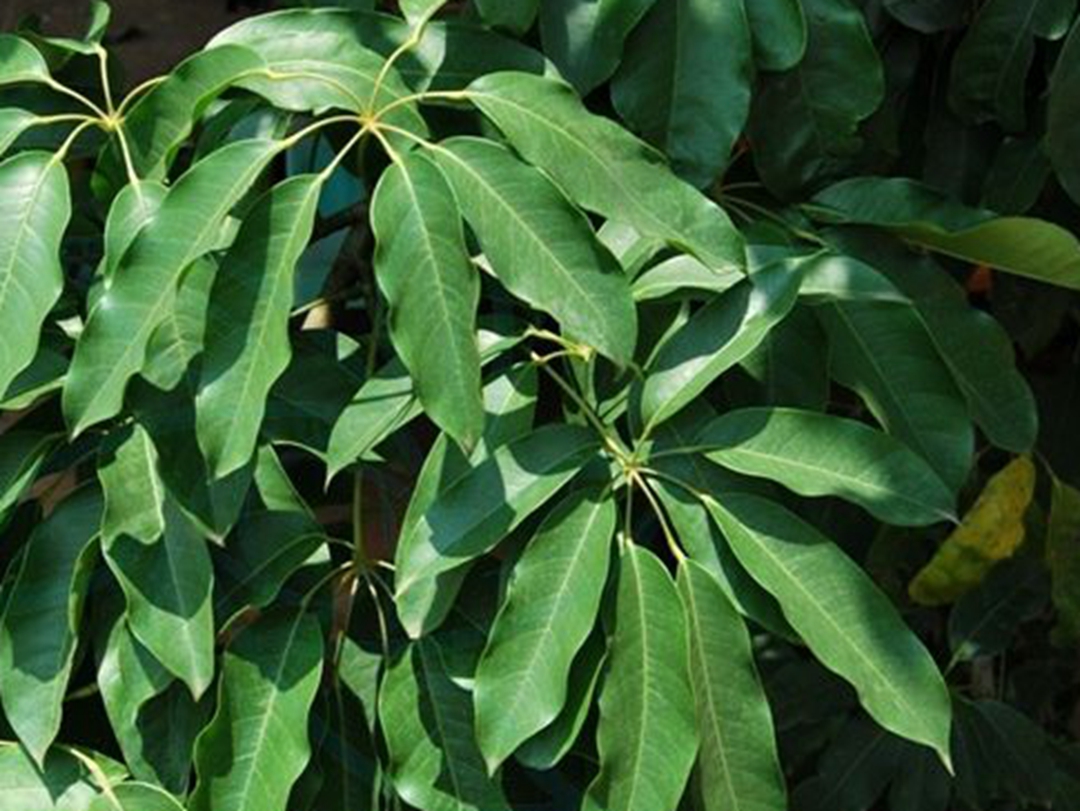
Dense-veined Schefflera
Schefflera venulosa, a name in traditional Chinese medicine. It refers to the stems and leaves of Schefflera venulosa (Wight & Arn.) Harms, a plant belonging to the genus Schefflera in the Araliaceae family. Schefflera venulosa is distributed in Hunan, Guangxi, Guizhou, Yunnan, Tibet, and other regions. It has the effects of dispelling wind and relieving pain, as well as promoting blood circulation and reducing swelling.It is primarily used to treat rheumatic pain, epigastric pain, swelling from contusions and bruises, fractures, and bleeding from external injuries.
Chinese Name : 密脉鹅掌柴
Aliases : Seven-Leaf Lotus, Wu Jia Feng, Mu Ke Mai, Wu Jia Pi (*Catalog of Medicinal Plants of Yunnan*); Dragon Claw Tree, Han Tao Ye (*Selected Medicinal Herbs of Yunnan*); Evergreen, Five-Claw Leaf (*Medicinal Herbs of Yuxi*)
Nature, Flavor & Meridian Tropism : Taste: bitter, pungent; Nature: warm. Enters the Liver and Stomach meridians
Benefits & Efficacy
Benefits
Dispels wind and relieves pain; promotes blood circulation and reduces swelling.
Indications
Rheumatic arthralgia, epigastric pain, swelling from contusions and bruises, fractures, and bleeding from external injuries.
Usage and Dosage
Internal use: Decoct 9–15 g; or steep in wine. External use: Apply an appropriate amount, pounded and applied as a poultice.
Precautions
Use with caution during pregnancy.
Relevant Discussions
1. *Yunnan Chinese Herbal Medicine*: “Relaxes tendons and activates meridians; reduces swelling and relieves pain. Primarily used for fractures and all types of pain from external injuries, as well as rheumatic bone pain.”
2. *Compendium of Chinese Herbal Medicine*: “The stem treats pain from gastric and duodenal ulcers; the leaves treat bleeding from external injuries.”
Applications
Related Compatibility
1. For chronic rheumatoid arthritis and trauma, use 15–30 g of Seven-Leaf Lotus. Decoct and drink. Alternatively, use 120 g of this herb steeped in 500 g of wine; after soaking for 48 hours, take orally. 10 ml per dose, three times daily. Fresh herb may also be used in an appropriate amount, pounded into a paste and applied to the affected area. (*Selected Yunnan Chinese Herbal Medicines*)
2. To treat various types of pain, use 9 g of Seven-Leaf Lotus. Decoct in water and take orally. (*Compendium of Chinese Herbal Medicines*)
Processing & Preparation
Harvesting & Processing
Can be harvested year-round; wash, slice, and sun-dry, or use fresh.
Crude Drug Identification
Properties of Crude Drugs
Stems and leaves are often cut into segments or slices. Stems are sometimes curved, with a brown outer surface featuring longitudinal striations and semilunar leaf scars. Whole leaves are elliptical to oblong, 7–20 cm long and 3–10 cm wide, with an acute or acuminate apex, a rounded to cuneate base, entire margins, glabrous surface, and prominent reticulate veins;acute or acuminate, base rounded to cuneate, entire, glabrous, with prominent reticulate veins; petiolules 1.5–6 cm long, glabrous. Twigs are tough and flexible; leaves are leathery.
Botanical Information
Botanical Classification
Dendrobium, a genus in the Araliaceae family.
Morphological Characteristics
Shrub or small tree, 2–10 m tall; sometimes an epiphytic vine-like shrub. Bark grayish-white; branches stout, cylindrical, green, with yellow lenticels, covered with rust-colored stellate tomenta that quickly fall off.Palmately compound leaves are alternate, with 5–7 leaflets; petioles are cylindrical, 10–18 cm long, glabrous; leaflet petioles are unequal in length, narrowly grooved, 2–5 cm long, with the central one longer than the lateral ones, glabrous; stipules and the base of the petiole are fused into a sheath; leaf blades are leathery, elliptic to oblong, 11–16 cm long, 4–6 cm wide;apex obtuse, acute, or shortly acuminate; base gradually narrowing, obtuse to nearly rounded; margin entire; glabrous on both surfaces; lateral veins 4–8 pairs; reticulate veins dense and raised. Umbels bear 6–12 flowers, forming a terminal panicle;the main peduncle is 5–7 mm long, and the pedicels are 1–2 mm long; bracts are triangular, about 7 mm long, and early deciduous; the calyx is glabrous, with entire to nearly entire margins; petals are 5, 2 mm long, with 3 veins, glabrous on both surfaces, and the flowers are pale red;There are 5 stamens, equal in length to or slightly longer than the petals; the ovary is inferior, 5-chambered, and lacks a style; the stigma is 5-lobed and sessile; the disk is slightly raised. The fruit is ovate or nearly spherical, 5-angled, about 4 mm long, and red. Flowering occurs in May, and fruiting in June.
Distribution Area
Distributed in Hunan, Guangxi, Guizhou, Yunnan, Tibet, and other regions.