Hollow Willow, a name in traditional Chinese medicine. It refers to the root or the whole plant of Spiraea salicifolia L., a member of the Rosaceae family. It is distributed in Heilongjiang, Jilin, Liaoning, Inner Mongolia, Hebei, and other regions. It has the effects of promoting blood circulation and regulating menstruation, promoting diuresis and relieving constipation, and resolving phlegm and relieving cough. It is commonly used for traumatic injuries, joint aches, amenorrhea, dysmenorrhea, difficulty urinating, constipation, and cough with excessive phlegm.
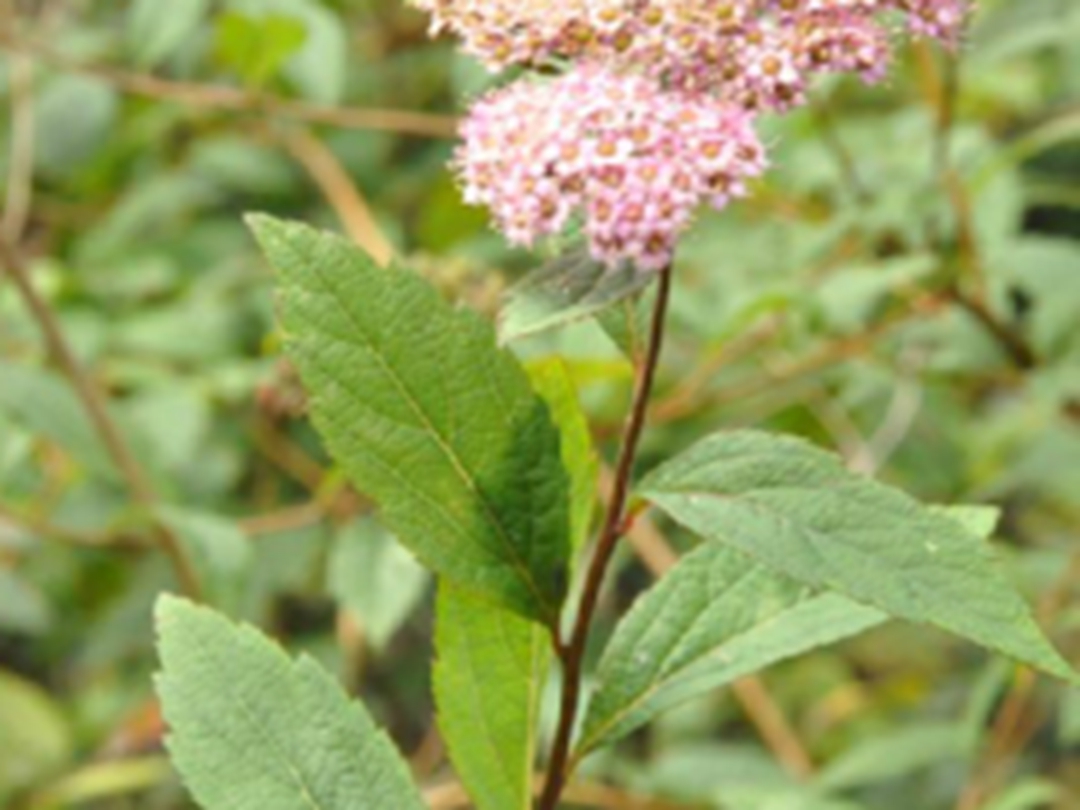
Hollow Willow
Hollow Willow, a name in traditional Chinese medicine. It refers to the root or the whole plant of Spiraea salicifolia L., a member of the Rosaceae family. It is distributed in Heilongjiang, Jilin, Liaoning, Inner Mongolia, Hebei, and other regions. It has the effects of promoting blood circulation and regulating menstruation, promoting diuresis and relieving constipation, and resolving phlegm and relieving cough. It is commonly used for traumatic injuries, joint aches, amenorrhea, dysmenorrhea, difficulty urinating, constipation, and cough with excessive phlegm.
Chinese Name : 空心柳
Benefits & Efficacy
Benefits
Promotes blood circulation and regulates menstruation; promotes diuresis and relieves constipation; resolves phlegm and suppresses cough.
Indications
Traumatic injuries, joint soreness, amenorrhea, dysmenorrhea, difficulty urinating, constipation, and cough with excessive phlegm.
Usage and Dosage
Internal use: Decoct 10–15 g. External use: Apply an appropriate amount after pounding into a paste.
Relevant Discussions
1. *Manual of Common Chinese Herbal Medicines in Heilongjiang*: “Treats traumatic injuries, joint pain, generalized body aches, cough with excessive phlegm, and knife wounds.”
2. *Compendium of Chinese Herbal Medicines*: “Regulates menstruation, promotes blood circulation and relieves constipation, and promotes diuresis. Treats amenorrhea, constipation with abdominal distension, and difficulty urinating.”
3. *Chronicle of Medicinal Plants of the Changbai Mountains*: “Removes blood stasis and relieves pain; resolves phlegm and suppresses cough.”
Applications
Related Compatibility
1. For contusions and bruises: 30 g of hollow willow root and branch bark. Decoct in water and take in divided doses. (*Manual of Common Chinese Herbal Medicines in Heilongjiang*)
2. For cough and generalized body aches: 30 g of hollow willow root. Decoct in water and take in divided doses. (*Manual of Common Chinese Herbal Medicines in Heilongjiang*)
3. For knife wounds: Use tender leaves of the hollow-stemmed willow; pound them into a paste and apply to the affected area; replace when dry. (*Manual of Common Chinese Herbal Medicines in Heilongjiang*)
Processing & Preparation
Harvesting & Processing
Roots: Harvested in the fall, washed, and sun-dried. Whole plant: Collected in summer and fall, washed, chopped, and sun-dried.
Crude Drug Identification
Botanical Information
Botanical Classification
Spiraea, a plant of the Rosaceae family.
Morphological Characteristics
Spiraea, also known as willow-leaved spiraea. A shrub 1–2 m tall. Branches are dense; twigs are slightly angular, yellowish-brown, with short soft hairs on young branches that fall off as they mature; winter buds are ovate or oblong-ovate, with an acute apex, bearing several brown, exposed scales, and covered with sparse, fine, short soft hairs.Simple leaves are alternate; petioles are 1–4 mm long and glabrous; leaf blades are oblong-lanceolate to lanceolate, 4–8 cm long and 1–2.5 cm wide, with an acute or acuminate apex, a cuneate base, and margins densely covered with sharp teeth, sometimes double-toothed; both surfaces are glabrous.The inflorescence is an oblong or pyramidal panicle, 6–13 cm long and 3–5 cm in diameter, covered with fine, short soft hairs, with densely arranged flowers; flower pedicels are 4–7 mm long; bracts are lanceolate to linear-lanceolate, entire or with a few teeth, and sparsely covered with fine, short soft hairs;flowers 5–7 mm in diameter; calyx tube campanulate, sepals triangular, inner surface sparsely covered with short soft hairs; petals ovate, apex usually rounded or obtuse, 2–3 mm long, 2–2.5 mm wide, pink; stamens 50, approximately twice as long as the petals;The disk is annular, with lobes finely and roundly serrate; the ovary is sparsely covered with short soft hairs, and the style is shorter than the stamens. The capsule is erect, glabrous or with short soft hairs along the ventral suture; the style is terminal, inclined and spreading, often with reflexed sepals. Flowering period: June–August; fruiting period: August–September.
Distribution Area
Heilongjiang, Jilin, Liaoning, Inner Mongolia, Hebei, and other areas.