Juhong is the name of a traditional Chinese medicine. It is the dried outer peel of the fruit of Citrus reticulata Blanco (a plant of the Rutaceae family) and its cultivated varieties. It has the effects of regulating qi and relieving epigastric distension, as well as drying dampness and resolving phlegm. It is used to treat coughs with excessive phlegm, indigestion caused by food accumulation or alcohol consumption, and symptoms such as vomiting, nausea, and epigastric fullness.

Juhong
Juhong is the name of a traditional Chinese medicine. It is the dried outer peel of the fruit of Citrus reticulata Blanco (a plant of the Rutaceae family) and its cultivated varieties. It has the effects of regulating qi and relieving epigastric distension, as well as drying dampness and resolving phlegm. It is used to treat coughs with excessive phlegm, indigestion caused by food accumulation or alcohol consumption, and symptoms such as vomiting, nausea, and epigastric fullness.
Chinese Name : 橘红
Latin Name : Citri Exocarpium Rubrum
Aliases : Yunpi, Yunhong
Authentic Producing Area : Zhejiang, Jiangsu, Fujian, Sichuan
Nature, Flavor & Meridian Tropism : Pungent and bitter in taste; warm in nature; enters the Lung and Spleen meridians
Benefits & Efficacy
Benefits
Regulates qi and relieves epigastric distension; dries dampness and transforms phlegm.
Indications
Cough with excessive phlegm; indigestion caused by food or alcohol; vomiting, nausea, and epigastric fullness.
Usage and Dosage
Internal use: Decocted as a soup, 3–9 g; or incorporated into pills or powders.
Precautions
Contraindicated in cases of dry cough due to yin deficiency or cough due to qi deficiency.
Chemical Constituents
Juhong contains chemical components such as flavonoids (e.g., naringin, naringin, apigenin), coumarins (e.g., isoimperatorin), triterpenes (e.g., ursolic acid, limonin, phellodendronone, nomilin), and essential oils.
Pharmacological Actions
Juhong has effects such as expectorant, antitussive, anti-inflammatory, analgesic, promoting gastric juice secretion, and lowering cholesterol.
Relevant Discussions
1. *Compendium of Materia Medica*: “It descends qi and eliminates phlegm.”
2. *Benjing Fengyuan*: “Juhong is specifically indicated for coughs with excessive phlegm caused by lung cold; it is frequently used in formulas for deficiency syndromes. However, it is not suitable for chronic coughs accompanied by qi leakage.”
3. *Yao Pin Hua Yi*: “Juhong: its pungent nature moves laterally to disperse nodules, while its bitter nature moves straight downward; it is an essential herb for regulating qi. Since treating phlegm requires regulating qi—and when qi flows smoothly, phlegm resolves on its own—it is used to target the lung and spleen meridians to treat all phlegm-related disorders, surpassing other phlegm-resolving herbs in efficacy.When combined with Bamboo Shavings (Zhú Rú) to treat heat-induced hiccups, or with Green Orange Peel (Qīng Pí) to guide stagnant qi, it works with Atractylodes (Cāng Zhú) and Magnolia Bark (Hòu Pò) to harmonize excess in the stomach. When paired with Scallion White (Cōng Bái) and Ephedra (Má Huáng), it expels cold and damp pathogenic factors from the exterior, aids digestion, alleviates alcohol toxicity, stops vomiting, and relieves chest and diaphragm fullness. It is capable of eliminating the old and bringing in the new—all due to the dispersing power of its pungent nature and the descending power of its bitter nature.”
Applications
Clinical Applications
1. For treating lung invasion by cold pathogens, characterized by a heavy cough, distension and fullness in the chest and diaphragm, and dizziness and blurred vision, it is often combined with Ephedra, Perilla Seed, and Apricot Kernel, as in the Huagai Powder from *Dan Tai Yu An*.
2. For coughs caused by damp phlegm, with phlegm obstruction and qi reversal, chest tightness, and shortness of breath, it can be combined with Pinellia and Poria, or used in conjunction with Magnolia Bark and Agarwood; if damp phlegm is complicated by heat, resulting in thick phlegm, phlegm obstruction, obesity, and shortness of breath, it can be combined with Pinellia, Trichosanthes Seed, and Scutellaria, as in the “Miraculous Formula for Relieving Asthma” from *Essential Readings on Medicine*.
3. To treat various conditions caused by damp turbidity obstructing the middle jiao, it is often combined with Cang Zhu and Hou Po; for spleen deficiency and weak stomach, with abdominal distension, poor appetite, and difficulty digesting food, it can be paired with Bai Zhu and Sha Ren, as in the “Stomach-Assisting Paste” from *Ju Fang*.
4. For persistent vomiting following illness or in deficient individuals, it is often used in combination with fresh ginger; it can also be paired with Xing Ren to treat constipation in the elderly caused by qi stagnation.
Related Compatibility
1. Ju Hong combined with Cicada Shedding: Ju Hong regulates qi and harmonizes the middle burner, while drying dampness and transforming phlegm; Cicada Shedding disperses wind-heat and clears and relieves the throat. When combined, their light and dispersing properties produce a significant effect in dispelling wind, transforming phlegm, and relieving cough. This combination is commonly used to treat itchy throat and cough caused by external invasion of wind-pathogen.
2. Ju Hong combined with Dried Ginger: Ju Hong is pungent, bitter, and warm, warming the lungs and resolving phlegm; Dried Ginger is pungent and hot, warming the lungs and resolving fluid retention. When combined, these two herbs complement each other’s actions, jointly achieving the effects of warming the lungs, dispelling cold, resolving phlegm, and eliminating fluid retention. This combination is used for conditions involving latent lung cold with phlegm and fluid retention, such as cough, asthma, thin white phlegm, aversion to cold, and a cold sensation in the back.
3. Ju Hong combined with Huoxiang: Ju Hong is pungent, bitter, and warm, and it dries dampness and regulates qi; Huoxiang is pungent and slightly warm, and its aromatic properties dispel dampness. The former promotes the smooth flow of the Three Jiao and dries and transforms spleen dampness; the latter regulates qi and transforms dampness, while also dispersing exterior pathogens.When combined, these two herbs provide aromatic dispersion, dry dampness, harmonize the middle burner, descend qi, and eliminate fullness. They are used for conditions involving dampness obstructing the middle burner and stagnation of spleen and stomach qi, such as epigastric and abdominal distension, loss of appetite, nausea and vomiting, and aching and heavy limbs.
Notes
Patients requiring treatment with traditional Chinese medicine should first consult a licensed TCM hospital, where a TCM practitioner will conduct a professional diagnosis and prescribe the appropriate herbal formula.
Processing & Preparation
Harvesting & Processing
Harvest the fruit after it ripens in late autumn or early winter; use a knife to peel off the outer pericarp, then sun-dry or air-dry.
Processing Methods
1. Juhong: Take the raw herb, remove impurities, brush off dust and dirt, and break into pieces when using; or wash thoroughly, cut into small pieces, and dry at a low temperature.
2. Roasted Juhong: Place the cleaned, crushed Juhong pieces in a pan and roast over low heat until scorch marks appear; remove and allow to cool.
3. Honey-Fried Juhong: Dilute refined honey with an appropriate amount of boiling water, add the cleaned Juhong fragments, mix thoroughly, let stand briefly, then place in a hot wok. Stir-fry over low heat until slightly yellow and no longer sticky to the touch; remove and allow to cool. Use 25 kg of refined honey per 100 kg of Juhong.
Storage Methods
Store in a dry container, tightly sealed, in a cool, dry place.
Crude Drug Identification
Properties of Crude Drugs
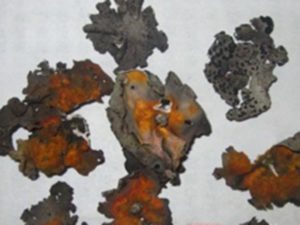
This product appears as long strips or irregular thin slices with shriveled and curled edges, approximately 0.2 mm thick. The outer surface is yellowish-brown or orange-red with a luster, densely covered with punctate, sunken or raised oil dots, commonly known as “brown eyes.” The inner surface is yellowish-white, also bearing distinct oil dots, and appears translucent when held up to the light. It is brittle and easily broken. It has a fragrant aroma and a slightly bitter, pungent taste.
Properties of Processed Slices
1. Juhong: Irregular fragments with a yellowish-brown or brownish-black outer surface densely covered with yellowish-white raised or sunken oil glands. The inner surface is yellowish-white, densely covered with small, sunken, translucent spots. It is brittle and easily broken. It has an aromatic odor and a slightly bitter, numbing taste.
2. Roasted Juhong: Similar in shape to Juhong, but with a darker color and scorch marks.
3. Honey-Fried Juhong: Similar in shape to Juhong, with a pale yellow surface.
Botanical Information
Botanical Classification
Citrus, a plant of the Rutaceae family.
Morphological Characteristics
An evergreen small tree or shrub, 3–4 m tall. Branches are slender and often thorny.Leaves are alternate; petioles are 0.5–1.5 cm long, with narrow wings and a joint at the apex; leaf blades are lanceolate or elliptical, 4–11 cm long and 1.5–4 cm wide, with a gradually tapering, slightly notched apex, a wedge-shaped base, entire or wavy margins with indistinct blunt teeth, and translucent oil dots.Flowers are solitary or clustered in groups of several at branch tips or in leaf axils; the calyx is cup-shaped and 5-lobed; there are 5 petals, white or tinged with pale red, curling upward when open; there are 15–30 stamens of varying lengths, with filaments often fused in groups of 3–5;there is a single pistil with a round ovary and a capitate stigma. The citrus fruit is nearly round or oblate, 4–7 cm in diameter; the peel is thin and wide, easily peeled; there are 7–12 segments, with soft, juicy vesicles. The seeds are ovoid, white, pointed at one end, ranging from a few to several dozen or absent. Flowering occurs from March to April, and fruiting from October to December.
Distribution Area
It is cultivated in Jiangsu, Anhui, Zhejiang, Jiangxi, Taiwan, Hubei, Hunan, Guangdong, Guangxi, Hainan, Sichuan, Guizhou, and Yunnan.
Growth Habits
It thrives in a hot and humid subtropical climate; it is not cold-tolerant but can tolerate some shade. The effective temperature for sprouting is 12.5°C, and the optimal growth temperature is 23–27°C. Growth ceases at temperatures as high as 37°C, and temperatures below –5°C cause frost damage. It is best cultivated in sandy loam soil that is well-aerated, with deep soil layers, in sunny, elevated, and dry locations.