Leaves of Platycarya strobilacea, a name in traditional Chinese medicine. These are the leaves of Platycarya strobilacea Sieb. et Zucc. or Platycarya longipes Wu., plants of the family Juglandaceae. They possess the efficacy of detoxifying, treating sores, killing parasites, and relieving itching.It is primarily used to treat boils, abscesses, and toxic swellings; bone abscesses with pus discharge; chronic tinea; scrotal eczema; and ringworm of the scalp.
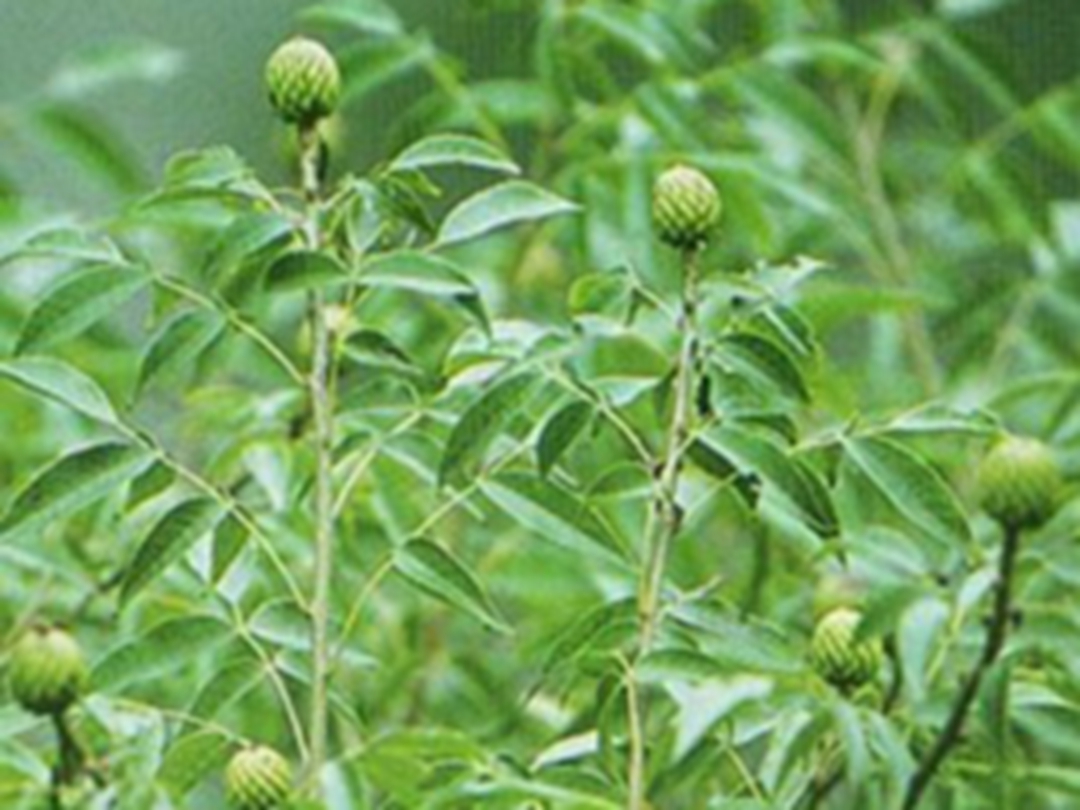
Leaves of Platycarya
Leaves of Platycarya strobilacea, a name in traditional Chinese medicine. These are the leaves of Platycarya strobilacea Sieb. et Zucc. or Platycarya longipes Wu., plants of the family Juglandaceae. They possess the efficacy of detoxifying, treating sores, killing parasites, and relieving itching.It is primarily used to treat boils, abscesses, and toxic swellings; bone abscesses with pus discharge; chronic tinea; scrotal eczema; and ringworm of the scalp.
Chinese Name : 化香树叶
Aliases : Mountain Willow Leaves, Small Fragrant Leaves
Nature, Flavor & Meridian Tropism : Pungent in taste, warm in nature. Enters the Heart and Spleen meridians
Benefits & Efficacy
Benefits
Detoxifies, treats sores, kills parasites, and relieves itching.
Indications
Mainly used to treat boils, abscesses, and toxic swellings; bone abscesses with pus discharge; stubborn tinea; scrotal eczema; and ringworm of the scalp.
Usage and Dosage
External use: Apply an appropriate amount, crushed into a paste; or soak in water for washing.
Precautions
1. This plant is toxic and must not be taken internally. 2. Patients requiring treatment with traditional Chinese medicine should first consult a licensed TCM hospital, where a TCM practitioner will conduct a professional pattern differentiation and prescribe an appropriate herbal formula. 3. Pregnant women, women planning to become pregnant, and breastfeeding women must proactively inform their doctor of their physiological status (e.g., stage of pregnancy, breastfeeding status, etc.) before using this medication, so that the doctor can assess its safety and suitability based on individual circumstances.
Chemical Constituents
The leaves of the fragrant tree contain juglone, 5-hydroxy-2-methoxy-1,4-naphthoquinone, 5-hydroxy-3-methoxy-1,4-naphthoquinone, p-coumaric acid methyl ester, p-coumaric acid, and coumarin.
Pharmacological Actions
The naphthoquinone compounds extracted from the leaves of the Huaxiang tree possess bactericidal properties and exhibit antimicrobial activity against pathogens such as Escherichia coli and Staphylococcus aureus.
Relevant Discussions
1. *Folk Medicines of Guizhou*: “Treats toxic sores.”
2. *Compendium of Fujian Medicinal Plants*: “Treats ringworm, eczema, and boils.”
Applications
Clinical Applications
1. For treating “Ba Gu Huang” (a bone abscess oozing pus that fails to heal over time and produces multiple bone fragments): 250 g of Huaxiang tree leaves. Pound them into a paste and soak in cold water. Immerse the affected area in the medicinal solution for several hours to dissolve the bone fragments; then use tweezers to remove them, and continue washing the area with the solution as needed.
2. For treating ringworm: 30 g of Hua Xiang tree leaves, 6 g of lime, and 1 cup of boiling water. Mix and steep for 2 hours. Dip a duck feather in the solution and apply it externally twice daily.
3. Treatment for acute inflammatory conditions such as boils, carbuncles, and furuncles: Equal parts of fresh leaves of the Fragrant Tree, Tripterygium wilfordii, celery, and garlic. Pound into a paste and apply externally. Do not use once the ulcer has ruptured.
Notes
References for this entry: 1. Encyclopedia of Traditional Chinese Medicine. 2. Chinese Materia Medica. 3. Zhang Nanfang, Yang Yanming, Xu Hongsheng, Shi Qiulin. Flora of Medicinal Plants in Xinzhou, Hubei. 2022. 4. Zhang Bingtian, Pan Qingping. Flora of Medicinal Plants in Hunan (Vol. 2). 2004.
Processing & Preparation
Harvesting & Processing
Harvest in summer or fall; use fresh or sun-dried.
Crude Drug Identification
Botanical Information
Botanical Classification
A species of the genus *Cinnamomum* in the family *Juglandaceae*, commonly known as the Cinnamomum tree or round-fruited Cinnamomum.
Morphological Characteristics
1. Fragrant Tree
A deciduous small tree, 2–6 m tall. The bark is grayish-brown and irregularly fissured longitudinally; the branches are dark brown with small lenticels; they are covered with bud scales in winter, and the pith is solid.
(1) Leaves: Odd-pinnate compound leaves, alternate, 15–30 cm long,with 7–23 leaflets, sessile, ovate-lanceolate to long-elliptic-lanceolate, thin and leathery, 4–11 cm long, 1.5–3.5 cm wide, unequal in size, slightly sickle-shaped, with a nearly rounded base that is slightly asymmetrical on one side, a long acuminate apex, and doubly serrate margins.
(2) Flowers: Unisexual or bisexual; monoecious; bisexual and male inflorescences are borne at the tips of twigs or in leaf axils, arranged in corymbose clusters, with the central one typically being a bisexual inflorescence, the male inflorescences above, and the female inflorescences below; male inflorescences are arranged around the bisexual inflorescence, usually numbering 3–8;Male floral bracts are broadly ovate, with an acuminate apex, curving outward; they lack small bracts and perianth segments, and bear 6–8 stamens with filaments of varying lengths;The female inflorescences are globose-ovate or oblong; the female bracts are ovate-lanceolate, with a long, acuminate apex, rigid but not outwardly curved; they lack bracteoles and bear two perianth segments that are adnate to both sides of the ovary and enlarge together with it. Flowering occurs from May to June.
(3) Fruit: The fruit cluster is cone-like, ovoid-elliptic to oblong-cylindrical, 2.5–5 cm long and 2–3 cm in diameter; the nutlets are flattened, with narrow wings on both sides. The seeds are ovate, with a membranous seed coat. Fruiting period: July–October.
2. Round-fruited Fragrant Tree
The round-fruited fragrant tree differs from the fragrant tree in that: the petiole is nearly as long as or longer than the rachis; there are 3–5 (–7) leaflets; and the fruit cluster is globose, 1.2–2 cm in diameter. Flowering occurs in May, and fruiting occurs from June to July.
Distribution Area
1. Fragrant Tree: Distributed in East China, southern Shaanxi, Taiwan, Henan, Hubei, Hunan, Sichuan, Guizhou, Yunnan, and other areas. 2. Round-fruited Fragrant Tree: Distributed in Guangdong, Guangxi, Guizhou, and other areas.