Lotus Flower, a name in traditional Chinese medicine. It refers to the flower buds of the lotus (Nelumbo nucifera Gaertn.), a plant in the Nymphaeaceae family. It has the effects of dispelling dampness and stopping bleeding. It is primarily used to treat hematemesis caused by trauma and pemphigus.
Lotus
Lotus Flower, a name in traditional Chinese medicine. It refers to the flower buds of the lotus (Nelumbo nucifera Gaertn.), a plant in the Nymphaeaceae family. It has the effects of dispelling dampness and stopping bleeding. It is primarily used to treat hematemesis caused by trauma and pemphigus.
Chinese Name : 莲花
Aliases : Hán Dàn, Lotus Flower, Water Flower, Hibiscus
Authentic Producing Area : Mainly produced in Hunan, Fujian, Jiangsu, and Zhejiang
Nature, Flavor & Meridian Tropism : Taste: bitter and sweet; nature: warm; enters the Spleen, Kidney, and Heart meridians
Benefits & Efficacy
Benefits
Dispels dampness and stops bleeding.
Indications
Mainly used to treat hematemesis caused by trauma and pemphigus.
Usage and Dosage
1. Internal use: Decoct 3–4.5 g in water. 2. External use: Apply an appropriate amount, crushed, to the affected area.
Precautions
Do not consume lotus seeds with crab or turtle meat to avoid certain adverse reactions.
Chemical Constituents
This product primarily contains luteolin, isoquercetin, naringin, naringin-3-galactosylglucose, and naringin-3-diglucoside.
Pharmacological Actions
This product has cholesterol-lowering effects.
Applications
Clinical Applications
1. For treating hematemesis due to falls or injuries, blood stasis from falls, and uncontrollable hematemesis from the heart or stomach: Grind dried lotus flowers into a powder; take approximately 1 gram each time, mixed with alcohol.
2. For treating blisters and moist sores: Apply lotus petals directly to the affected area.
3. For treating sores on the lips: Apply white lotus petals directly to the affected area.
Notes
Patients requiring treatment with Chinese herbal medicine should first consult a licensed Traditional Chinese Medicine (TCM) hospital, where a TCM practitioner will conduct a professional pattern differentiation and issue a herbal prescription.
Processing & Preparation
Harvesting & Processing
Harvest large flower buds that have not yet bloomed or flowers about to bloom between June and July, then dry them in the shade.
Processing Methods
Remove impurities and flower stalks, then sift out any dust or debris.
Storage Methods
Store in a well-ventilated, dry place, protected from insect infestation and moisture.
Crude Drug Identification
Properties of Crude Drugs
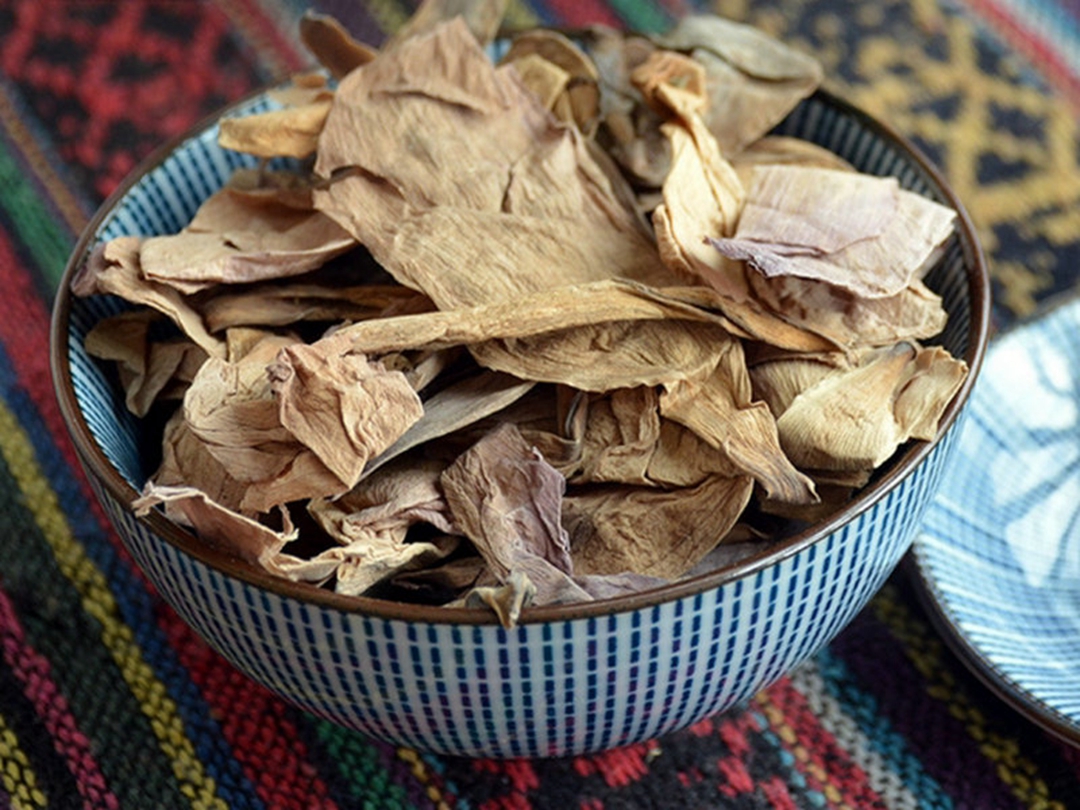
The flower buds are conical, 2.5–5 cm long and 2–3 cm in diameter. The surface is grayish-brown, and the petals are arranged in multiple layers. The scattered petals are ovate or elliptical, wrinkled or folded, with numerous fine veins on the surface; they are smooth and soft.After removing the petals, a small lotus pod is revealed at the center; it has a flat top with more than ten small pores on the surface, tapers gradually toward the base, and is surrounded by numerous stamens. It has a fragrant aroma and a slightly astringent taste.
Properties of Processed Slices
See “Characteristics of Medicinal Materials.”
Botanical Information
Botanical Classification
Nelumbo nobilis, a plant of the genus Nelumbo in the family Nymphaeaceae.
Morphological Characteristics
A perennial aquatic herb. The rhizome grows horizontally; it is thick with swollen internodes, containing numerous longitudinal air pores, and bears external fibrous adventitious roots.Leaves emerge from the nodes and rise above the water surface; the petiole is attached to the center of the leaf’s underside, is stout and cylindrical, and is covered with many spines; the leaf blade is round, 25–90 cm in diameter, with entire or slightly wavy margins; the upper surface is powdery green, while the lower surface features veins radiating from the center with 1–2 orders of forked branches. Flowers are solitary at the tip of the peduncle, which is as long as or slightly longer than the petiole and also bears scattered small spines;The flower is 10–20 cm in diameter, fragrant, and red, pink, or white; the petals are elliptical or obovate, 5–10 cm long and 3–5 cm wide; there are numerous stamens with linear anthers and slender filaments attached below the receptacle; there are numerous carpels buried within the swollen receptacle, with an elliptical ovary and an extremely short style.After flowering, it produces a “lotus pod” that is inversely conical, 5–10 cm in diameter, with 20–30 small openings, each containing a single fruit; the nut is elliptical or ovate, 1.5–2.5 cm long, with a leathery, hard pericarp that turns dark brown when ripe.The seeds are ovate or elliptical, 1.2–1.7 cm long, with a red or white seed coat. The flowering period is June–August, and the fruiting period is August–October.
Distribution Area
It is cultivated in provinces and regions throughout China, from north to south.
Growth Habits
It prefers a warm and humid climate and can be planted in still ponds, low-lying areas, or marshes connected to streams.
Propagation Methods
Propagation is by rhizomes.
Cultivation Techniques
Select small lotus roots with plump buds for planting. After draining and preparing the soil, dig trenches with a row spacing of 3–4 feet and a plant spacing of 2 feet. Plant the lotus roots in a straight line in the mud, with the buds facing upward, at a depth of 5–6 inches. Use stakes inserted on both sides of each lotus root to secure it and prevent it from floating after irrigation.After planting, flood the field to a depth of 1 foot. Once the leaves emerge above the water surface in 30–40 days, water as needed, but avoid flooding the field too deeply.
Pest and Disease Control
1. For the long-legged water leaf beetle, mix 30 kg of 40% ethion powder per hectare with 375 kg of fine soil, apply the mixture to the field surface, and then till it into the soil after adding shallow water.
2. For the lotus midge, spray a 1,000–1,500-fold dilution of 90% diazinon during the larval stage.