Mituoseng is the name of a traditional Chinese medicine. It consists of the residue deposited at the bottom of furnaces during the extraction of silver and lead from galena—a sulfide mineral in the galena group—or it may be a processed product derived from molten lead. There are many galena deposits in China, with the most famous locations including Changba in Gansu, Xietieshan in Qinghai, Shuikoushan in Hunan, Fan Kou in Guangdong, and Jinding in Yunnan.It has the effects of drying dampness, killing parasites, detoxifying, astringing, and preserving. It is primarily used to treat chronic, non-healing ulcers and sores, mouth ulcers, eczema, scabies, body odor, tinea versicolor, hyperpigmentation, rosacea, and burns and scalds.
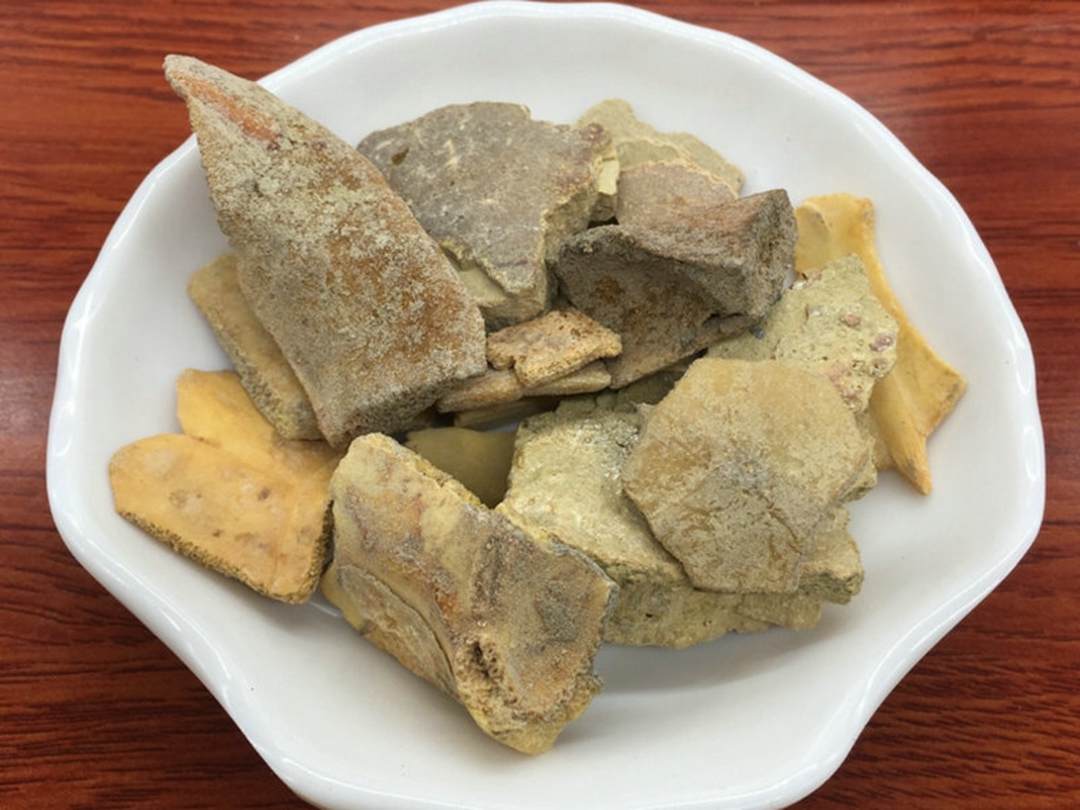
Mituoseng
Mituoseng is the name of a traditional Chinese medicine. It consists of the residue deposited at the bottom of furnaces during the extraction of silver and lead from galena—a sulfide mineral in the galena group—or it may be a processed product derived from molten lead. There are many galena deposits in China, with the most famous locations including Changba in Gansu, Xietieshan in Qinghai, Shuikoushan in Hunan, Fan Kou in Guangdong, and Jinding in Yunnan.It has the effects of drying dampness, killing parasites, detoxifying, astringing, and preserving. It is primarily used to treat chronic, non-healing ulcers and sores, mouth ulcers, eczema, scabies, body odor, tinea versicolor, hyperpigmentation, rosacea, and burns and scalds.
Chinese Name : 密陀僧
Aliases : Tuoseng, *Formulas for Universal Relief*; Mo Duoseng, *Newly Revised Materia Medica*; Ludidi, *Compendium of Materia Medica*; Yin Chi and Dan Yin, *Discourse on the Origin and Production of Medicinal Substances*; Jin Ludidi and Yin Ludidi, *Modern Practical Chinese Herbal Medicine*; Jin Tuoseng, *Chronicle of Chinese Herbal Medicine*
Nature, Flavor & Meridian Tropism : Taste: salty and pungent; nature: neutral. Enters the Liver and Spleen meridians
Benefits & Efficacy
Benefits
Dries dampness, kills parasites, detoxifies, astringes, and preserves.
Indications
Chronic, non-healing ulcers and sores; mouth ulcers; eczema; scabies and tinea; body odor; pityriasis versicolor; hyperpigmentation; rosacea; burns and scalds.
Usage and Dosage
Internal use: Grind into powder, 0.2–0.5 g; or incorporate into pills or powders. External use: Apply an appropriate amount as a powder (sprinkled or mixed with a carrier); or formulate into plasters, ointments, or oils.
Precautions
This product is primarily for external use; long-term or excessive use may lead to lead poisoning. Internal use should be approached with caution; do not exceed the recommended dosage or use for more than one week. Contraindicated for individuals with weakened constitutions, pregnant women, and children.
Pharmacological Actions
1. Antibacterial effect. 2. Anti-inflammatory effect. 3. Astringent effect.
Relevant Discussions
*Ben Cao Yan Yi* states: “Mituoseng is hard and heavy; those that, when crushed, reveal a golden color are of superior quality.”
Applications
Clinical Applications
1. Treatment of neurodermatitis.
2. Prevention and treatment of rice-paddy dermatitis.
3. Treatment of burns.
Related Compatibility
1. For treating abscesses and swellings where, after lancing, the pus and exudate have subsided but the tissue has not regenerated: 1.5 liang of Mitosang, 1 liang of Coptis (with the stalks removed), and 0.3 fen of Areca nut. Pound the ingredients into a fine powder. Apply three times daily. (*Shenghui Fang*)
2. For various sores that have not healed for a long time: 1 liang each of calcined Mithridate, calcined Huarui Stone, and white dragon bone; 1 qian each of frankincense and mercury oxide. Grind into a fine powder and mix evenly. Apply dry. (Pingji Powder, *Zhengzhi Zhunsheng: Yao Yi*)
3. For treating sores caused by prolonged sitting on a hard surface, characterized by swelling, pain, and excessive pus: equal parts of Mithridate (calcined), raw alum, and rhubarb. Grind into an extremely fine powder and apply topically. (*Jingyue Quanshu*)
4. For treating all types of heat-toxin sores and lower-body ulcers: take one and a half fen each of Mithridate and Phellodendron bark, one qian of talcum powder, and a small amount of musk. First wash the sore, pat it dry, and apply the mixture; for severe cases, repeat three or four times. (*Zhengzhi Zhunsheng: Sores and Ulcers*)
Processing & Preparation
Harvesting & Processing
The traditional method involves melting lead and rotating an iron rod several times within the molten lead so that some of the molten lead adheres to it. The iron rod is then removed and immersed in cold water; once the molten lead cools, it forms mitosang. This process is repeated multiple times; when a sufficient quantity of mitosang has accumulated, it is tapped off to obtain the final product.The modern method involves placing lead oxide in an iron pot and smelting it over a high flame. When the temperature rises above 400°C, some of the oxygen in the lead oxide is released, forming mitoseng. Allow it to cool, then remove it.
Processing Methods
Take the raw herbal material, remove impurities, and grind it into a fine powder.
Storage Methods
Store in a dry container in a dry place; keep tightly sealed to protect against moisture and dust.
Crude Drug Identification
Identification
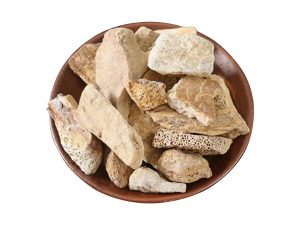
~I. Appearance of the Medicinal Material: This product consists of irregular lumps; some are thick plates, with one side slightly convex and the other slightly curved; it is golden yellow or pale grayish-yellow with a greenish tint; the streak is pale yellow. The outer surface is rough but often flakes off to reveal a relatively smooth surface that shimmers when held up to the light.Heavy in weight, hard and brittle; can be crushed; the fracture surface is uneven with distinct layered striations that can be peeled off layer by layer; exhibits a silvery-star-like luster. This product is practically insoluble in water, readily soluble in nitric acid, and also dissolves in acetic acid; when exposed to air, it slowly absorbs carbon dioxide and transforms into basic lead carbonate. It has a faint odor.The best quality specimens are yellow, lustrous, consistent in appearance both inside and out, heavy, and hard yet brittle. ~II. Characteristics of the Prepared Herb: Mitong is a yellow or brownish-yellow powder that exhibits a white metallic sheen when exposed to sunlight. It is heavy. It has a faint odor and a bland taste. ~
Properties of Crude Drugs
1. Shape of the Raw Herb: This product consists of irregular lumps; some are thick plate-like, with one side slightly convex and the other slightly curved. It is golden yellow or pale grayish-yellow with a greenish tint; the streak is pale yellow. The outer surface is rough and often flakes off to reveal a relatively smooth surface that shimmers when held up to the light. It is heavy, hard, and brittle; it can be crushed, and the fracture surface is uneven with distinct layered striations that can be peeled off layer by layer;with a silvery-star-like luster. This product is practically insoluble in water, readily soluble in nitric acid, and also dissolves in acetic acid; when exposed to air, it slowly absorbs carbon dioxide and transforms into basic lead carbonate. It has a faint odor. The best quality specimens are yellow in color, lustrous, consistent in appearance both inside and out, heavy, and hard yet brittle.
2. Characteristics of the Herbal Preparation: Mitong is a yellow or brownish-yellow powder that exhibits a white metallic sheen when exposed to sunlight. It is heavy. It has a faint odor and a bland taste.
Botanical Information
Morphological Characteristics
Its crystal structure belongs to the isometric system. It has the m3m symmetry and typically forms cubic crystals, though it sometimes appears as aggregates of octahedra and cubes. It usually occurs as granular or dense massive aggregates. It is lead-gray in color with a gray-black streak and a metallic luster. Its hardness is 2–3; it exhibits three sets of perfect cleavage parallel to the crystal axes. Its relative density is 7.4–7.6. It possesses weak electrical conductivity and good detection properties.
Distribution Area
There are many galena deposits in China, the most famous of which are located in Changba (Gansu), Xitieshan (Qinghai), Shuikoushan (Hunan), Fan Kou (Guangdong), and Jinding (Yunnan).