Morel, a name in traditional Chinese medicine. It refers to the fruiting bodies of fungi in the Morchellaceae family, including Morchella esculenta (L.) Pers., Morchella angusticeps Peck., Morchella conica Pers., Morchella crassipes (Vent.) Pers., and Morchella delicioosa Fr., among others.Morchella is distributed in Jilin, Hebei, Shanxi, Shaanxi, Gansu, Qinghai, Xinjiang, Jiangsu, Sichuan, Yunnan, and other regions. Morchella angusticeps is found in Inner Mongolia, Shanxi, Qinghai, Sichuan, Yunnan, Tibet, and other regions. Morchella conica is distributed in Hebei, Shanxi, Gansu, Xinjiang, Jiangsu, Hunan, Yunnan, and other regions. Morchella crassipes is found in Heilongjiang, Shanxi, Xinjiang, and other regions.The small morel is found in Shanxi, Shaanxi, Ningxia, Xinjiang, Sichuan, and other regions. It aids digestion, soothes the stomach, resolves phlegm, and regulates qi. It is commonly used to treat indigestion and coughs with excessive phlegm.

Morel
Morel, a name in traditional Chinese medicine. It refers to the fruiting bodies of fungi in the Morchellaceae family, including Morchella esculenta (L.) Pers., Morchella angusticeps Peck., Morchella conica Pers., Morchella crassipes (Vent.) Pers., and Morchella delicioosa Fr., among others.Morchella is distributed in Jilin, Hebei, Shanxi, Shaanxi, Gansu, Qinghai, Xinjiang, Jiangsu, Sichuan, Yunnan, and other regions. Morchella angusticeps is found in Inner Mongolia, Shanxi, Qinghai, Sichuan, Yunnan, Tibet, and other regions. Morchella conica is distributed in Hebei, Shanxi, Gansu, Xinjiang, Jiangsu, Hunan, Yunnan, and other regions. Morchella crassipes is found in Heilongjiang, Shanxi, Xinjiang, and other regions.The small morel is found in Shanxi, Shaanxi, Ningxia, Xinjiang, Sichuan, and other regions. It aids digestion, soothes the stomach, resolves phlegm, and regulates qi. It is commonly used to treat indigestion and coughs with excessive phlegm.
Chinese Name : 羊肚菌
Latin Name : Morchella esculenta (L.) Pers.
Aliases : Sheep’s Stomach Mushroom, Sheep’s Stomach Fungus, Straw Hat Mushroom
Authentic Producing Area : Jilin, Hebei, Shanxi, Shaanxi, Gansu, and other regions
Nature, Flavor & Meridian Tropism : Sweet in taste, neutral in nature. Enters the Spleen and Stomach meridians
Benefits & Efficacy
Benefits
Aids digestion and harmonizes the stomach; resolves phlegm and regulates qi.
Indications
Indigestion, cough with excessive phlegm.
Usage and Dosage
Internal use: Decoct 30–60 g.
Precautions
1. Before consumption, thoroughly rinse off the spores attached to the fruiting body. 2. *Chinese Medicinal Mycology*: “The spores on the fruiting bodies of the Morchella genus are toxic; the gelatinous toxin they contain can damage the liver, kidneys, and nervous system. Therefore, before consumption, thoroughly rinse off the spores attached to the fruiting body.”
Pharmacological Actions
Inhibits platelet aggregation.
Relevant Discussions
Liu Bo, *Medicinal Fungi of China*: “Beneficial to the stomach and intestines; resolves phlegm and regulates qi. Treats indigestion, excessive phlegm, and shortness of breath.”
Applications
Related Compatibility
For indigestion, excessive phlegm, and shortness of breath: Boil 60 g of dried morel mushrooms and consume the broth twice daily. (*Manual on the Edible and Medicinal Uses of Wild Vegetables*)
Notes
This fungus has various health benefits, including promoting human growth and development, boosting the immune system, enhancing hematopoiesis, and improving cognitive function and skin health.
Processing & Preparation
Harvesting & Processing
At the turn of spring and summer, after harvesting, wash away the soil from the base of the stem, sun-dry, and set aside for later use.
Crude Drug Identification
Properties of Crude Drugs
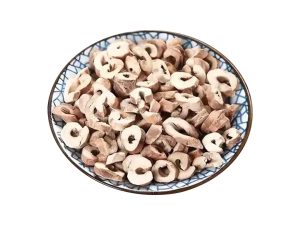
1. Morel: The cap is elliptical or ovoid, with a blunt, rounded apex, 4–8 cm long and 3–6 cm in diameter. The surface features numerous small pits, giving it an appearance resembling a sheep’s stomach. The pits are irregular or circular in shape, brownish-red in color, 4–12 mm in diameter, with yellowish-brown ridges.The stem is nearly cylindrical, 5.5–8 cm long and 2–4 cm in diameter, off-white in color, slightly swollen at the base, sometimes with irregular grooves, and hollow. It is light in weight and crisp in texture. It has a faint odor and a mild, slightly sour and astringent taste.2. Small-capped Morel: The cap is narrowly conical with a slightly pointed tip, 1–4 cm long and approximately 2.5 cm in diameter; the pits are mostly rectangular in shape, 5–10 mm long and 2–5 mm in diameter, light brown in color, with darker-colored ridges. The stem is nearly cylindrical and hollow. The fruiting body is light and crisp in texture. It has a faint odor and a mild taste.3. Pointed Morel: The cap is subconical, with a pointed or relatively pointed apex, approximately 4 cm long and 2 cm in diameter; the pits are mostly oblong, light brown, with lighter-colored ridges. The stem is yellowish-white, sometimes with irregular grooves on the lower part, and hollow. The fruiting body is light and brittle. It has a faint aroma and a mild flavor.4. Thick-Stemmed Morel: The cap is conical, approximately 6 cm long and 4 cm in diameter; the pits are circular, large and relatively shallow, pale yellow, with faint ridges. The stem is stout, about 10 cm long, tapering gradually toward the top, with a swollen base approximately 5 cm in diameter.It is nearly white, with a longitudinally wrinkled surface forming twisted longitudinal stripes, and is hollow. The body is light and brittle. It has a faint odor and a mild taste. 5. Small Morel: The cap is subconical, 1.7–3.3 cm long and 1–1.5 cm in diameter;the small pits are mostly rectangular in shape, light brown in color, with lighter-colored ridges. The stem is 1.5–2.5 cm long and 5–8 mm in diameter, swollen at the base, slightly grooved, and hollow. It is off-white or pale yellow. The fruiting body is light and crisp. It has a faint odor and a mild taste.
Botanical Information
Botanical Classification
Morchella genus of the Morchellaceae family: Morchella, Small-capped Morchella, Pointed-capped Morchella, Thick-stemmed Morchella, and Dwarf Morchella.
Morphological Characteristics
1. Morel: The cap is nearly spherical, ovate, or elliptical, 4–10 cm tall and 3–6 cm wide, with a bluntly rounded apex and a surface featuring pits resembling a sheep’s stomach. The pits are irregular to nearly circular, 4–12 mm wide, eggshell-colored to pale yellowish-brown, with lighter-colored ridges that intersect irregularly.The stem is nearly cylindrical, nearly white, hollow, smooth toward the top, and swollen at the base with irregular shallow grooves; it is 5–7 cm long and approximately two-thirds as thick as the cap. The asci are cylindrical, measuring (280–320) μm × (18–22) μm. The spores are oblong, colorless, and arranged in a single row of eight per ascus.The tips of the paraphyses are swollen, reaching a thickness of up to 12 μm. 2. Small-capped Morel: The cap is narrowly conical with a pointed apex, 2–5 cm tall. The base is 1.7–3.3 cm wide, with mostly rectangular pits, and is eggshell-colored. The ridges are black, arranged longitudinally, and connected by transverse veins.The stem is milky white, nearly cylindrical, 3–5 cm long, and 11–20 mm thick, with a flat upper part and a slightly grooved base. Ascospores measure (210–250) μm × (15–20) μm. Spores are arranged in a single row, measuring (22–26) μm × (12–14) μm; the tips of the paraphyses are swollen, reaching a diameter of 11 μm.3. Pointed Morel: The cap is long, nearly conical, with a pointed or slightly pointed apex, up to 5 cm long and up to 2.5 cm in diameter. The pits are mostly rectangular, light brown; the ridges are lighter in color, mostly arranged longitudinally, and connected by transverse veins. The stem is white, up to 6 cm long, with a diameter approximately equal to two-thirds of the cap’s base; the upper part is flat, and the lower part has irregular grooves.Asci: (250–300) μm × (17–20) μm; spores arranged in a single row, (20–24) μm × (12–15) μm. Paraphyses are swollen at the tips, with a diameter of 9–12 μm.4. Thick-stemmed Morel: The cap is nearly conical, approximately 7 cm tall and 5 cm wide. The depression is nearly circular, large and shallow, pale yellow, with faint, irregularly interwoven ridges. The stem is stout, pale yellow, about 10 cm long, 5 cm in diameter at the base, slightly grooved, and tapering upward.The ascus is cylindrical, with the spore-bearing portion measuring 150 × 18 μm. There are 8 spores arranged in a single row; they are elliptical, colorless, and measure (22–25) μm × (15–17) μm. The paraphyses are colorless and swollen at the tips.5. Small Morel: The cap is conical to nearly conical, 17–33 mm tall and 8–15 mm wide. The pits are often elongated and light brown. The ridges are usually arranged longitudinally, intersecting irregularly, and are lighter in color than the pits.The stem is 15–25 mm long and 5–8 mm thick, nearly white or pale yellow; the base is often swollen and grooved. The asci are nearly cylindrical; the spore-bearing portion measures approximately 100 × 16 μm; spores are arranged in a single row, elliptical, (18–20) μm × (10–11) μm. The paraphyses are swollen at the tips.
Distribution Area
1. Morel: Found in Jilin, Hebei, Shanxi, Shaanxi, Gansu, Qinghai, Xinjiang, Jiangsu, Sichuan, Yunnan, and other regions. 2. Small-capped Morel: Found in Inner Mongolia, Shanxi, Qinghai, Sichuan, Yunnan, Tibet, and other regions. 3. Pointed-capped Morel: Found in Hebei, Shanxi, Gansu, Xinjiang, Jiangsu, Hunan, Yunnan, and other regions.4. Thick-stemmed Morel: Grows after rain in late spring and early summer. Found in Heilongjiang, Shanxi, Xinjiang, and other regions. 5. Dwarf Morel: Found in Shanxi, Shaanxi, Ningxia, Xinjiang, Sichuan, and other regions.