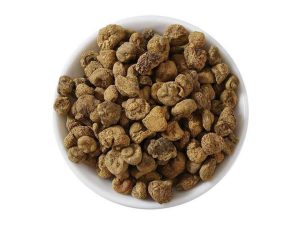
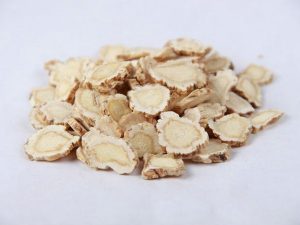
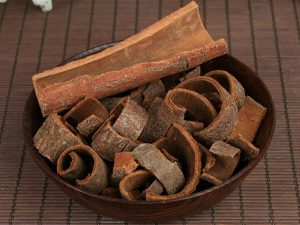
Niuteng Fruit is the name of a traditional Chinese medicine. It is the fruit of the plants Stauntonia hexaphylla Decne. or S. hexaphylla Decne. var. urophylla Hand.-Mazz., both belonging to the Lardizabalaceae family. Stauntonia hexaphylla is distributed in Taiwan, Guangdong, Guangxi, and other regions; S. hexaphylla var. urophylla is distributed in Zhejiang, Jiangxi, Fujian, Hunan, Guangdong, Guangxi, and other regions. It has the effects of detoxifying, reducing swelling, killing parasites, and relieving pain.It is primarily used to treat boils, hernia pain, ascariasis, and trichuriasis.

Niuteng Fruit
Niuteng Fruit is the name of a traditional Chinese medicine. It is the fruit of the plants Stauntonia hexaphylla Decne. or S. hexaphylla Decne. var. urophylla Hand.-Mazz., both belonging to the Lardizabalaceae family. Stauntonia hexaphylla is distributed in Taiwan, Guangdong, Guangxi, and other regions; S. hexaphylla var. urophylla is distributed in Zhejiang, Jiangxi, Fujian, Hunan, Guangdong, Guangxi, and other regions. It has the effects of detoxifying, reducing swelling, killing parasites, and relieving pain.It is primarily used to treat boils, hernia pain, ascariasis, and trichuriasis.
Chinese Name : 牛藤果
Nature, Flavor & Meridian Tropism : Bitter in taste, cold in nature
Benefits & Efficacy
Benefits
Detoxifies, reduces swelling, kills parasites, and relieves pain.
Indications
It is primarily used to treat boils, hernia pain, ascariasis, trichuriasis, and other conditions.
Usage and Dosage
Niuteng fruit can be used both internally and externally. 1. Internal use: Decoct 6–12 g in water. 2. External use: Apply an appropriate amount of fresh, crushed fruit as a poultice. It is important to note that due to differences in each patient’s condition, constitution, age, and other factors, the specific dosage and method of use for Niuteng fruit may vary from person to person. Patients should strictly follow the doctor’s prescription when using this product.
Precautions
1. Patients requiring treatment with traditional Chinese medicine should first consult a licensed TCM hospital, where a TCM practitioner will conduct a professional pattern differentiation and issue a prescription. 2. If you need to take other medications concurrently during treatment, consult your doctor or pharmacist first. Do not take any medications on your own to avoid drug interactions that could reduce efficacy or increase the risk of adverse reactions. 3. Pregnant women, women planning to become pregnant, and breastfeeding women must proactively inform their doctor of their physiological status (such as stage of pregnancy or breastfeeding status) before taking this medication, so that the doctor can assess the safety and suitability of the medication based on their individual circumstances.
Pharmacological Actions
Modern pharmacological research has found that the fruit and kernels have anthelmintic effects against roundworms and whipworms.
Applications
Notes
References for this entry: [1] Editorial Committee of *Chinese Materia Medica*, State Administration of Traditional Chinese Medicine. *Chinese Materia Medica* [M]. Shanghai: Shanghai Science and Technology Press, 1999.
Processing & Preparation
Harvesting & Processing
Harvest the fruits in autumn when they are nearly ripe but still green; use them fresh or sun-dry them.
Crude Drug Identification
Botanical Information
Botanical Classification
A plant of the family Lardizabalaceae, specifically *Naten* or *Tail-leaf Naten*.
Morphological Characteristics
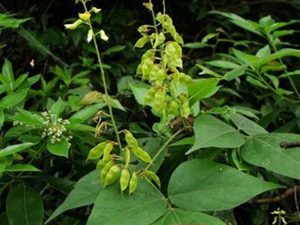
1. Na-teng: An evergreen vine. Palmate compound leaves are alternate; petioles are long; there are 3–7 leaflets, with petiolules 3 cm long; leaflets are oblong to oblong-ovate, leathery, with a short acuminate apex and a rounded base, 4–9 cm long and 2–2.5 cm wide, entire-margined, smooth on the upper surface, and whitish on the lower surface.Racemose or umbellate inflorescences consist of 3–7 flowers; the plant is monoecious; flowers are 1.5–2 cm in diameter, white, pale red, or with a bluish-purple halo;Male flowers have an outer whorl of 3 sepals, broadly lanceolate, about 13 mm long; an inner whorl of 3 sepals, linear, slightly longer; and 6 stamens; female flowers are larger but fewer in number, with an inner whorl of 3 sepals, lanceolate and shorter than those of the outer whorl, 6 rudimentary stamens, and mature ovaries that are ovate and purple.The berries are ovoid, red, 6–7 cm long, with white flesh and containing numerous black seeds. Flowering occurs in May, and fruiting in September–October.
2. Tail-leaved Liana: A climbing shrub. The entire plant is glabrous. Twigs are grayish-brown. Leaves are palmately compound; leaflets number 3–7 and are leathery;leaf shapes vary greatly, ranging from obovate to oblong-oblanceolate, 3.8–8 cm long and 1–3 cm wide, with a long, tail-like apex; the apex often bears a short, easily breakable filiform tip; the base is broadly cuneate or nearly rounded; the upper surface is bright green, the lower surface is yellowish-green, sometimes with white spots; lateral veins and reticulate veins are often distinctly sunken on the upper surface and slightly raised on the lower surface.Flowers are monoecious, often arranged in loose racemes; the raceme peduncle is 3–8 cm long, and the florets’ pedicels are 1–3 cm long; male flowers have 6 sepals: the outer whorl consists of 3 oblong-lanceolate sepals with slightly acute or obtuse apices, while the inner whorl is smaller and narrower, with linear-lanceolate sepals and obtuse apices;no petals; 6 stamens, with filaments completely fused; the anther connective has a convex tip about 1 mm long, much shorter than the anther; the sepals of the female flowers are similar to those of the male flowers but larger, with 3 carpels. The berry is ovoid, containing several glossy black seeds. Flowering period: March–May.
Distribution Area
1. Naten: Found in Taiwan, Guangdong, Guangxi, and other areas. 2. Tail-leaved Naten: Found in Zhejiang, Jiangxi, Fujian, Hunan, Guangdong, Guangxi, and other areas.