Mulberry Bark (Sangbai Pi) is the name of a traditional Chinese medicine. It is the root bark of Morus alba L., a plant of the genus Morus in the Moraceae family. It has the effects of clearing lung heat, relieving wheezing, promoting diuresis, and reducing edema. It is primarily used to treat cough and wheezing due to lung heat, edema with abdominal distension and scant urination, and swelling of the face, eyes, and skin.

Mulberry Bark
Mulberry Bark (Sangbai Pi) is the name of a traditional Chinese medicine. It is the root bark of Morus alba L., a plant of the genus Morus in the Moraceae family. It has the effects of clearing lung heat, relieving wheezing, promoting diuresis, and reducing edema. It is primarily used to treat cough and wheezing due to lung heat, edema with abdominal distension and scant urination, and swelling of the face, eyes, and skin.
Chinese Name : 桑白皮
Latin Name : Mori Cortex
Aliases : White Mulberry Root Bark, White Mulberry Bark, Mulberry Bark, Mulberry Root Bark
Authentic Producing Area : Mainly produced in Anhui, Henan, Zhejiang, Jiangsu, Hunan, and other regions.
Nature, Flavor & Meridian Tropism : Sweet in taste, cold in nature; enters the Lung meridian
Benefits & Efficacy
Benefits
Drains the lungs and relieves wheezing; promotes diuresis and reduces swelling.
Indications
Lung heat with wheezing and cough; edema with distension and scanty urine; swelling of the face, eyes, and skin.
Usage and Dosage
1. Internal use: Decoct 9–15 g; or incorporate into a powdered formula. 2. External use: Apply an appropriate amount of pounded juice or wash with a decoction.
Precautions
Contraindicated in cases of lung deficiency without internal heat, frequent urination, or coughs caused by wind-cold. 1. *Collected Notes on the Classic of Materia Medica*: Combines well with Dipsacus astragalus, Cinnamomum cassia, and dry hemp stalks. 2. *Commentary on the Classic of Materia Medica*: Do not use in cases of lung deficiency without internal heat where a cough is triggered by an invasion of cold. 3. *Compatible Materia Medica*: Contraindicated in cases of lung deficiency with frequent urination.
Chemical Constituents
It primarily contains flavonoids (morusin, cyclomorusin, moronone, morusone, morusene, cyclomorusone, cyclomorusene, cyclomorusol, morusoside A–D,moruscharone A, morusone, etc.), coumarin compounds (umbelliferone, scopolin, scopolinone, etc.), as well as polysaccharides, tannins, and essential oils.
Pharmacological Actions
This product has a mild antitussive effect and acts as a diuretic, increasing urine output as well as the excretion of sodium, potassium, and chloride; decoctions and extracts prepared with ethanol, diethyl ether, and methanol exhibit varying degrees of antihypertensive effects; it exerts sedative, tranquilizing, anticonvulsant, analgesic, and antipyretic effects on the nervous system; and it has a stimulating effect on the intestines and uterus.The decoction exhibits inhibitory effects against Staphylococcus aureus, Salmonella typhi, and Shigella species. This product inhibits cervical cancer cells (JTC-26) and lung cancer cells; recent studies have also indicated that it possesses anti-HIV activity.
Relevant Discussions
1. *Treatise on the Nature of Medicinal Substances*: “Treats lung-related shortness of breath and fullness, edema caused by water retention; primarily treats injury and collapse; promotes urination; eliminates water retention; addresses consumptive diseases with external heat; relieves headaches; and internally replenishes deficiencies.”
2. *Compendium of Materia Medica*: “Mulberry bark excels at promoting urination; when there is excess, it also acts as a laxative. Therefore, it is suitable for those with water retention in the lungs or excess lung fire.”
Applications
Clinical Applications
1. To treat cough and wheezing due to lung heat, combine with Lycium bark (Diguipi), as in the Xie Bai San formula (*Direct Decisions on Pediatric Medicinal Syndromes*).
2. To treat fluid retention in the lungs causing distension, fullness, and shortness of breath, it is combined with herbs that disperse the lungs and expel fluid, such as Ephedra, Apricot Kernel, and Corn Silk.
3. To treat cough, wheezing, shortness of breath, tidal fever, and night sweats caused by heat in a context of lung deficiency, it can also be combined with tonifying herbs such as Ginseng, Schisandra, and Prepared Rehmannia, as in the Lung-Tonifying Decoction (*Yonglei Qianfang*).
4. To treat generalized edema, swelling of the face, eyes, and skin, distension, shortness of breath, and scanty urination, it is combined with Poria peel, Areca nut peel, and Tangerine peel, as in the Five-Peel Powder (from *The Classic of the Middle Jiao*).
Related Compatibility
1. Mulberry Bark Combined with Lycium Bark: Mulberry Bark acts on the Qi level, primarily to clear lung heat and relieve wheezing; Lycium Bark clears and drains lung heat, cools the blood, and alleviates night sweats. When used together, these two herbs work synergistically to clear lung heat, stop coughing, and relieve wheezing. They clear lung heat without damaging Yin and protect Yin fluids without allowing pathogens to linger. This combination is suitable for conditions characterized by lung heat with coughing and wheezing, copious thick and sticky phlegm, fever, and thirst;It also treats yin deficiency with excessive fire, characterized by coughing and wheezing accompanied by restlessness and heat in the palms and soles.
2. White Mulberry Bark combined with Poria Bark: White Mulberry Bark is sweet and cold, excelling at clearing lung heat, relieving wheezing, promoting diuresis, and reducing edema; Poria Bark is sweet, bland, and neutral, excelling at promoting diuresis, draining dampness, and reducing edema. When combined, the diuretic and edema-reducing effects are enhanced, making this combination suitable for conditions such as edema and difficulty urinating.
Medicinal Identification
1. Mulberry Bark and Cornflower Seeds: Both can clear lung heat, relieve asthma, promote diuresis, and reduce edema; they are both used to treat lung heat, fluid retention in the lungs, phlegm-retention-induced cough and wheezing, and edema, and are often used in combination. However, Mulberry Bark is sweet and cold, with a relatively mild nature; it excels at clearing lung heat and subduing lung fire, and is frequently used for lung-heat-induced cough and wheezing, yellow phlegm, and cutaneous edema;Tingli Seeds are bitter, pungent, and extremely cold in nature, with a potent and vigorous action. They focus on draining dampness and phlegm from the lungs and are particularly suitable for patients with severe pathogenic factors causing wheezing and chest fullness that prevents lying down. Their diuretic effect is even stronger, making them effective for treating abdominal distension and fluid accumulation in the chest and abdomen.
2. Mulberry Bark and Plantain Seed: Both are sweet and cold in nature and enter the Lung Meridian. They function to clear lung heat, resolve phlegm, promote diuresis, and reduce swelling, and can both treat lung-heat cough, edema, and difficulty urinating. However, Mulberry Bark drains the lungs to relieve wheezing and promotes diuresis to reduce swelling, with a focus on the upper source of fluid retention; it is commonly used for lung-heat phlegm-induced wheezing and wind-water syndrome characterized by swelling of the head and face;Plantain Seed (Cheqianzi), with its slippery and lubricating nature, focuses on promoting diuresis through the lower orifices and is frequently used for conditions such as difficulty urinating, dribbling, and painful urination caused by damp-heat descending into the bladder.
Related Medicines
Xie Bai Syrup, She Ma Oral Solution, Zhi Sou Qing Guo Pills (Oral Solution), Bai Ke Jing Syrup, Ling Yang Qing Fei Granules (Pills).
Related Prescriptions
Xie Bai Powder (*Direct Decisions on Pediatric Medicines and Syndromes*), Bu Fei Decoction (*Yun Qi Zi’s Collection of Life-Preserving Formulas*), Wu Pi Decoction (*Classic of the Central Viscera*), and Modified Xie Bai Powder (*Comprehensive Book of Surgical Diagnosis and Treatment*).
Medicinal Diet Therapy
Donkey-Hide Gelatin and White Mulberry Bark Porridge:
1. Effects: Nourishes blood, improves vision, and clears and dries the lungs. Suitable for chronic cough due to blood and yin deficiency, as well as symptoms such as hemoptysis, metrorrhagia, and hematochezia.
2. Ingredients: 15 grams each of donkey-hide gelatin and white mulberry bark, 100 grams of glutinous rice, and 8 grams of brown sugar.
3. Preparation: Decoct the mulberry bark twice in water, strain out the residue, and reserve the liquid. Rinse the glutinous rice thoroughly, place it in a pot, add water, and boil for 10 minutes. Pour in the herbal decoction and donkey-hide gelatin. Once the porridge is cooked, add the brown sugar and stir until well mixed.
4. Usage: Take twice daily, on an empty stomach in the morning and evening.
Notes
Patients requiring treatment with traditional Chinese medicine should first consult a licensed TCM hospital, where a TCM practitioner will conduct a professional pattern differentiation and issue a prescription.
Processing & Preparation
Harvesting & Processing
Dig up the roots from late autumn when the leaves fall until just before bud break the following spring. Scrape off the yellowish-brown coarse bark, split the root lengthwise, peel off the root bark, sun-dry it, cut it into strips, and use it raw or honey-fried.
Processing Methods
1. Mulberry Bark: Take the raw herb, remove the coarse outer bark, rinse quickly under running water (avoid prolonged soaking), drain, air-dry briefly, cut into strips, and dry thoroughly.
2. Roasted Mulberry Bark: Place mulberry bark strips in a pan and roast over low heat until yellow or slightly charred; remove and allow to cool.
3. Honey-fried Mulberry Bark: Take refined honey, dilute it with an appropriate amount of boiling water, add the cleaned mulberry bark strips, mix thoroughly until thoroughly moistened, place in a pan, and heat over low heat until it no longer sticks to the hands; remove and let cool. Use 30 kg of refined honey for every 100 kg of mulberry bark.
Storage Methods
Store in a dry container; keep the honey-processed mulberry bark tightly sealed and place in a cool, dry place.
Crude Drug Identification
Identification
1. Cross-section of this product: The phloem rays are 2–6 cell rows wide; lactiferous vessels are scattered; fibers are present singly or in bundles, non-lignified or slightly lignified; parenchyma cells contain starch granules, and some cells contain calcium oxalate rhomboids. In older root bark, clusters of thick-walled cells interspersed with stone cells are present, with most cell cavities containing rhomboids.
The powder is pale grayish-yellow. Fibers are abundant, mostly fragmented, with a diameter of 13–26 μm; their walls are thick, non-lignified to slightly lignified. Calcium oxalate crystals measure 11–32 μm in diameter. Stone cells are subcircular, subsquare, or irregular in shape, with a diameter of 22–52 μm; their walls are relatively thick or extremely thick, with distinct pits and pit canals; some cell cavities contain crystals.There are also crystal-containing thick-walled cells. Starch granules are very numerous; single granules are subcircular, 4–16 μm in diameter; compound granules consist of 2–8 subgranules.
2. Take 2 g of the powdered sample, add 20 mL of saturated sodium carbonate solution, subject to ultrasonic treatment for 20 minutes,filter; adjust the pH of the filtrate to 1–2 with dilute hydrochloric acid, let stand for 30 minutes, filter again, and extract the filtrate twice with ethyl acetate (10 mL each time); combine the ethyl acetate extracts, evaporate to dryness, and dissolve the residue in 1 mL of methanol to prepare the test solution.Separately, take 2 g of Mulberry Bark (Sangbaipi) reference material and prepare a reference material solution using the same method. Test by thin-layer chromatography (General Rules 0502): pipette 5 μl of each of the two solutions and spot them separately onto the same polyamide membrane. Develop with acetic acid for approximately 10 cm, remove the plate, allow it to air-dry, and examine under ultraviolet light (365 nm).In the test sample chromatogram, two identical main fluorescent spots appear at positions corresponding to those in the reference herbal material chromatogram.
Properties of Crude Drugs
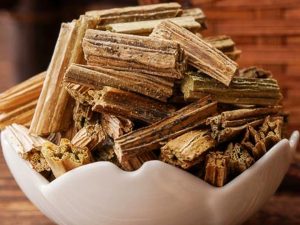
The root bark is twisted into a cylindrical, grooved, or plate-like shape, varying in length, width, and thickness, with a thickness of 1–4 mm. The outer surface is white or pale yellowish-white and relatively flat; some specimens retain orange-yellow or brownish-yellow scaly rough bark. The inner surface is yellowish-white or grayish-yellow with fine longitudinal striations.It is light in weight, tough in texture, and highly fibrous; it is difficult to break but tears easily lengthwise, releasing a cloud of fine dust when torn. It has a faint odor and a slightly sweet taste.
Properties of Processed Slices
1. Mulberry Bark (Sang Baipi): Filamentous, 3–5 mm wide, with a white or pale yellow, flat outer surface; the inner surface is yellowish-white or pale yellow with fine longitudinal striations. It is tough and highly fibrous; powder is released when torn. It has a faint odor and a slightly sweet taste.
2. Roasted Mulberry Bark: Yellow or deep yellow in color, with scorched spots.
3. Honey-Fried Mulberry Bark: Deep yellow in color, moist in texture, with a slight sheen, and a sweet taste.
Botanical Information
Botanical Classification
Morus alba, a plant of the genus Morus in the family Moraceae.
Morphological Characteristics
A deciduous shrub or small tree, 3–15 m tall. The bark is grayish-white with shallow, striated fissures; the root bark is yellowish-brown or reddish-yellow and highly fibrous. Simple leaves are alternate; petioles are 1–2.5 cm long;leaf blades are ovate or broadly ovate, 5–20 cm long and 4–10 cm wide, with an acute or acuminate apex, a rounded or nearly cordate base, and margins bearing coarse serrations or rounded teeth; sometimes irregularly lobed; the upper surface is glabrous and glossy, while the lower surface has short hairs along the veins and axillary hairs; three basal veins interweave with fine veins to form a reticulate pattern, which is more prominent on the underside;Stipules are lanceolate and early deciduous. Flowers are unisexual, with separate male and female plants; both female and male inflorescences are arranged in axillary spikelike catkins. Female inflorescences are 1–2 cm long, hairy, with a peduncle 5–10 mm long; male inflorescences are 1–2.5 cm long, pendulous, and slightly pubescent;Male flowers have 4 perianth segments and 4 stamens, with a sterile pistil in the center; female flowers have 4 perianth segments fused at the base and a 2-lobed stigma. The fruit is an achene, with numerous achenes densely aggregated into an ovoid or oblong syncarp, 1–2.5 cm long, initially green, becoming fleshy, blackish-purple, or red upon maturity. The seeds are small. Flowering occurs from April to May, and fruiting from May to June.
Distribution Area
Found throughout the country.
Growth Habits
It prefers a warm, humid climate and is moderately shade-tolerant. Bud break begins when temperatures rise above 12°C; the optimal growth temperature is 25–30°C. Growth is inhibited at temperatures exceeding 40°C and ceases when temperatures drop below 12°C. It is drought-tolerant but intolerant of waterlogging and can thrive in poor soil. It is highly adaptable to various soil types.
Propagation Methods
Propagation is by seed, grafting, and layering.
Cultivation Techniques
1. Seed Propagation: Harvest ripe purple mulberries, rub off the pulp, wash the seeds, and sow immediately or store them in moist sand. Sowing can be done in spring, summer, or fall. For summer and fall sowing, use fresh seeds from the current year.Before sowing, blanch the seeds in 50°C warm water; after they have cooled naturally, soak them for 12 hours. Store them in a sand mixture to promote germination, keeping the mixture moist at all times. Sow when the seed coat cracks and the embryo becomes visible. Dig furrows with a row and plant spacing of 20–30 cm and a depth of 1 cm. Use 7.5–15 kg of seed per hectare. Cover with soil. Seedlings will emerge in about 10 days.When seedlings reach 3–4 cm in height, thin them out by removing weak ones and retaining strong ones, and replant where necessary. In spring and fall, thin to a final plant spacing of 10–15 cm.
2. Propagation by Grafting: Use the “pouch grafting” method. Twenty days before grafting, cut the scions and store them in moist sand to allow the bark and wood at the rootstock’s cut surface to separate into a pouch-like structure; then insert the scion until it fits snugly.For bud grafting, use the “T”-shaped bud graft or tubular bud graft (sleeve graft) in spring and summer.
3. Layering Propagation: In early spring, lay the mother plant horizontally on the ground and secure it. Bury it in a trench, leaving the apical shoot exposed. Cover with soil and compact it. Once roots have formed, separate the new plant from the mother plant.Transplant in spring or fall. Dig planting holes with a row spacing of 2 m and a plant spacing of 0.4 m; each hole should be 0.5–0.7 m in diameter. Apply well-rotted manure to the bottom of the hole, cover with a thin layer of soil, plant the sapling, and backfill with topsoil. Gently lift the plant upward to spread the roots, then fill the hole with soil, compact it, and water thoroughly.
Pest and Disease Control
1. Diseases include mulberry wilt, mulberry blight, mulberry brown spot, and mulberry root-knot nematode disease.
2. Pests include the mulberry moth, mulberry leaf beetle, mulberry weevil, mulberry mealybug, mulberry longhorn beetle, mulberry thrips, and mulberry leaf mite.