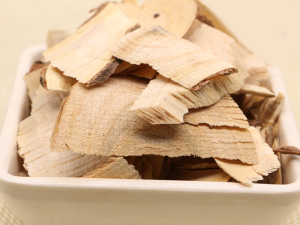
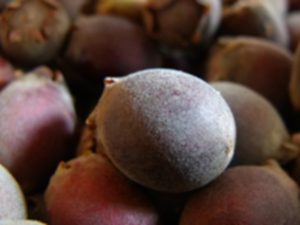
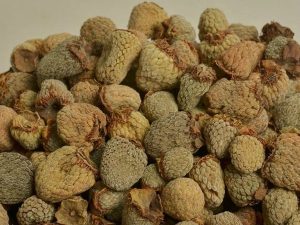
Hua Yao, a name in traditional Chinese medicine. It refers to the rhizome of Cyrtomium macrophyllum (Makino) Tagawa, a plant in the family Polypodiaceae. It has the effects of clearing heat and detoxifying, promoting blood circulation and stopping bleeding, and expelling parasites. It is used to treat burns and scalds, metrorrhagia, leukorrhea, traumatic injuries, and ascariasis.

Pharmaceutical
Hua Yao, a name in traditional Chinese medicine. It refers to the rhizome of Cyrtomium macrophyllum (Makino) Tagawa, a plant in the family Polypodiaceae. It has the effects of clearing heat and detoxifying, promoting blood circulation and stopping bleeding, and expelling parasites. It is used to treat burns and scalds, metrorrhagia, leukorrhea, traumatic injuries, and ascariasis.
Chinese Name : 化药
Aliases : Rock-edge Seven, Small Guanzhong, Iron-nail Rake
Nature, Flavor & Meridian Tropism : Bitter, cold. Spleen and Stomach meridians
Benefits & Efficacy
Benefits
Clears heat and detoxifies; promotes blood circulation and stops bleeding; expels parasites.
Indications
Used for burns and scalds, metrorrhagia, leukorrhea, traumatic injuries, and ascariasis.
Usage and Dosage
Internal use: Decoct 9–15 g. External use: Apply an appropriate amount, pounded into a paste; or grind into a powder and apply as a poultice.
Precautions
Use with caution in patients with spleen-stomach deficiency-cold.
Applications
Processing & Preparation
Harvesting & Processing
Can be harvested year-round; wash thoroughly, sun-dry, or use fresh.
Crude Drug Identification
Properties of Crude Drugs
The rhizome bears sparsely arranged, broad-lanceolate, dark brown scales; the petioles are 20–30 cm long, deep straw-colored, and bear sparse scales;The leaf blade is oblong, 20–50 cm long and 20–25 cm wide; the rachis and pinnae bear a few fibrous scales. The leaves are odd-pinnate; the pinnae are oblong-ovate or oblong-lanceolate, with a rounded base and nearly entire margins or a few short, pointed teeth; the venation is reticulate, with 7–8 rows of mesh-like cells on either side of the midrib and 1–3 hidden minor veins.Sporangia are clustered in the middle of the concealed minor veins; the indusia are round-shield-shaped with entire margins. Slight odor.
Botanical Information
Botanical Classification
A plant of the family Polypodiaceae, *Polypodium maculatum*.
Morphological Characteristics
Da Yu Guan Zhong, also known as Large-leaved Guan Zhong. The plant grows to a height of 60–80 cm. The rhizome is short and obliquely ascending; together with the base of the petiole, it is covered with dark brown, lanceolate or narrowly lanceolate scales.Leaves are clustered; petioles are 20–30 cm long, deep straw-colored, with sparse scales above the base; leaf blades are oblong, papery, 20–50 cm long and 20–25 cm wide, with a few fibrous scales along the rachis and pinnae, and are odd-pinnate;The pinnae are large, numbering 15–20 pairs, arranged alternately or in inferior opposite pairs; they are obliquely triangular-oblong with very short petioles. The lower pinnae are larger, oblong-ovate, with an acuminate apex; the upper side of the base is truncate and parallel to the rachis, forming a short auriculate projection, while the lower side is cuneate; the margins bear blunt teeth. The remaining pinnae gradually decrease in size toward the apex, with the terminal pinna nearly pinnately lobed;The venation is reticulate, with 7–8 rows of mesh-like openings on either side of the midrib, each containing a single hidden lateral vein. Sporangia are clustered in the middle of the hidden lateral veins and scattered across the abaxial surface of the pinnae; the indusia are round-shield-shaped, brown, thicker in the center, with membranous margins and entire edges.
Distribution Area
Southwest China, as well as Shaanxi, Gansu, Jiangxi, Hubei, and Hunan.