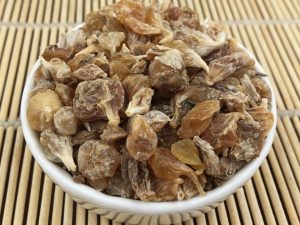
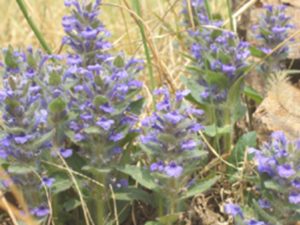
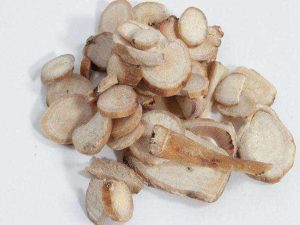
Pyrrosia is the name of a traditional Chinese medicine. It consists of the dried leaves of plants in the Polypodiaceae family: Lushan Pyrrosia (Pyrrosia sheareri (Bak.) Ching), Pyrrosia (Pyrrosia lingua (Thunb.) Farwell), or Stalked Pyrrosia (Pyrrosia petiolosa (Christ) Ching). It has the effects of promoting urination and relieving urinary obstruction, clearing the lungs and suppressing cough, and cooling the blood to stop bleeding.It is primarily used to treat heat-induced dysuria, blood-in-urine, calculous dysuria, urinary retention, painful and scanty urination, lung heat with wheezing and cough, hemoptysis, epistaxis, hematuria, and metrorrhagia and menorrhagia.

Pyrrosia
Pyrrosia is the name of a traditional Chinese medicine. It consists of the dried leaves of plants in the Polypodiaceae family: Lushan Pyrrosia (Pyrrosia sheareri (Bak.) Ching), Pyrrosia (Pyrrosia lingua (Thunb.) Farwell), or Stalked Pyrrosia (Pyrrosia petiolosa (Christ) Ching). It has the effects of promoting urination and relieving urinary obstruction, clearing the lungs and suppressing cough, and cooling the blood to stop bleeding.It is primarily used to treat heat-induced dysuria, blood-in-urine, calculous dysuria, urinary retention, painful and scanty urination, lung heat with wheezing and cough, hemoptysis, epistaxis, hematuria, and metrorrhagia and menorrhagia.
Chinese Name : 石韦
Latin Name : Pyrrosiae Folium
Aliases : Stone-leaf, Stone-bark, Stone-reed, Golden-star Grass, Stone-orchid, Raw-tug, Stone-sword, Rainbow-sword Grass, Golden Spoon, Lung-heart Grass, Huiquan Grass, Stone-ear, Snake-tongue Wind, Small-leaved Red-under
Authentic Producing Area : Found in most regions of the country
Nature, Flavor & Meridian Tropism : Sweet and bitter in taste; slightly cold in nature; enters the Lung and Bladder meridians
Benefits & Efficacy
Benefits
Promotes urination and relieves dysuria; clears the lungs and stops coughing; cools the blood and stops bleeding.
Indications
Heat-induced dysuria, blood-in-urine, stone-induced dysuria, difficulty urinating, painful and scanty urination, lung heat with wheezing and cough, hemoptysis, epistaxis, hematuria, and metrorrhagia and menorrhagia.
Usage and Dosage
1. Internal use: Decoct 9–15 g; or grind into powder. 2. External use: Apply an appropriate amount of the powdered herb as a poultice.
Precautions
Contraindicated in cases of yin deficiency or the absence of damp-heat.
Chemical Constituents
It primarily contains organic acids (such as chlorogenic acid), flavonoids and their glycosides (such as kaempferol, quercetin, isoquercetin, trifoliate glycoside, astragalin,glycyrrhizin, mangiferin, and isomangiferin), as well as damaran-type triterpenes, such as damasinan and (18S)-18-hydroxydama-21-ene.
Pharmacological Actions
This product exhibits nephroprotective, antitussive, expectorant, hypoglycemic, anti-herpes simplex virus type I, anti-inflammatory, analgesic, antibacterial, anti-urinary tract infection, and antiarrhythmic effects.
Relevant Discussions
1. *Shennong Bencao Jing*: “Treats fever caused by overwork and pathogenic factors, five types of dysuria with obstruction, and promotes urination.”
2. *Bencao Gangmu*: “Treats metrorrhagia and metrorhoagia, as well as traumatic wounds; clears lung qi.”
Applications
Clinical Applications
1. To treat hematuria, use it in combination with Angelica sinensis, Pollen of Typha, and Paeonia lactiflora, as in the Shiwei Powder (from *Qianjin Fang*); to treat heat-induced dysuria, as in *Shenghui Fang*, where this herb is ground into a powder with talc and taken orally; to treat calculous dysuria, grind it into a powder with talc and take it with rice water or honey, as in the Shiwei Powder from *Gujin Luyan*.
2. To treat coughing, wheezing, and shortness of breath caused by lung heat, it may be used in combination with Houttuynia cordata, Scutellaria baicalensis, and Phragmites root.
3. To treat hemoptysis, epistaxis, hematuria, and metrorrhagia caused by uncontrolled blood flow due to blood heat, it may be used alone or, depending on the condition, combined with Platycladus orientalis leaves, Gardenia, and Salvia miltiorrhiza.
Related Compatibility
1. Combining Shiwei with Haijinsha: Shiwei can clear heat, drain dampness, promote urination, and relieve pain, while also cooling the blood and stopping bleeding; Haijinsha is effective at draining damp-heat from the bladder and small intestine and has the ability to cool the blood and promote urination. When used together, the effects of clearing heat, promoting urination, and cooling the blood to stop bleeding are enhanced. This combination is suitable for stone-induced dysuria, heat-induced dysuria, and blood-induced dysuria.
2. Shiwei combined with raw Pu Huang: Shiwei can clear heat and promote urination, as well as cool the blood and stop bleeding; raw Pu Huang excels at invigorating blood circulation and dispersing blood stasis, while also stopping bleeding and promoting urination. When used together, the effects of promoting urination, relieving dysuria, dispersing blood stasis, and stopping bleeding are enhanced. This combination is suitable for painful and difficult urination and hematuria.
Medicinal Identification
1. Shiwei and Cheqianzi: Both herbs are diuretics that promote urination and relieve dysuria; they are sweet and cold in nature and can clear heat and relieve dysuria. They also both enter the Lung Meridian, where they clear lung heat, transform phlegm, relieve cough, and alleviate wheezing. They are used to treat dysuria with dribbling, painful urination, as well as lung-heat-induced cough and wheezing.However, Plantain Seed promotes diuresis and drains dampness, and can also be used for edema and summer-dampness-induced diarrhea; it enters the Liver Meridian, where it clears liver heat and improves vision, making it suitable for red eyes caused by liver heat. Stone Weed, on the other hand, enters the Bladder Meridian and excels at clearing heat from both the Lung and Bladder Meridians, making it particularly suitable for treating heat-induced dysuria and hematuria; it can also cool the blood and stop bleeding, and is used to treat bleeding caused by uncontrolled blood flow due to blood heat.
2. Shiwei and Qumai: Both herbs are key agents for promoting diuresis and relieving dysuria. They are bitter and cold in nature and can direct heat downward, clear heat, promote diuresis, and relieve dysuria; they are used to treat heat-induced dysuria, blood-induced dysuria, and dysuria characterized by a trickling,涩, and painful flow.However, Lycopodium also enters the Heart and Small Intestine meridians and excels at clearing fire from these two meridians: it can penetrate the blood level to break up blood stasis and unblock the menstrual channels, and is used for conditions such as amenorrhea due to blood stasis. Pyrrosia also enters the Lung meridian and excels at clearing heat from the Lung and Bladder meridians; it can also clear heat from the Lung, transform phlegm, stop coughing, and relieve wheezing, making it suitable for coughs caused by Lung heat; furthermore, it cools the blood and stops bleeding, and is used for conditions such as excessive uterine bleeding and nosebleeds caused by blood heat.
3. Shiwei and Talc: Both herbs are cold in nature and enter the Bladder Meridian; they clear heat, promote diuresis, and relieve dysuria, making them excellent treatments for heat-type dysuria and calculous dysuria with painful, scanty urination. However, Shiwei has the effect of cooling the blood and stopping bleeding, so it is particularly suitable for blood-type dysuria and heat-type dysuria; Talc, with its slippery nature, drains dampness and is more suitable for damp-heat dysuria and calculous dysuria.In addition, Shiwei clears lung heat and relieves cough, cools the blood and stops metrorrhagia; it is used for lung-heat cough and blood-heat-induced metrorrhagia. Talc clears summer-heat and quenches thirst, as well as dries dampness and promotes wound healing; it is used for summer-heat-induced restlessness and thirst, damp-heat-induced chest tightness, summer-dampness-induced diarrhea, and topically for eczema and damp sores.
Related Medicines
Dangdi Ling Granules, Compound Shiwei Tablets.
Related Prescriptions
Shiwei Powder from *Collected Effective Formulas*.
Notes
Patients requiring treatment with Chinese herbal medicine should first consult a licensed Traditional Chinese Medicine (TCM) hospital to receive a prescription following a professional TCM differential diagnosis.
Processing & Preparation
Harvesting & Processing
It can be harvested year-round; remove the rhizomes and roots, then sun-dry or air-dry.
Processing Methods
Remove impurities, wash thoroughly, cut into sections, dry, and sift out fine particles.
Storage Methods
Store in a well-ventilated, dry place.
Crude Drug Identification
Properties of Crude Drugs
1. Lushan Shiwei: The leaves are slightly wrinkled; when flattened, they are lanceolate, 10–25 cm long and 3–5 cm wide. The apex is gradually tapering; the base is auriculate and asymmetrical; the margin is entire and often curled inward; the upper surface is yellowish-green or grayish-green, scattered with small, round, black pits;the underside is densely covered with reddish-brown stellate hairs, and some lateral veins are dotted with clusters of brown, round spore sacs. The petiole is quadrangular, 10–20 cm long, 1.5–3 mm in diameter, slightly twisted, and has longitudinal grooves. The leaf blade is leathery. It has a faint odor and a slightly astringent, bitter taste.
2. Stonewort: The leaf blade is lanceolate or oblong-lanceolate, 8–12 cm long and 1–3 cm wide. The base is cuneate and symmetrical. Spore clusters are located between the lateral veins, arranged closely and neatly. The petiole is 5–10 cm long and approximately 1.5 mm in diameter.
3. Pedunculate Stonewort: Leaves are often curled into a cylindrical shape; when flattened, they are oblong or ovate-oblong, 3–8 cm long and 1–2.5 cm wide. The base is wedge-shaped and symmetrical. The lateral veins on the underside are indistinct, and the surface is covered with spore clusters. The petiole is 3–12 cm long and approximately 1 mm in diameter.
Properties of Processed Slices
This product appears as thread-like strands. The upper surface is yellowish-green or grayish-brown, while the lower surface is densely covered with reddish-brown stellate hairs. Sporangia clusters are attached between the lateral veins or cover the entire lower surface. The leaves are entire. The leaf blades are leathery. It has a faint odor and a slightly astringent, bitter taste.
Botanical Information
Botanical Classification
Plants of the Polypodiaceae family: Lushan Shiwei, Shiwei, and Pedunculate Shiwei.
Morphological Characteristics
1. Lushan Shiwei: The plant grows to a height of 20–60 cm. The rhizome is horizontal, densely covered with lanceolate scales with serrated margins. Leaves are clustered; the petioles are stout, 10–30 cm long, and attached to the rhizome at the nodes;Leaf blades are stiff and leathery, broadly lanceolate, 20–40 cm long and 3–5 cm wide, gradually narrowing toward the apex, with an acute tip; the base is slightly widened, forming an unequal auriculate or cordate shape, and does not extend downward; lateral veins are slightly sunken on both surfaces. Spore clusters are small, arranged in multiple rows between the lateral veins; there are no indusia.
2. Potentilla: Plant height 10–30 cm. Rhizome slender and elongated, growing horizontally; both the rhizome and petioles are densely covered with brown, lanceolate scales that are acuminate at the apex, shield-shaped, with a dark brown center, pale brown margins, and ciliate.Leaves are distichous and nearly dimorphic; petioles are 3–10 cm long, dark brown, shallowly grooved, covered with stellate hairs when young, and attached to the rhizome at the nodes; leaf blades are leathery, lanceolate to oblong-lanceolate, 6–20 cm long and 2–5 cm wide, with a gradually tapering apex, a gradually narrowing base extending down the petiole, and entire margins;green on the upper surface, occasionally with stellate hairs and pits, and densely covered with grayish-brown stellate hairs on the lower surface; sterile and fertile leaves are of the same type or slightly shorter and broader; the midrib is slightly sunken on the upper surface and raised on the lower surface; lateral veins are more or less visible, and the reticulate veins are net-like. Sporangia are densely distributed on the lower surface or upper part of the leaf; when young, they are densely covered with stellate hairs, but become exposed upon maturity; there are no indusia.
3. Pedunculate Alisma: Plant height 5–20 cm. Rhizome long and creeping, densely covered with brownish-pink ovate-lanceolate scales with serrated margins.Leaves are distichous, dimorphic, thick and leathery, glabrous on the upper surface with neatly arranged small pits, and densely covered with grayish-brown stellate hairs on the lower surface; spore-bearing leaf petioles are much longer than the leaf blades, 3–12 cm long, while vegetative leaf petioles are equal in length to the leaves;The leaf blades are oblong or ovate-oblong, with an acute or obtuse apex and a slightly extended base; spore-bearing leaves usually curl inward when dry, becoming nearly tubular; leaf veins are inconspicuous. When mature, sporangia clusters cover the entire underside of the leaf; the sporangia are round and biconvex, without caps, and hidden among the stellate hairs.
Distribution Area
1. Lushan Stonewort is distributed in the southwestern region and in the provinces and regions of Anhui, Zhejiang, Jiangxi, Fujian, Taiwan, Hubei, Hunan, Guangdong, and Guangxi. 2. Stonewort: Distributed in East China, Central-South China, and Southwest China. 3. Stalked Stonewort: Distributed in the southwestern region and in the provinces and regions of Jilin, Liaoning, Hebei, Shaanxi, Shandong, Jiangsu, Anhui, Henan, Hubei, and Guangxi.
Growth Habits
It prefers a cool, dry, shaded climate and grows on rocky surfaces.
Propagation Methods
Propagated by division.
Cultivation Techniques
Plant in March. Before planting, select mature plants with plenty of nutritious leaves, dig them up with their roots intact, cut each into sections of 3–4 nodes, soak them in water for one day and one night, and plant after they have absorbed sufficient moisture.Select sites under trees where rocks are covered with moss for better survival rates. When planting, maintain a row and plant spacing of 23–27 cm; clear away the moss, place 1–2 sections of rhizome into the space, and press down firmly with moist humus-rich soil. It can also be planted on stone retaining walls by placing the seedlings in crevices and packing them securely with moist humus-rich soil.