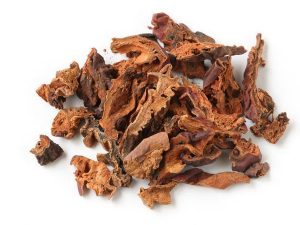
Xiebai is the name of a traditional Chinese medicine. It consists of the dried bulbs of Allium macrostemon Bge. (small-rooted garlic) or Allium chinense G.Don, both belonging to the genus Allium in the Liliaceae family. It has the therapeutic effects of promoting yang energy, dispersing nodules, regulating qi, and relieving stagnation. It is primarily used to treat chest pain caused by bi syndrome, epigastric and abdominal fullness, distension, and pain, as well as tenesmus following diarrhea or dysentery.

Xie Bai
Xiebai is the name of a traditional Chinese medicine. It consists of the dried bulbs of Allium macrostemon Bge. (small-rooted garlic) or Allium chinense G.Don, both belonging to the genus Allium in the Liliaceae family. It has the therapeutic effects of promoting yang energy, dispersing nodules, regulating qi, and relieving stagnation. It is primarily used to treat chest pain caused by bi syndrome, epigastric and abdominal fullness, distension, and pain, as well as tenesmus following diarrhea or dysentery.
Chinese Name : 薤白
Latin Name : Allii Macrostemonis Bulbus
Aliases : Leek root, Allium tuberosum, wild garlic, small wild garlic, white leek bulb
Authentic Producing Area : Northeast China, Hebei, Jiangsu, Hubei
Nature, Flavor & Meridian Tropism : Pungent and bitter in taste; warm in nature; enters the Heart, Lung, Stomach, and Large Intestine meridians
Benefits & Efficacy
Benefits
Promotes yang and disperses nodules; regulates qi and relieves stagnation.
Indications
Chest pain due to chest obstruction (xiongbi), epigastric and abdominal fullness, distension, and pain; tenesmus following diarrhea or dysentery.
Usage and Dosage
1. Internal use: Decoct 5–10 g (or 30–60 g of fresh product); or incorporate into pills or powders; may also be cooked into congee. 2. External use: Pound into a paste and apply; or extract the juice and apply topically.
Precautions
1. This herb has a slippery and purgative nature; it should not be used by individuals without stagnation. 2. It should not be taken by those with a weak stomach and poor appetite, or those who cannot tolerate the taste of garlic.
Chemical Constituents
This herb primarily contains steroidal saponins, such as Allium saponins A–K; it also contains prostaglandins, alkaloids, and nitrogen-containing compounds.
Pharmacological Actions
This product has effects such as protecting the vascular endothelium, combating myocardial ischemia, preventing thrombosis, regulating lipids, providing antioxidant and anti-inflammatory effects, and relieving asthma.
Relevant Discussions
1. *Supplement to the Materia Medica*: “Regulates the middle jiao; primarily treats chronic diarrhea that does not resolve and persistent abdominal distension with a foul sensation; simply boil and consume in large quantities.”
2. *Compendium of Materia Medica*: “Treats Shao Yin syndrome characterized by cold extremities, cold-induced reversal of qi, and diarrhea; as well as stabbing chest pain (chest bi); it descends qi, disperses blood stasis, and stabilizes the fetus.”
Applications
Clinical Applications
1. To treat chest bi syndrome caused by cold phlegm obstruction and deficient chest yang, it is often combined with Trichosanthes fruit, Pinellia, and Zhi Shi, as in the Trichosanthes, Leek White, and White Wine Decoction; the Trichosanthes, Leek White, and Pinellia Decoction; and the Zhi Shi, Leek White, and Cinnamon Twig Decoction (Jin Gui Yao Lue).
2. For treating chest bi caused by the mutual entanglement of phlegm and blood stasis, it may be used in combination with Danshen, Chuanxiong, and Trichosanthes peel.
3. For treating epigastric and abdominal fullness, distension, and pain due to cold and qi stagnation in the stomach, it may be used in combination with Gaoliangjiang, Sha Ren, and Mu Xiang.
4. For gastrointestinal qi stagnation, diarrhea, dysentery, tenesmus, and a sensation of incomplete evacuation, this herb may be used alone or in combination with Mu Xiang and Zhi Shi.
Related Compatibility
1. Combining Xie Bai with Huang Bai: Xie Bai is pungent and dispersing, excelling at promoting Yang and resolving stagnation; it relieves chest pain in the upper body and dispels Qi stagnation in the large intestine. Huang Bai is bitter and cold, with descending and purging properties; it clears heat and dries dampness, specializing in purging Kidney fire and clearing damp-heat in the lower jiao.When used together, the pungent action opens while the bitter action descends, with a focus on promoting flow; the combination of cold and warm properties focuses on clearing heat. The clearing of heat is accompanied by the promotion of yang to prevent the bitter-cold nature from suppressing yang; the drying of dampness is accompanied by the regulation of qi to prevent qi stagnation caused by dampness removal. This formula is used to treat symptoms such as tenesmus following diarrhea or dysentery and difficult, sluggish bowel movements caused by the stagnation of damp-heat and epidemic toxins in the intestines.
2. Xie Bai combined with Gua Lou: Xie Bai promotes yang and disperses nodules, while regulating qi and relieving pain; Gua Lou clears the lungs and transforms phlegm, relieves chest constriction and disperses nodules, and moistens dryness to lubricate the intestines. Xie Bai emphasizes pungent dispersion and warm promotion to disperse yin nodules and relieve chest bi; Gua Lou, sweet, cold, and lubricating, focuses on clearing and descending to relieve chest constriction, facilitate diaphragmatic function, and resolve bi.When used together, one promotes circulation while the other descends—they invigorate yang and regulate qi, opening chest bi from above and resolving qi stagnation from below, clearing the lungs and transforming phlegm, dispersing nodules, and relieving pain. This is a commonly used herbal combination for treating chest bi. It is indicated for chest bi presenting with chest pain and tightness, shortness of breath, wheezing, coughing, and spitting, with symptoms that come and go intermittently, or even chest pain radiating to the back and back pain radiating to the chest, with unrelenting pain.
3. Xie Bai combined with Zhi Shi: Xie Bai is pungent and bitter in taste and warm in nature; its pungent nature disperses, its bitter nature descends, and its warmth promotes circulation and lubrication. It has the functions of promoting yang, dispersing nodules, regulating qi, and relieving pain. Zhi Shi is bitter, pungent, and sour in taste, with a slightly cold nature; it breaks up stagnant qi, eliminates food stagnation, transforms phlegm, and removes fullness. When these two herbs are combined, they synergize to enhance the effects of promoting yang, eliminating fullness, breaking up stagnant qi, guiding stagnation, transforming phlegm, and removing turbidity.It is used to treat chest pain (xiongbi), persistent cough with difficult expectoration, epigastric and abdominal fullness and distension, and constipation or incomplete diarrhea.
4. Xie Bai Combined with Ban Xia: Both Xie Bai and Ban Xia are pungent and warm in nature and enter the Lung, Stomach, and Large Intestine meridians.Xie Bai regulates qi and relieves chest constriction, while warming the middle burner and promoting yang; Ban Xia dries dampness and transforms phlegm, eliminates fullness and disperses masses, and harmonizes the stomach to stop vomiting. When used together, these two herbs work synergistically to transform phlegm, disperse masses, regulate qi, and relieve pain. This combination is used to treat chest bi with chest pain radiating to the back, shortness of breath, and wheezing.
5. Xie Bai Combined with Da Fu Pi: Xie Bai is bitter, pungent, and warm in nature, with the functions of promoting yang, dispersing nodules, regulating qi, and relieving pain; Da Fu Pi is pungent and slightly warm, and serves to regulate qi, resolve food stagnation, promote diuresis, and reduce swelling. When combined, these two herbs enhance the effects of regulating qi and resolving food stagnation. This combination is suitable for treating epigastric and abdominal fullness, distension, and pain caused by gastrointestinal qi stagnation, as well as diarrhea, dysentery, tenesmus, and a sensation of incomplete evacuation.
Medicinal Identification
Xie Bai and Green Onion White: Both herbs have a pungent and warm nature and enter the Lung and Stomach meridians; both can disperse cold pathogens and promote the flow of yang qi, but their functions differ significantly.Xie Bai specifically targets the interior; with pungent, dispersing, bitter, descending, and lubricating properties, in addition to promoting yang and resolving nodules, it is also particularly effective at descending to eliminate food stagnation. It is primarily used to treat chest bi caused by phlegm-dampness stagnation and deficient chest yang, as well as diarrhea and dysentery with tenesmus and a sensation of incomplete evacuation, and epigastric and abdominal distension and fullness.Scallion White, on the other hand, is pungent and warm; it acts both internally and externally. It can induce sweating to relieve exterior syndromes and is used for mild cases of wind-cold common cold. It also dispels cold and promotes yang, treating cold extremities, diarrhea, and a faint pulse caused by excessive internal yin cold that repels yang outward. When used externally, it can detoxify, disperse nodules, and promote lactation, treating boils, carbuncles, breast distension and pain, and insufficient lactation.
Related Medicines
Shuxin Jiangzhi Tablets, Zhenxintong Oral Solution, Shuxin Ning Tablets.
Related Prescriptions
Zhishi-Xiebai-Guizhi Decoction (*Jin Gui Yao Lue*), Gualou-Xiebai-Baijiu Decoction (*Jin Gui Yao Lue*), Gualou-Xiebai-Banxia Decoction (*Jin Gui Yao Lue*), Chaihu Qinggu Powder (*Yi Zong Jin Jian*), Xiebai Powder (*Pu Ji Fang*).
Medicinal Diet Therapy
Leek White Porridge
1. Efficacy: This porridge promotes yang, disperses nodules, regulates qi, and relieves stagnation. It is suitable for conditions such as chest pain due to chest obstruction, phlegm-retention with coughing and wheezing, and tenesmus following diarrhea or dysentery.
2. Ingredients: 10–15 g of leek white (or 30–50 g of fresh leek white), 100 g of japonica rice.
3. Preparation: Wash the Allium tuberosum white part thoroughly, place it in a pot, add the rinsed japonica rice, pour in an appropriate amount of water, and simmer over low heat until it becomes porridge.
4. Usage: Take twice daily while still warm.
Notes
Patients requiring treatment with Chinese herbal medicine should first consult a licensed Traditional Chinese Medicine (TCM) hospital, where a TCM practitioner will conduct a professional pattern differentiation and prescribe an herbal formula.
Processing & Preparation
Harvesting & Processing
Harvest in summer and autumn; wash thoroughly, remove fibrous roots, steam thoroughly or blanch in boiling water until fully cooked, then sun-dry.
Processing Methods
Take the raw material, remove impurities, fibrous roots, and blackened grains, and sift out the outer membrane; or take fresh Xie Bai, wash it thoroughly, steam it until it becomes plump and tender throughout, dry it, and remove any loose outer membrane.
Storage Methods
Store in a dry container in a well-ventilated, dry place to prevent insect infestation.
Crude Drug Identification
Identification
1. Identification by Physical Characteristics
(1) Allium tuberosum: The powder is yellowish-white. The outer epidermal cells of older scale leaves have cell walls that are slightly thickened in a bead-like pattern. The inner epidermal cells of the scale leaves are oblong, 68–197 μm long and 29–76 μm wide, arranged closely together. Calcium oxalate prismatic crystals are common, measuring 7–29 μm in length.Stomata are rare, mostly indeterminate in form, with four subsidiary cells. Spiral vessels have a diameter of 12–17 μm.
(2) Allium tuberosum: The outer epidermal cells of the scale leaves show no obvious thickening of the cell walls. The inner epidermal cells of the scale leaves are larger, measuring 258–668 μm in length.
2. Physicochemical Identification
Take 4 g of the powdered sample, add 20 mL of n-hexane, subject to ultrasonic treatment for 20 minutes, filter, and evaporate the filtrate to dryness. Dissolve the residue in 1 mL of n-hexane to prepare the test solution.Separately, take 4 g of Xie Bai reference material and prepare a reference solution using the same method. Perform thin-layer chromatography (General Chapter 0502): pipette 10 μL of each of the two solutions and apply them separately onto the same silica gel G plate. Develop with n-hexane–ethyl acetate (10:1) as the developing solvent, remove the plate, and allow it to air-dry.spray with a 10% ethanol solution of sulfuric acid, heat at 105°C until the spots become clearly visible, and examine under ultraviolet light (365 nm). In the test sample chromatogram, fluorescent spots of the same color appear at positions corresponding to those in the reference herbal material chromatogram.
Properties of Crude Drugs
1. Allium chinense: Irregularly ovate, 0.5–1.5 cm long, 0.5–1.8 cm in diameter. The surface is yellowish-white or pale yellowish-brown, wrinkled, translucent, and covered with whitish membranous scales; a prominent bulbous base is present at the bottom. The texture is hard and horny; it has a garlic odor and a slightly pungent taste.
2. Allium tuberosum: Slightly flattened, elongated-ovate in shape, 1–3 cm tall and 0.3–1.2 cm in diameter. The surface is pale yellowish-brown or brownish-gray with shallow longitudinal wrinkles. The texture is relatively soft, and 2–3 layers of scale leaves are visible on the cross-section. It sticks to the teeth when chewed.
Properties of Processed Slices
See “Characteristics of Medicinal Materials.”
Botanical Information
Botanical Classification
Allium species in the Liliaceae family: Allium chinense and Allium tuberosum.
Morphological Characteristics
1. Allium chinense: A perennial herb, 30–60 cm tall. The bulb is nearly spherical, 0.7–1.5 cm in diameter, often with 1–3 small bulbs attached to the side; it is covered externally by white, membranous scales that later turn black.Leaves are alternate; they are bluish-green, semicylindrical to narrowly linear, hollow, 20–40 cm long, 2–4 mm wide, with a gradually tapering apex and a sheathing base that encloses the stem. The flower stalk is solitary and erect, 30–70 cm tall; the terminal umbel is globose, with membranous bracts below that are ovate and long-acuminate at the apex;flower pedicels 1–2 cm long; some inflorescences bear only a few small flowers, interspersed with numerous fleshy bulbils, or may even consist entirely of small plantlets; perianth segments 6, pink or rose-red; stamens 6, longer than the perianth, filaments slender and elongated, slightly expanded at the base; ovary superior, globose. Capsule obovate, with a depressed apex. Flowering period: May–June; fruiting period: August–September.
2. Allium: Similar to the previous species, but with several bulbs clustered together, narrowly ovate, 1–1.5 cm in diameter; the outer bulb skin is white or reddish, membranous, and does not split. Leaves are basal, 2–5 in number; cylindrical with 3–5 ridges, hollow, and nearly as long as the flower stalk.The flower stalk is lateral, cylindrical, 20–40 cm tall; the involucre is membranous, 2-lobed, and persistent; the umbel is hemispherical and loose; the pedicels are 2–4 times as long as the perianth and bear bracts; the flowers are pale purple to bluish-purple; the perianth consists of 6 segments, 4–6 mm long, broadly elliptic to nearly circular, with a blunt apex;the filaments are twice as long as the perianth segments, fused only at the base and adnate to the perianth; the inner whorl is expanded at the base, with one tooth on each side, while the outer whorl is toothless; the ovary is broadly obovate, with three capped depressions at the base; the style extends beyond the perianth. Flowering and fruiting occur from October to November.
Distribution Area
1. Small-rooted garlic: Distributed throughout China except for Xinjiang and Qinghai. 2. Chinese leek: Widely cultivated in the Yangtze River Basin and southern provinces and regions of China.
Growth Habits
Prefers a relatively warm and humid climate. Best grown in loose, fertile, humus-rich, well-drained loam or sandy loam.
Propagation Methods
Propagated by bulbs.
Cultivation Techniques
Dig up the bulbs in spring or late fall; set aside the larger ones for medicinal use and the smaller ones for propagation. In August–September, on prepared raised beds, dig holes with a row spacing of 20–25 cm and a hole spacing of 8–10 cm. Plant 3–5 bulbs per hole with the bud tip facing upward, apply liquid manure, cover with wood ash, and top with 3 cm of soil.