Red-haired Acanthopanax, a name in traditional Chinese medicine. It is the stem bark or root bark of Acanthopanax giraldii Harms, a plant in the Araliaceae family. It is distributed in Hebei, Shanxi, Shaanxi, Ningxia, Qinghai, Henan, Hubei, Sichuan, and other regions. It has the effects of dispelling wind-dampness, strengthening tendons and bones, and promoting blood circulation and diuresis.It is commonly used to treat wind-cold-damp bi syndrome, stiffness and pain, weakness of tendons and bones, weakness in the feet and knees, pain in the chest and abdomen, hernias, trauma, fractures, and edema due to physical debility.

Red-haired Acanthopanax
Red-haired Acanthopanax, a name in traditional Chinese medicine. It is the stem bark or root bark of Acanthopanax giraldii Harms, a plant in the Araliaceae family. It is distributed in Hebei, Shanxi, Shaanxi, Ningxia, Qinghai, Henan, Hubei, Sichuan, and other regions. It has the effects of dispelling wind-dampness, strengthening tendons and bones, and promoting blood circulation and diuresis.It is commonly used to treat wind-cold-damp bi syndrome, stiffness and pain, weakness of tendons and bones, weakness in the feet and knees, pain in the chest and abdomen, hernias, trauma, fractures, and edema due to physical debility.
Chinese Name : 红毛五加皮
Aliases : Five-clawed Acanthopanax, Sichuan Acanthopanax Bark, Prickly Acanthopanax Bark, Acanthopanax Bark, Shu Acanthopanax
Nature, Flavor & Meridian Tropism : Taste: pungent, slightly bitter; Nature: warm. Enters the Liver and Kidney meridians
Benefits & Efficacy
Benefits
Dispels wind-dampness, strengthens tendons and bones, promotes blood circulation, and promotes diuresis.
Indications
Wind-cold-damp bi syndrome, stiffness and pain, weakness and atrophy of tendons and bones, weakness in the feet and knees, pain in the chest and abdomen, hernias, trauma, fractures, and edema due to physical weakness.
Usage and Dosage
Internal use: Decoct 3–15 g; or steep in wine. External use: Apply an appropriate amount as a paste made from the powdered herb.
Precautions
Use with caution in cases of yin deficiency with excessive internal heat.
Pharmacological Actions
1. Effects on the cardiovascular system. 2. Effects on the central nervous system. 3. Anti-inflammatory effects. 4. Anti-stress effects. 5. Anti-radiation effects. 6. Protective effects on hematopoietic function. 7. Effects on immune function. 8. Other effects. 9. Toxicity.
Relevant Discussions
1. *Herbal Medicine of Southern Yunnan*: “Primarily treats typhoid fever, regardless of whether the symptoms resemble yin or yang patterns, or whether the disease transmits through meridians or not.”
2. *Commonly Used Chinese Herbs of Sichuan*: “Dispels wind-dampness, unblocks joints, and strengthens tendons and bones; treats atrophy and numbness, stiffness and pain, wind-cold-dampness arthralgia, weakness in the feet and knees, cutaneous rheumatism, impotence, and dampness in the scrotum.”
3. *Manual of Common Chinese Herbs in Qinghai*: “Treats edema and difficulty urinating.”
4. *Compendium of Chinese Herbs Nationwide*: “Primarily treats trauma and contusions.”
Applications
Related Compatibility
1. For rheumatic joint pain: 15 g of Acanthopanax bark, 9 g each of Atractylodes, Gentiana, and Asarum, and 12 g of Old Crane Grass. Decoct in water or steep in wine. (*Compendium of Chinese Herbal Medicines*)
2. For contusions and bruises: (Red-haired Acanthopanax) 9–15 g. Decoct in water and drink, or steep in wine and consume. (*Enshi Manual of Chinese Herbal Medicine*)
Processing & Preparation
Harvesting & Processing
Between June and July, cut the stems and branches, then strike them with a wooden stick to separate the woody core from the bark; peel off the stem bark and sun-dry it. Roots can be harvested year-round; wash them, peel off the root bark, and sun-dry it.
Crude Drug Identification
Properties of Crude Drugs
1. Characteristics of the Herbal Material
The stem bark is cylindrical, 20–30 cm long, 0.5–1.5 cm in diameter, and 0.5–1 mm thick. The outer surface is yellow or yellowish-brown, densely covered with yellowish-brown, reddish-brown, or brownish-black spines; the spines point downward, are slender and needle-shaped, 3–7 mm long, with a basal diameter of approximately 0.5 mm;The nodes bear bud scars and petiole scars. The inner surface is yellowish-green or pale brown and smooth. The material is light and brittle, breaks easily, and has a fibrous fracture. It has a faint odor and a bland taste.
2. Characteristics of the Prepared Slices
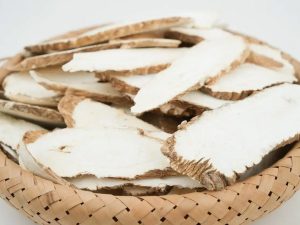
These are irregular, hollow, circular, thin slices. Store in a dry container, tightly sealed, in a cool, dry place, protected from moisture and insect infestation.
Botanical Information
Botanical Classification
A plant of the Araliaceae family, Red-haired Acanthopanax.
Morphological Characteristics
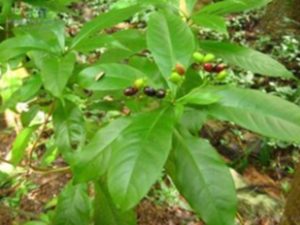
Red-haired Acanthopanax, also known as Ji’s Acanthopanax or Shaanxi-Gansu Acanthopanax.A deciduous shrub, 1–3 m tall. Old branches are gray; new branches are yellowish-brown, either spineless or densely covered with slender, bristle-like spines, which point downward or spread out. Leaves are alternate or clustered in groups of several on short branches; they are palmately compound; petioles are 3–7 cm long, glabrous or sparsely covered with short bristles, with a ring of reddish-brown bristle-like spines near the base where they attach to the branch;leaflets usually 5, rarely 3–4, sessile or nearly sessile, often with a cluster of bristle-like spines on the abaxial surface near the base; leaf blades obovate or oblanceolate, sometimes slightly rhomboid, 2.5–5 cm long, 1.5–2.5 cm wide, apex acuminate, base cuneate, both surfaces sparsely covered with short bristles along the veins, margins serrate;lateral veins approximately 5 pairs. Umbels solitary at branch tips, approximately 2 cm in diameter; peduncle approximately 7 mm long, occasionally reaching 2 cm; flowers numerous, very small, white-green; calyx tube fused with ovary, margin with 5 indistinct small teeth; petals 5, obovate; stamens 5, filaments slender and long;ovary inferior, 5-chambered; 5 styles, fused at the base and separate from the middle upward. The drupe is berry-like, nearly spherical, up to 8 mm in diameter, 5-angled, black when ripe, with a persistent style. Flowering period: May–July; fruiting period: June–October.
Distribution Area
Distributed in Hebei, Shanxi, Shaanxi, Ningxia, Qinghai, Henan, Hubei, Sichuan, and other regions.