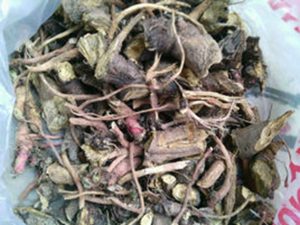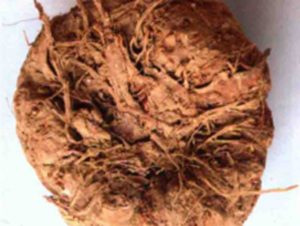
Red Sweet Potato Seeds, a name in traditional Chinese medicine. These are the seeds of the sweet potato (Ipomoea batatas [L.] Lam.), a plant in the Convolvulaceae family. It is cultivated throughout China, from the north to the south. It has the efficacy of promoting tissue regeneration and healing wounds. It is commonly used for chronic ulcers and burns from hot liquids or fire.

Red Sweet Potato Mother-and-Child
Red Sweet Potato Seeds, a name in traditional Chinese medicine. These are the seeds of the sweet potato (Ipomoea batatas [L.] Lam.), a plant in the Convolvulaceae family. It is cultivated throughout China, from the north to the south. It has the efficacy of promoting tissue regeneration and healing wounds. It is commonly used for chronic ulcers and burns from hot liquids or fire.
Chinese Name : 红苕母子
Nature, Flavor & Meridian Tropism : Sweet in taste, neutral in nature. Enters the Spleen Meridian
Benefits & Efficacy
Benefits
Promotes tissue regeneration and heals wounds.
Indications
Chronic ulcers, scalds, and burns.
Usage and Dosage
External use: Pound and apply as a poultice.
Relevant Discussions
*Compendium of Sichuan Traditional Chinese Medicine*: “Pound fresh and apply externally to treat scalds and burns.”
Applications
Related Compatibility
For scalds and burns: Fresh Red Sweet Potato and its tubers are pounded and applied topically. (*Compendium of Sichuan Traditional Chinese Medicine*)
Processing & Preparation
Crude Drug Identification
Botanical Information
Botanical Classification
Sweet potato (a plant of the Convolvulaceae family).
Morphological Characteristics
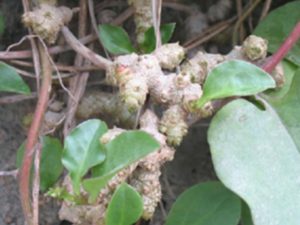
Annual herb. The underground part consists of round, oval, or spindle-shaped tubers. The stem is prostrate or ascending, occasionally twining, highly branched, cylindrical or ribbed, green or purple, and readily produces adventitious roots at the nodes. Simple leaves are alternate; petioles are 2.5–20 cm long, sparsely pubescent or glabrous;leaf blade shape and color vary by variety, typically broad-ovate, 4–13 cm long and 3–13 cm wide, entire or 3–5-lobed, with a gradually tapering apex, a cordate or nearly truncate base, and both surfaces sparsely pubescent or nearly glabrous. Cymes are axillary, bearing 1–7 flowers; bracts are small, lanceolate, and early deciduous;There are 5 sepals of unequal length; the corolla is pink, white, pale purple, or purple, bell-shaped or funnel-shaped; there are 5 stamens, which are included, with the filaments hairy at the base; the ovary is 2–4-chambered, hairy or sometimes glabrous. The fruit is a capsule, though usually rare. Flowering period: September–December.