Fried Atractylodes is a processed form of the traditional Chinese medicinal herb Atractylodes. It consists of the dried rhizomes of Atractylodes macrocephala Koidz. (a plant of the Asteraceae family), which are cleaned, sliced, and stir-fried with additives. This product is produced in Zhejiang, Anhui, and other regions. Depending on the additives used, it can be classified into two types: bran-fried Atractylodes and earth-fried Atractylodes.Among these, wheat bran-fried Atractylodes primarily strengthens the spleen, aids digestion, and harmonizes the stomach; it is commonly used to treat symptoms such as poor appetite, abdominal distension, and fatigue caused by disharmony between the spleen and stomach and impaired transport and transformation functions. Earth-fried Atractylodes primarily tonifies the spleen and stops diarrhea; it is commonly used to treat spleen deficiency with poor appetite, diarrhea, and loose stools.

Roasted Atractylodes
Fried Atractylodes is a processed form of the traditional Chinese medicinal herb Atractylodes. It consists of the dried rhizomes of Atractylodes macrocephala Koidz. (a plant of the Asteraceae family), which are cleaned, sliced, and stir-fried with additives. This product is produced in Zhejiang, Anhui, and other regions. Depending on the additives used, it can be classified into two types: bran-fried Atractylodes and earth-fried Atractylodes.Among these, wheat bran-fried Atractylodes primarily strengthens the spleen, aids digestion, and harmonizes the stomach; it is commonly used to treat symptoms such as poor appetite, abdominal distension, and fatigue caused by disharmony between the spleen and stomach and impaired transport and transformation functions. Earth-fried Atractylodes primarily tonifies the spleen and stops diarrhea; it is commonly used to treat spleen deficiency with poor appetite, diarrhea, and loose stools.
Chinese Name : 炒白术
Authentic Producing Area : Yuqian, Zhejiang
Nature, Flavor & Meridian Tropism : Bitter and sweet in taste, warm in nature; enters the Spleen and Stomach meridians
Benefits & Efficacy
Benefits
Roasted Atractylodes macrocephala has a bitter and sweet taste, a warm nature, and enters the Spleen and Stomach meridians. Among these, bran-roasted Atractylodes macrocephala primarily strengthens the spleen, aids digestion, and harmonizes the stomach, while earth-roasted Atractylodes macrocephala primarily tonifies the spleen and stops diarrhea.
Indications
1. Wheat-bran-fried Atractylodes is commonly used to treat symptoms such as poor appetite, abdominal distension, and fatigue caused by disharmony of the spleen and stomach and impaired transport and transformation functions. 2. Earth-fried Atractylodes is commonly used to treat spleen deficiency with poor appetite, diarrhea, and loose stools.
Usage and Dosage
Take 6–12 g as a decoction; or prepare as a paste; or incorporate into pills or powders.
Precautions
1. This herb is warm in nature and bitter in taste; it can dry dampness but may also deplete body fluids. Therefore, it should be used with caution in patients with yin deficiency with internal heat or those with fluid depletion and dry thirst. 2. This herb has a hypoglycemic effect; therefore, patients with hypoglycemia should not take large doses of this single herb over the long term. 3. It is not recommended to take large doses of this single herb in cases of fetal restlessness during pregnancy attributed to a heat pattern. 4. This herb should not be used in combination with antibacterial drugs such as streptomycin, neomycin, sulfonamides, and griseofulvin, as well as hypoglycemic agents, mercury compounds, iodine compounds, arsenic compounds, antihistamines, and diuretics. 5. When prepared by conventional decoction, it should be taken before meals. 6. During treatment, maintain a light, easily digestible diet; avoid raw, cold, and greasy foods. Do not consume peaches, plums, sparrow meat, cilantro, garlic, or greenfish while taking this product.
Chemical Constituents
This product contains components such as Atractylolide II, Atractylolide III, Atractylone, and Bis-Atractylolide.
Pharmacological Actions
Modern pharmacological studies have found that this product promotes gastrointestinal motility, enhances immune function, and exhibits antibacterial, hypoglycemic, and antioxidant effects.
Applications
Related Compatibility
1. Wheat-stir-fried Atractylodes macrocephala can be used in combination with Zhi Shi (Bitter Orange Fruit) to tonify spleen qi and relieve epigastric fullness and distension. It is effective for treating epigastric and abdominal fullness and distension caused by spleen deficiency with qi stagnation and food stagnation.
2. Earth-roasted Atractylodes macrocephala can be used in combination with White Peony Root (Bai Shao), Fangfeng, and Dried Tangerine Peel (Chen Pi). This combination has the effect of draining the liver and tonifying the spleen, and can treat intestinal rumbling, abdominal pain, and loose stools caused by liver hyperactivity and spleen deficiency.
3. Earth-roasted Atractylodes macrocephala, when used in combination with dried ginger, ginseng, and fried licorice, has the effects of tonifying qi, strengthening the spleen, warming the middle burner, and dispelling cold. It is used to treat conditions such as loose stools caused by deficiency of spleen yang and cold in the middle burner.
Medicinal Identification
Raw Atractylodes, earth-roasted Atractylodes, bran-roasted Atractylodes, and charred Atractylodes: These are different processed forms of Atractylodes, each with distinct therapeutic focuses. Among them, raw Atractylodes primarily strengthens the spleen, dries dampness, promotes diuresis, and reduces swelling; it is often used to treat phlegm-fluid retention, edema, and rheumatic arthralgia;Earth-fried Atractylodes excels at tonifying the spleen and stopping diarrhea, and is often used to treat spleen deficiency with poor appetite and loose stools; Bran-fried Atractylodes focuses on strengthening the spleen, aiding digestion, and harmonizing the stomach, and is often used to treat disharmony between the spleen and stomach and impaired transformation and transportation; Charred Atractylodes, used in some regions, helps prevent adverse reactions such as qi stagnation and can be used to treat conditions such as abdominal distension and diarrhea caused by spleen deficiency.
Related Medicines
Spleen-Fortifying Pills, Harmonizing the Middle and Regulating the Spleen Pills, Fragrant Sand, Trifoliate Orange, and Atractylodes Pills, Ginseng-Poria-Atractylodes Powder, etc.
Related Prescriptions
Seven-Ingredient Atractylodes Powder (*Direct Decisions on Pediatric Medicines*), Essential Formula for Pain and Diarrhea (formula by Li Dongyuan cited in *The Complete Works of Jingyue*), and Bu Zhong Yi Qi Decoction (*Treatise on the Spleen and Stomach*), among others.
Medicinal Diet Therapy
1. Shiquan Dabu Decoction
(1) Ingredients: 1 turtle (weighing approximately 500 g), 10 g of Codonopsis pilosula, 10 g of fried Astragalus membranaceus, 10 g of stir-fried Atractylodes macrocephala, 10 g of wine-processed Paeonia lactiflora, 10 g of Poria cocos, 3 g of Cinnamomum cassia (with coarse bark removed), 15 g of Rehmannia glutinosa, 15 g of Angelica sinensis,6g Chuanxiong, 6g fried licorice, 5 jujubes, and an appropriate amount of fresh ginger.
(2) Preparation: Grind the herbs—Dangshen, fried Astragalus, stir-fried Atractylodes, wine-processed White Peony, Poria, Cinnamon, Raw Rehmannia, Angelica, Chuanxiong, and fried licorice—into a fine powder. Take 10g of the mixture each time and place it in a cloth bag, tying it securely.Place the turtle in a basin, pour hot water over it to flush out any waste, then rinse it clean. Chop off the head and feet, remove the internal organs, and place the turtle along with the herb pouch, ginger, and red dates into a clay pot. Add an appropriate amount of water. Bring to a boil over high heat, then simmer over low heat until the turtle meat is thoroughly cooked. Remove the herb pouch.
(3) Benefits: Tonifies qi and nourishes blood.
2. Eight-Treasure Chicken Soup
(1) Ingredients: 10g each of Codonopsis, Poria, stir-fried Atractylodes, and White Peony; 6g of fried Licorice; 15g each of Prepared Rehmannia and Angelica; 7g of Ligusticum; 1 plump white hen (approx. 1000g); 500g each of pork and pork bones; scallion segments and ginger slices to taste.
(2) Preparation: Place the above 8 herbal ingredients into a muslin bag and tie the opening securely; cut the pork into large chunks; crush the pork bones. Place the pork, chicken, herb bag, pork bones, scallion segments, ginger slices, and 3,000 ml of water into a pot. Bring to a boil over high heat, then reduce to low heat and simmer for 90 minutes until done.
(3) Benefits: Regulates and tonifies qi and blood.
Notes
Patients requiring treatment with stir-fried Atractylodes macrocephala should first consult a licensed Traditional Chinese Medicine (TCM) hospital to receive a TCM prescription following a professional TCM differential diagnosis.
Processing & Preparation
Harvesting & Processing
Harvest in winter when the lower leaves have withered and turned yellow and the upper leaves have become brittle. Remove dirt and sand, then dry in an oven or in the sun, and finally remove the fibrous roots. Cut into thick slices.
Processing Methods
1. Wheat Bran-Fried Atractylodes: First, heat a wok over medium heat. Sprinkle in wheat bran (or honey-roasted wheat bran). When smoke begins to rise, add the Atractylodes slices and stir-fry continuously until they turn a dark yellow color and emit a toasty aroma. Remove from heat, sift out the wheat bran, and allow to cool. Use 10 kg of wheat bran for every 100 kg of Atractylodes slices.
2. Stir-frying with Stove-Heart Soil: Grind stove-heart soil into a fine powder and place it in a wok. Heat over medium heat. Once the soil becomes loose and crumbly, add the Atractylodes macrocephala slices. Stir-fry until the slices are evenly coated with the soil powder, then remove from heat, sift off the soil powder, and let cool. Use 25 kg of stove-heart soil per 100 kg of Atractylodes macrocephala slices.
Storage Methods
Store in a dry container in a cool, dry place. Take care to prevent mold and insect infestation. Do not store for many years, as this may cause the product to lose its oil or turn black.
Crude Drug Identification
Properties of Crude Drugs
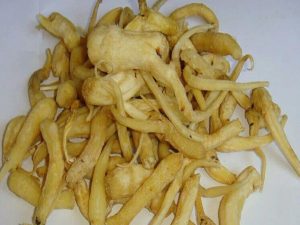
Atractylodes is an irregular, thickened tuber, 3–13 cm long and 1.5–7 cm in diameter. The surface is grayish-yellow or grayish-brown, with tuberous protrusions, intermittent longitudinal wrinkles and grooves, and traces of fibrous roots; the top retains remnants of the stem base and bud scars.It is hard and difficult to break; the fracture surface is uneven, ranging from yellowish-white to pale brown, with scattered brownish-yellow punctate oil glands. When dried, the fracture surface appears horn-like, with a darker color or fissures. It has a fresh, fragrant aroma, a sweet and slightly pungent taste, and feels slightly sticky when chewed.
Properties of Processed Slices
1. Wheat Bran-Fried Atractylodes: Wheat Bran-Fried Atractylodes consists of irregular, thick slices. The surface is scorched yellow or yellowish-brown, occasionally with scorched spots, and has a slight roasted aroma.
2. Earth-Fried Atractylodes: Earth-Fried Atractylodes consists of irregular, thick slices. The surface is apricot-earth yellow, coated with fine earth particles, and has an earthy aroma.
Botanical Information
Botanical Classification
A plant of the genus Atractylodes in the Asteraceae family.
Morphological Characteristics
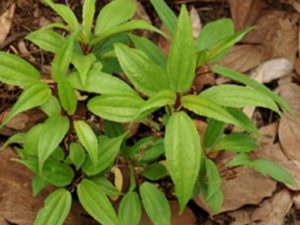
Atractylodes is a perennial herb, 30–60 cm tall. The rhizome is thick and slightly fist-shaped, with irregular branching and a grayish-yellow outer skin. The stem is erect, branched toward the top, lignified at the base, and has indistinct longitudinal grooves.Leaves are alternate; those on the lower part of the stem have long petioles, with leaf blades deeply lobed into 3 (occasionally 5) segments, the apical lobe being the largest. The lobes are elliptic to ovate-lanceolate, with spiny teeth along the margins; the petioles of the upper stem leaves gradually shorten, and the leaf blades are entire, elliptic to ovate-lanceolate, with an acuminate apex, a base that gradually narrows and extends downward into the petiole, weak spines along the margins, and prominent veins.A single capitulum is borne at the branch tip; the involucre is bell-shaped, with 7–8 layers of involucral bracts arranged in an imbricate pattern; the base of the involucre is surrounded by a ring of deeply pinnately lobed, leaf-like bracts;All flowers are tubular, with a purple corolla that is 5-lobed at the apex, spreading or reflexed; there are 5 stamens; the ovary is inferior and densely covered with tomentum; the style is slender and long, with a capitate stigma bearing a shallow slit at the apex. The pappus is pinnately branched and approximately equal in length to the corolla. The achenes are elliptical, slightly flattened, and covered with yellowish-white tomentum. Flowering occurs in the fall.
Distribution Area
Distributed in Zhejiang, Hubei, Hunan, Anhui, and other regions.
Growth Habits
It prefers a cool climate, thrives in shade, and is drought-tolerant, cold-hardy, and tolerant of poor soil; it does not tolerate waterlogging, direct strong sunlight, or high temperatures. It grows best in loose, well-drained, deep, slightly acidic to slightly alkaline light loam.