Xanthium, a name in traditional Chinese medicine. It refers to the whole plant of Xanthium sibiricum Patrin ex Widder or Xanthium mongolicum Kitag., both belonging to the genus Xanthium in the Asteraceae family. It has the effects of dispelling wind, clearing heat, removing dampness, and detoxifying.It is primarily used to treat the common cold, headaches, dizziness, chronic nasal discharge, red eyes, corneal opacities, rheumatic pain, stiffness and numbness, tinea versicolor, boils, scabies, skin itching, hemorrhoids, and dysentery.

Siberian Burdock
Xanthium, a name in traditional Chinese medicine. It refers to the whole plant of Xanthium sibiricum Patrin ex Widder or Xanthium mongolicum Kitag., both belonging to the genus Xanthium in the Asteraceae family. It has the effects of dispelling wind, clearing heat, removing dampness, and detoxifying.It is primarily used to treat the common cold, headaches, dizziness, chronic nasal discharge, red eyes, corneal opacities, rheumatic pain, stiffness and numbness, tinea versicolor, boils, scabies, skin itching, hemorrhoids, and dysentery.
Chinese Name : 苍耳
Aliases : Di Kui, White Coriander, Changsi, Changsi Vegetable, Yangfulai, Jinxian Vegetable, Heqicao, Buddha’s Ear, Wild Eggplant, Pig’s Ear, Chitoupo, Sticky Mallow, False Dwarf Gourd, White Sows’ Vein, Boil Grass, Wild Eggplant, Dog’s Ear Grass, Cangzi Ke
Nature, Flavor & Meridian Tropism : Taste: bitter, pungent; nature: slightly cold; enters the Lung, Spleen, and Liver meridians
Benefits & Efficacy
Benefits
Dispels wind, clears heat, removes dampness, and detoxifies.
Indications
Common cold, headache, dizziness, chronic rhinitis, red eyes, corneal opacity, rheumatic pain, stiffness and numbness, leprosy, boils, scabies, skin itching, hemorrhoids, dysentery.
Usage and Dosage
1. Internal use: Decocted as a soup, 6–12 g; high dose 30–60 g; or pounded to extract juice; or boiled into a paste; or incorporated into pills or powders. 2. External use: Apply an appropriate amount as a poultice; or burn until charred, grind into powder, and apply as a paste; or decoct in water for washing; or boil into a paste for application.
Precautions
Avoid excessive internal use; use with caution in patients with qi deficiency or blood deficiency.
Chemical Constituents
The whole herb contains xanthoglycoside (i.e., β-sitosterol glucoside), cryptoglycoside, xantholide,8-(3-isopentenyl)-5,7,3',4-tetrahydroxyflavone, caffeic acid, 1,4-dicaffeoylquinic acid, as well as chalcone derivatives, water-soluble glycosides,glucose, fructose, amino acids, tartaric acid, succinic acid, fumaric acid, malic acid, potassium nitrate, calcium sulfate, etc.
Pharmacological Actions
Xanthium has vasodilatory and blood pressure-lowering effects.
Relevant Discussions
1. *Mingyi Bielu*: “Treats knee pain and stream-borne toxins.”
2. *Yaoxing Lun*: “Treats liver heat and improves eyesight.”
3. *Bencao Shiyi*: “Rub the leaves under the tongue to induce labor; it also removes yellowing of the eyes and alleviates drowsiness.”
4. *Bencao Mengquan*: “For hemorrhoids protruding from the anus, steaming with a decoction is highly effective.”
5. *De Pei Bencao*: “Treats various wind-induced brain disorders, dizziness, and fainting.” “Severe wind-related infectious diseases.” “Neutralizes the toxicity of realgar.”
6. *Caomu Bianfang*: “Dispels wind-dampness and clears the head and eyes. Treats toothache, chronic nasal discharge, limb numbness and pain, boils, and carbuncles.”
Applications
Clinical Applications
1. To treat headaches caused by stroke or typhoid fever, as well as severe and oppressive carbuncles: Pound fresh Xanthium roots and leaves, mix with the urine of a child suffering from renal colic to extract the juice, and drink one sheng while cold, three times a day. (*Dietary Therapy Materia Medica*)
2. To treat toothache caused by wind: Take a handful of Xanthium, boil it in whey, add salt, and hold it in the mouth. (*Wai Tai*)
3. To treat women suffering from blood wind attacking the brain, causing dizziness, fainting, sudden collapse, and loss of consciousness: Pick the tender shoots of Xanthium, dry them in the shade, grind into powder, and take one daqian with regular wine. (*Doumen Fang*)
4. For corneal opacities: Pound fresh Xanthium herb into a paste, apply it to a medicated plaster, and affix the plaster to the temples. (*Zhejiang Folk Herbal Medicine*)
5. For leprosy: Take equal parts of tender Xanthium and lotus leaves. Grind into a powder; take two qian per dose, mixed with warm wine. (*Pocket Formulas*)
6. For red and white sweat spots: Pound the tips of tender Xanthium leaves with rock salt until pulverized. Rub the mixture onto the affected area five to six times during the months of May and June. (*Selected Mysterious Formulas*)
7. For women suffering from wind-induced itching and rashes, with unrelenting body itching: Take equal parts of Xanthium flowers, leaves, and seeds. Pound them into a fine powder. Take two qian per dose, mixed with soybean-infused wine. (*Formulas of Divine Grace*)
8. For lymph node tuberculosis and unexplained swellings: Use an appropriate amount of the entire Xanthium plant. Chop it finely, boil in water, strain out the residue, and simmer the liquid until it becomes a black ointment. Apply the ointment to an adhesive patch and affix it to the affected area; change the patch once every 7 days. (From *Henan Handbook of Chinese Herbal Medicine*)
Related Compatibility
1. Combining Xanthium with Mulberry Leaves: Xanthium dispels wind and clears heat; mulberry leaves disperse wind and clear heat. The former focuses on dispersing, while the latter excels at promoting penetration.When used in combination, these two herbs complement each other, jointly achieving the effects of dispersing wind-heat and promoting the penetration of the lung-wei system. They are used for external invasion by wind-heat, manifested as fever, mild aversion to cold, headache, nasal congestion, dry throat, and cough, as well as symptoms such as red eyes and dizziness with headache caused by wind-heat.
2. Xanthium combined with Honeysuckle: Xanthium can detoxify, reduce swelling, and disperse exterior pathogens; Honeysuckle clears heat, detoxifies, and cools to disperse wind-heat. When combined, these two herbs can clear heat, detoxify, disperse nodules, reduce swelling, and promote the penetration of pathogenic heat. They are used for the early stages of boils and abscesses.
Notes
Patients requiring treatment with traditional Chinese medicine should first consult a licensed TCM hospital, where a TCM practitioner will conduct a professional pattern differentiation and issue a prescription.
Processing & Preparation
Harvesting & Processing
Harvest the whole plant in summer, remove any soil, cut into sections, and sun-dry, or use fresh.
Processing Methods
Take the raw herb, remove impurities, rinse thoroughly with running water, and moisten slightly. Cut into medium-length sections, dry, and sift out any dust or debris.
Storage Methods
Store in a dry container in a well-ventilated, dry place to prevent mold.
Crude Drug Identification
Properties of Processed Slices
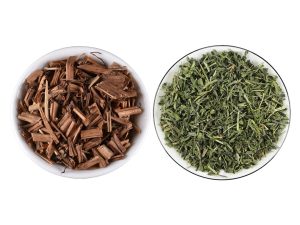
Segmented pieces consisting of a mixture of stems, leaves, flowers, and fruits. The stems are cylindrical, with a brownish-red surface featuring longitudinal ridges, scattered yellowish-white dot-like lenticels, and dark purple streaks. The leaves are dark green, covered with short, coarse hairs on both surfaces.It has a fresh, fragrant aroma and a slightly salty taste. The head-like inflorescence of Xanthium is small, with short, soft hooks; the achenes have an inward-curving beak at the apex. The head-like inflorescence of Mongolian Xanthium is oval, with a hard involucre sparsely covered with stiff hooks. It bears two achenes, each with a forked beak at the apex.
Botanical Information
Botanical Classification
Plants of the genus Xanthium in the Asteraceae family: Xanthium and Mongolian Xanthium.
Morphological Characteristics
1. Xanthium: An annual herb, 20–90 cm tall. The root is spindle-shaped, branched or unbranched. The stem is erect, unbranched or rarely branched; the lower part is cylindrical, the upper part has longitudinal grooves, and it is covered with grayish-white, rough, appressed hairs.Leaves are alternate; long-petiolate, 3–11 cm long; leaf blades are triangular-ovate or cordate, 4–9 cm long, 5–10 cm wide, nearly entire or with 3–5 inconspicuous shallow lobes, apex acute or obtuse, with three basal veins; upper surface green, lower surface pale grayish-white, covered with coarse or short white appressed hairs.Capitula are nearly sessile, clustered, and unisexual on the same plant; male inflorescences are globose, with small bracts arranged in a single row and densely pubescent; the receptacle is columnar, with oblanceolate receptacle segments; florets are tubular, 5-lobed at the apex; stamens number 5, with oblong-linear anthers;female inflorescences are ovate; the involucral bracts are arranged in 2–3 rows, forming a saccate-ovate, 2-chambered, rigid structure with outward-pointing spines on the outside and two conical apices at the top; there are two florets, each without a corolla; the ovary is located within the involucre, with one floret per chamber; the style is linear and protrudes beyond the involucre.The mature, achene-bearing involucre becomes hard, ovate or elliptic, 12–15 mm long including the beak and 4–7 mm wide; it is green, pale yellow, or reddish brown, with sparse, hooked involucral spines on the outside. The involucral spines are slender, 1–1.5 mm long, without a thickened base, and the beak is 1.5–2.5 mm long;There are two achenes, obovate in shape, each containing a single seed. Flowering occurs from July to August, and fruiting from September to October.
2. Mongolian Xanthium: This species differs from Xanthium in that the mature, achenium-bearing involucre is elliptical, 18–20 mm long (including the beak) and 8–10 mm wide, with relatively sparse involucral spines on the outside; the spines are stiff, 2–5.5 mm long (usually 5 mm), and thickened at the base.
Distribution Area
1. Common Burdock: Distributed throughout China. 2. Mongolian Burdock: Distributed in Heilongjiang, Liaoning, Inner Mongolia, and Hebei (Yixian County).
Growth Habits
Prefers a warm, slightly humid climate. Best grown in loose, fertile, well-drained sandy loam.
Propagation Methods
Propagated by seed, either by direct seeding or by raising seedlings for transplanting.
Cultivation Techniques
1. Direct Seeding: In April, dig holes 6–8 cm deep at a spacing of 45 cm × 45 cm. Sow about 8 seeds per hole, cover with soil, lightly tamp down, and water.
2. Seedling Transplanting Method: Start seedlings in March–April. Once seedlings reach about 10 cm in height, transplant 3–4 seedlings per hole.
Pest and Disease Control
Pests include the cabbage looper, cockchafer, and cutworms.