Uncaria is the name of a traditional Chinese medicine. It refers to the dried, hooked stems of the plants Uncaria rhynchophylla (Miq.) Miq. ex Havil., Uncaria macrophylla Wall., Uncaria hirsuta Havil., Uncaria sinensis (Oliv.) Havil. or Uncaria sessilifructus Roxb. The main production areas are Guangxi, Guangdong, Hunan, Jiangxi, and Sichuan. This product has the effects of calming wind and alleviating convulsions, as well as clearing heat and harmonizing the liver. It is primarily used to treat internal liver wind, convulsions and spasms, high-fever convulsions, common cold complicated by convulsions, infantile crying fits, eclampsia during pregnancy, and headaches with dizziness.

Uncaria
Uncaria is the name of a traditional Chinese medicine. It refers to the dried, hooked stems of the plants Uncaria rhynchophylla (Miq.) Miq. ex Havil., Uncaria macrophylla Wall., Uncaria hirsuta Havil., Uncaria sinensis (Oliv.) Havil. or Uncaria sessilifructus Roxb. The main production areas are Guangxi, Guangdong, Hunan, Jiangxi, and Sichuan. This product has the effects of calming wind and alleviating convulsions, as well as clearing heat and harmonizing the liver. It is primarily used to treat internal liver wind, convulsions and spasms, high-fever convulsions, common cold complicated by convulsions, infantile crying fits, eclampsia during pregnancy, and headaches with dizziness.
Chinese Name : 钩藤
Latin Name : Uncariae Ramulus Cum Uncis
Aliases : Diao Teng, Diao Teng, Hook Vine Hook, Diao Hook Vine, Diao Teng Hook, Oriole Claw Wind, Tender Hook, Golden Hook Vine
Authentic Producing Area : Guangxi, Guangdong, Hunan, Jiangxi, Sichuan
Nature, Flavor & Meridian Tropism : Sweet in taste, cool in nature; enters the Liver and Pericardium meridians
Benefits & Efficacy
Benefits
Calms wind and relieves convulsions; clears heat and pacifies the liver.
Indications
Uncaria is primarily used to treat internal liver wind, convulsions and spasms, febrile convulsions, colds complicated by convulsions, infantile crying fits, eclampsia, and headaches with dizziness.
Usage and Dosage
Oral use: Decoction, 3–12 g, added later in the decoction.
Precautions
Patients requiring treatment with traditional Chinese medicine should first consult a licensed TCM hospital, where a TCM practitioner will conduct a professional pattern differentiation and issue a prescription.
Chemical Constituents
It primarily contains indole alkaloids (such as uncarin, iso-uncarin, dehydro-uncarin, and iso-dehydro-uncarin), triterpenoids (such as hederagenin and uncaggenin), and flavonoids (such as quercetin and quercetin glycosides).
Pharmacological Actions
This product has pharmacological effects including antiepileptic, sedative, anti-psychotropic dependence, antihypertensive, anti-cerebral ischemia, antispasmodic, anxiolytic, and neuroprotective properties.
Relevant Discussions
1. *Mingyi Bielu*: “Treats fever and chills in children, as well as the twelve types of convulsions and epilepsy.”
2. *Yaoxing Lun*: “Treats convulsive crying in children, as well as convulsions and heat congestion.”
3. *Bencao Gangmu*: “For adults with dizziness and vertigo, it calms liver wind and clears heart heat; for children with abdominal pain and rashes.”
Applications
Clinical Applications
1. Treatment of night crying in children: A modified version of the Cicada Shedding and Uncaria Decoction (Chan Tui Gou Teng San) is used; the combination of Uncaria, Cicada Shedding, White Peony Root, Wood Fragrance, Sichuan Lovage, and Corydalis is effective for treating night crying in children.
2. Treatment of facial nerve paralysis: The modified Peony, Uncaria, and Wood Ear Fungus Decoction, combined with acupuncture, is effective for treating facial nerve paralysis. Additionally, there are clinical reports of using Uncaria to treat streptomycin reactions, athlete’s foot, and whooping cough.
Related Compatibility
1. Gou Teng Combined with Cicada Shedding: Gou Teng clears and drains liver heat, calms and lowers liver yang, and can clear and dispel pathogenic heat; Cicada Shedding excels at dispersing wind-heat in the lung and liver meridians, improving vision and removing corneal opacities, cooling the liver, subduing wind, and relieving spasms.When used together, these two herbs disperse wind and clear heat, subdue liver yang and calm wind, and improve vision while removing opacities. This combination can be used to treat colds complicated by startle reactions, infantile crying fits, wind-heat headaches, and headaches accompanied by dizziness.
2. Gou Teng combined with Niuxi: Gou Teng clears heat and calms the liver; Niuxi tonifies the liver and kidneys, and directs blood and fire downward. When used together, one clears while the other tonifies—clearing the upper and tonifying the lower—to clear heat and calm the liver. This combination is frequently used to treat liver yang hyperactivity, dizziness, and vertigo.
3. Uncaria combined with Lithospermum: Uncaria is cool in nature, light, and ascending, functioning to clear and disperse pathogenic heat; Lithospermum is cold in nature, cools the blood, promotes blood circulation, detoxifies, and promotes the eruption of rashes. When used together, these two herbs enhance the effects of clearing heat, cooling the blood, detoxifying, and promoting rash eruption. This combination is suitable for warm diseases characterized by excessive blood heat and toxin, purple-black macules, and measles that fail to erupt properly.
Medicinal Identification
Uncaria and Chrysanthemum: Both herbs enter the Liver Meridian; they can both pacify Liver Yang and clear Liver heat, as well as disperse wind-heat. They can be used to treat exterior wind-heat syndromes and dizziness and headaches caused by excessive Liver Yang or ascending Liver fire.However, Uncaria is particularly effective at subduing wind and relieving spasms; it is a commonly used herb for treating internal liver wind, convulsions, and epileptic seizures. It can be used for conditions such as febrile convulsions, common cold complicated by convulsions, infantile crying fits, and eclampsia during pregnancy. Chrysanthemum excels at dispersing wind-heat and can also clear heat and eliminate toxins; it is used to treat boils, abscesses, and toxic swellings.
Related Medicines
Brain-Clearing and Blood-Pressure-Lowering Tablets, Epilepsy-Relieving Tablets, Heart-Vessel-Unblocking Tablets, and Gastrodia and Uncaria Granules.
Related Prescriptions
Gou Teng Decoction (*Yi Zong Jin Jian*), Ling Jiao Gou Teng Decoction (*Tong Su Shang Han Lun*), Gou Teng Decoction with Seeds (*Qi Xiao Liang Fang*), Gou Teng Powder (*Ben Shi Fang*).
Medicinal Diet Therapy
Tianma and Uncaria Tea:
1. Effects: Calms the liver and subdues wind; soothes the mind and calms the spirit. Suitable for hypertension caused by liver yang hyperactivity, as well as symptoms such as dizziness, vertigo, neurasthenia, and numbness in the limbs.
2. Ingredients: 5 g of Tianma, 6 g of Uncaria, and 10 g of green tea.
3. Preparation: Wash the Tianma and Gou Teng, add an appropriate amount of water, and decoct twice; strain out the residue. Use the resulting liquid to steep the green tea; cover tightly and let steep for 5–10 minutes.
4. Usage: One dose daily; drink as a tea substitute.
Processing & Preparation
Harvesting & Processing
Harvest in the fall and winter; remove the leaves, cut into sections, and sun-dry.
Processing Methods
Take the raw herbal material and remove impurities. For uncut material, after removing impurities, rinse with water, moisten until soft, cut into sections, and dry.
Storage Methods
Store in a dry container, seal tightly, and keep in a cool, dry place to prevent mold.
Crude Drug Identification
Properties of Crude Drugs
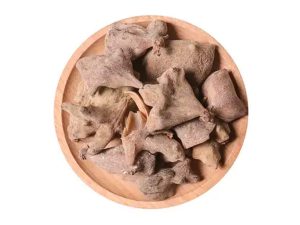
The stems and branches are cylindrical or nearly square in cross-section, 2–3 cm long, and 0.2–0.5 cm in diameter. Those with a reddish-brown to purplish-red surface have fine longitudinal striations and are smooth and glabrous; those with a yellowish-green to grayish-brown surface may have visible white, dot-like lenticels and are covered with yellowish-brown soft hairs.On most nodes, two downward-curving hooks (sterile inflorescence pedicels) are arranged oppositely, or hooks are present on only one side, with a raised scar on the other; the hooks are slightly flattened or somewhat rounded, with a fine, pointed tip and a relatively broad base; on the branches at the base of the hooks, pitted marks where petioles have fallen off and annular stipule scars are visible.The texture is tough and resilient; the cross-section is yellowish-brown, with a fibrous cortex and a yellowish-white or hollow pith. It has a faint odor and a bland taste.
Properties of Processed Slices
It consists of irregular small segments; each stem node bears a pair or a single downward-curving hook; the surface is reddish-brown or brownish-black; the cross-section is yellowish-brown; the pith is yellowish-white or hollow; it is odorless and has a bland taste.
Botanical Information
Botanical Classification
Species of the genus Uncaria in the Rubiaceae family, including Uncaria, Large-leaved Uncaria, Hairy Uncaria, Chinese Uncaria, and Stemless-fruited Uncaria.
Morphological Characteristics
1. Uncaria: An evergreen woody vine that can grow up to 10 m in length. Twigs are quadrangular, brown, and glabrous. Hooks, occurring in pairs or singly, are present in the leaf axils; they curve downward, have pointed tips, and are 1.7–2 cm long.Leaves are opposite; short-petiolate; leaf blades are ovate, ovate-oblong, or elliptic, 5–12 cm long and 3–7 cm wide, with an acuminate apex, a broadly cuneate base, and entire margins; the upper surface is glossy, while the lower surface often bears tufts of hairs within the axils of the veins, giving it a slightly whitish-powdery appearance that turns brownish-red when dry; stipules are deeply bifid, with linear-acicular lobes 6–12 mm long.Capitula are solitary and axillary or arranged in terminal racemes, 2–2.5 cm in diameter; the peduncle is slender, 2–5 cm long; flowers are yellow, with a fused corolla that is 5-lobed at the top, the lobes covered with powdery pubescence on the outside; there are 5 stamens; the ovary is inferior. The capsule is obovate or elliptic, sparsely pubescent, and bears a persistent calyx.The seeds are winged at both ends.
2. Hua Gou Teng: This species is similar to Gou Teng, but the leaves are glabrous; the stipules are entire, broadly triangular to circular, or sometimes slightly depressed at the apex; the calyx lobes are linear-oblong; the flowers and small capsules are nearly sessile, and small bracts are present between the flowers.
3. Large-leaved Uncaria: This species is similar to the previous two, but the leaves are large and leathery; the calyx lobes are linear-oblong; the flowers and small capsules are stalked, and there are no small bracts between the flowers.
Distribution Area
1. Uncaria: Found in Shaanxi, Anhui, Zhejiang, Jiangxi, Fujian, Hubei, Hunan, Guangdong, Guangxi, Sichuan, Guizhou, Yunnan, and other regions. 2. Chinese Uncaria: Found in Hubei, Hunan, Guangxi, Sichuan, Guizhou, Yunnan, and other regions. 3. Large-leaved Uncaria: Found in Guangdong, Guangxi, Yunnan, and other regions.
Growth Habits
Prefers a warm and humid climate; does not tolerate severe cold. Best cultivated in deep, loose, fertile loam rich in humus.
Propagation Methods
Propagation is by seed or division.
Cultivation Techniques
1. Seed Propagation: Harvest mature seeds in October–November and sow immediately. Use row sowing: dig furrows with a row spacing of 12–15 cm, scatter the seeds evenly, and cover with a thin layer of fine soil. Seedlings will emerge the following spring after overwintering; ensure proper care, including watering and fertilization. Transplant in the spring after one year of cultivation.
2. Division: In the spring, use a hoe to gently damage the roots around the base of the mother plant to stimulate the growth of adventitious buds. After one year, cut off the new shoots with their roots attached and plant them.