Rhinoceros Horn is a name for a traditional Chinese medicine. It refers to the horn of a rhinoceros. The Tang Dynasty text *Yao Xing Ben Cao* (Compendium of Medicinal Properties) states that rhinoceros horn has the effects of “calming the mind, relieving severe fever, and dispelling wind toxins,” and can be used to treat conditions such as “fever as intense as fire, restlessness, toxins invading the heart, and delirious speech.” These therapeutic effects are entirely due to the cooling nature inherent in rhinoceros horn.Since rhinos are nationally protected animals, the use of rhino horn as medicine has been banned; water buffalo horn is now commonly used as a substitute.
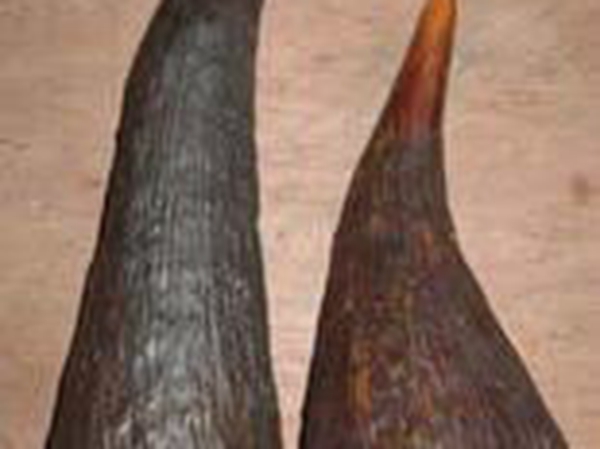
Rhinoceros Horn
Rhinoceros Horn is a name for a traditional Chinese medicine. It refers to the horn of a rhinoceros. The Tang Dynasty text *Yao Xing Ben Cao* (Compendium of Medicinal Properties) states that rhinoceros horn has the effects of “calming the mind, relieving severe fever, and dispelling wind toxins,” and can be used to treat conditions such as “fever as intense as fire, restlessness, toxins invading the heart, and delirious speech.” These therapeutic effects are entirely due to the cooling nature inherent in rhinoceros horn.Since rhinos are nationally protected animals, the use of rhino horn as medicine has been banned; water buffalo horn is now commonly used as a substitute.
Chinese Name : 犀牛角
Latin Name : Rhinoceros unicornis L., Rhinoceros xondaicus Desmarest, Rhinoceros sumatrensis (Fischer), Rhinoceros nicornis LR. simus Burchell
Aliases : Rhinoceros Horn
Authentic Producing Area : Indian rhinoceros: Nepal and northern India; Javan rhinoceros: Java; Sumatran rhinoceros: Myanmar, Thailand, Malaysia, and Sumatra and Borneo in Indonesia
Nature, Flavor & Meridian Tropism : Sour, salty, and cold in nature. Enters the Heart and Liver meridians.
Benefits & Efficacy
Benefits
Clears heat, cools the blood, and detoxifies.
Indications
Mainly used to treat high fever in warm diseases, mental confusion and delirium, convulsions and spasms, and blood heat-induced vomiting and epistaxis.
Usage and Dosage
6–15 g; coarsely chop and decoct first; may also be ground into powder and taken with hot water.
Precautions
Not suitable for those with spleen and stomach deficiency-cold. 1. *Lei Gong’s Treatise on Medicinal Preparation*: “Pregnant women should not take this, as it can disperse and regulate qi.” 2. *Collected Annotations to the Classic of Materia Medica*: “Pine resin is its assistant herb. It is incompatible with Jun and Leiwan.” 3. *Compendium of Materia Medica*: “Cimicifuga is its assistant herb. It is incompatible with Aconite and Wuhui.” 4. *Commentary on the Classic of Materia Medica*: “Not suitable for cases of smallpox with qi deficiency and no severe fever; should not be mistakenly used for cases of typhoid fever with yin syndrome presenting restlessness.”
Chemical Constituents
The main component of rhinoceros horn is keratin. It also contains other proteins, peptides, free amino acids, guanidine derivatives, and sterols. Among the amino acids comprising rhinoceros horn keratin, cysteine accounts for 8.7%, along with three basic amino acids: arginine, lysine, and arginine.Its molecular ratio is 1:5:12; therefore, similar to wool and bovine horn, it primarily belongs to the eukeratin group.
Relevant Discussions
1. *Compendium of Materia Medica*: “Rhinoceros horn is a medicine for the Stomach Meridian of the Foot-Yangming. The stomach is the ‘sea of water and grain’; food, drink, and medicines must first pass through it. Therefore, rhinoceros horn can neutralize all kinds of toxins. The five zang organs and six fu organs all derive their qi from the stomach; wind pathogens and heat toxins must first affect it. Therefore, rhinoceros horn can treat various blood-related disorders, as well as symptoms of mania, delirium, and smallpox.”
2. *Commentary on the Classic of Materia Medica*: “Rhinoceros horn is currently used to treat hemoptysis, epistaxis, and hematochezia; as well as mania and delirium caused by blood stasis in typhoid fever; jaundice; maculopapular rashes; and conditions such as dense, intensely hot, black, and sunken sores and abscesses. All these applications rely on its ability to enter the Stomach and Heart meridians, disperse pathogenic factors, clear heat, cool the blood, and neutralize toxins.”
3. *The Correct Materia Medica*: “Rhinoceros Horn has an ascending nature and excels at dispersing; therefore, it treats cases of typhoid fever where toxic heat obstructs the exterior, causing restlessness, fever, and drowsiness without the ability to sweat. When its tip is ground and mixed into the formula, it induces sweating as swiftly as a response to a call. Zhang Zhongjing stated: ‘If rhinoceros horn is unavailable, use Cimicifuga root as a substitute.’ This is precisely because both substances enter the Yangming channel and share the functions of ascending and dispersing; yet, people today fail to understand this.Whenever doubts are raised, it is because people only recognize rhinoceros horn’s ability to clear heart heat, but fail to recognize that its ascending and dispersing properties are even more potent and rapid than those of Cimicifuga. In cases of deficient middle qi with a fine, lifeless pulse, or in conditions such as blood deficiency in smallpox lesions and insufficiency of true yin—where there is aversion to sweating, aversion to cold, or aversion to dispersing agents—its use should be strictly avoided. If its use is absolutely unavoidable, it should be administered in conjunction with tonifying agents.”
4. *Benjing Fengyuan*: “Rhinoceros Horn treats hemoptysis, epistaxis, and blood in the urine or stool; the Rhinoceros Horn and Rehmannia Decoction is the specific formula for this.However, it is strictly contraindicated for patients with chronic qi deficiency, as it can disperse blood and qi. It is particularly essential for smallpox cases characterized by intense blood heat and toxin; yet, during the sixth or seventh day when the lesions are filling with fluid, it is strictly contraindicated, as it can transform pus into fluid. However, for residual toxins leading to abscesses and swellings after scab formation, it is not contraindicated; only in cases of smallpox with qi deficiency and intense toxin should it absolutely not be used.”
Applications
Processing & Preparation
Processing Methods
Rhinoceros Horn Slices: Split the rhinoceros horn into sections, soak in warm water, remove, slice, and sun-dry. Rhinoceros Horn Powder: Grind the rhinoceros horn into an extremely fine powder.
(1) *Lei Gong’s Treatise on Processing and Roasting*: When processing any type of horn, salt is strictly prohibited.
(2) *Extended Commentary on the Materia Medica*: The tip of the rhinoceros horn is best ground into powder for oral administration; if used in decoctions or powders, it should be finely ground.
Crude Drug Identification
Botanical Information
Botanical Classification
Rhinocerotidae: White rhinoceros, black rhinoceros, Indian rhinoceros, Javan rhinoceros, and Sumatran rhinoceros.
Morphological Characteristics
1. Indian Rhinoceros, also known as the “Single-Horned Rhinoceros” (*Compendium of Materia Medica*). It has a robust and massive build, with a body weight second only to that of elephants and hippopotamuses. Its body length is approximately 3.2–3.5 meters, and its shoulder height reaches 1.8 meters. It has a large head, short neck, long ears, small eyes, and large nostrils. Its skin is thick and tough, and it is completely hairless except for the ears and tail.It has broad, shield-shaped folds of skin on the shoulders, under the neck, and at the joints of the limbs. The skin surface is covered with numerous wart-like protrusions and is blackish-gray in color with a slight purplish tint. Both males and females have a single horn at the tip of the nose; it is black, conical, thick but not long, typically measuring about 30–40 centimeters. The limbs are robust, each with three toes.It inhabits humid, dense savanna-like grasslands in subtropical regions. It lives alone or in pairs; it is nocturnal, with keen senses of smell and hearing but poor eyesight. Its diet consists of fresh branches, tender shoots, bamboo, mangoes, and other similar foods.
2. Javan Rhinoceros, also known as the Pygmy Rhinoceros. Its appearance is similar to that of the Indian Rhinoceros but smaller.Its skin also has thick folds, but the three folds on its back are completely connected at the top and bottom. Only the males of this species have horns, which grow from the tip of the nose; the horns are small, measuring only about 25 centimeters in length. It inhabits tropical dense forests, enjoys swimming, and avoids direct sunlight. It often lives alone or in pairs, feeding on fresh branches, tender shoots, leaves, bamboo, mangoes, and figs.
3. Sumatran Rhinoceros, also known as the Two-horned Rhinoceros. It is the smallest in size, with a body length of approximately 2.4 to 2.5 meters. Its body is heavily furred, brown or black in color, with coarse, thick skin. Both males and females have two horns on their noses; the front horn is long and the rear horn is short, arranged in a vertical row. The upper lip is not protruding. Its lifestyle is similar to that of the previous species.
Distribution Area
1. Indian rhinoceros, found in Nepal and northern India. 2. Javan rhinoceros, found on Java. 3. Sumatran rhinoceros, found in Myanmar, Thailand, Malaysia, and parts of Indonesia such as Sumatra and Borneo.