Taxus refers to the dried branches and leaves of the Northeast Chinese yew (Taxus cuspidata Sieb. et Zucc.) of the Taxaceae family. It is primarily produced in Jilin and Heilongjiang, with a small distribution in Liaoning as well.This herb has a sweet and bland taste, a neutral nature, and enters the Kidney meridian. It has the effects of promoting diuresis and reducing edema, as well as warming the Kidney and unblocking the meridians. It is commonly used to treat edema, difficulty urinating, dysuria, irregular menstruation, postpartum blood stasis, and dysmenorrhea. In addition, Taxus contains antitumor compounds such as paclitaxel, triterpenoid alkaloids, and bacartine III, and can therefore be used to treat various neoplastic diseases.
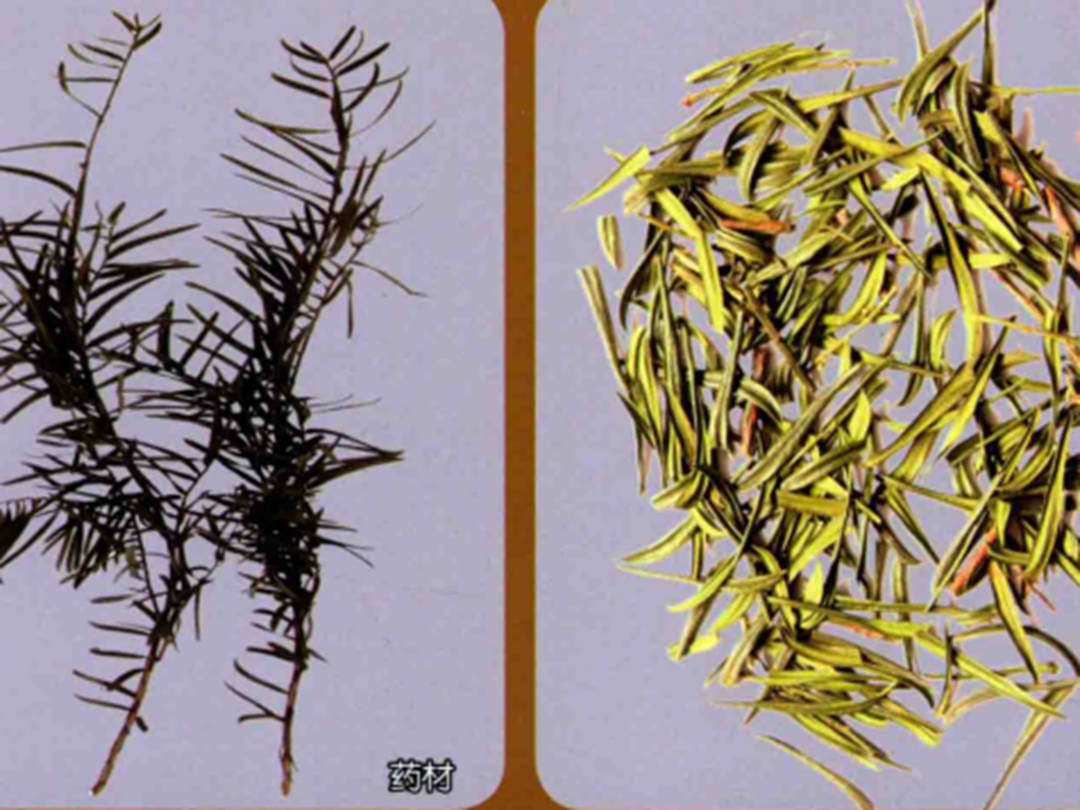
Yew
Taxus refers to the dried branches and leaves of the Northeast Chinese yew (Taxus cuspidata Sieb. et Zucc.) of the Taxaceae family. It is primarily produced in Jilin and Heilongjiang, with a small distribution in Liaoning as well.This herb has a sweet and bland taste, a neutral nature, and enters the Kidney meridian. It has the effects of promoting diuresis and reducing edema, as well as warming the Kidney and unblocking the meridians. It is commonly used to treat edema, difficulty urinating, dysuria, irregular menstruation, postpartum blood stasis, and dysmenorrhea. In addition, Taxus contains antitumor compounds such as paclitaxel, triterpenoid alkaloids, and bacartine III, and can therefore be used to treat various neoplastic diseases.
Chinese Name : 紫杉
Aliases : Northeastern Red Yew, Red Cypress
Nature, Flavor & Meridian Tropism : Taste: sweet and bland; nature: neutral; enters the Kidney meridian
Benefits & Efficacy
Benefits
Taxus has a sweet and bland taste, a neutral nature, and enters the Kidney meridian; it has the effects of promoting diuresis and reducing edema, as well as warming the Kidney and unblocking the meridians.
Indications
Taxus chinensis is primarily used to treat edema, difficulty urinating, dysuria, irregular menstruation, postpartum blood stasis, and dysmenorrhea.
Usage and Dosage
It is taken orally as a decoction; the common dosage for leaves is 5–18 g, and for twigs (without bark) is 9–15 g. The specific dosage should be determined based on the advice of a professional TCM practitioner.
Precautions
1. Taxus is toxic; do not exceed the recommended dosage. 2. If you experience significant adverse reactions to Taxus, discontinue use immediately and consult a physician.
Chemical Constituents
Taxus contains components such as paclitaxel, taxol, taxine, Taxus acutifolia sterol A, ecdysterone, and Taxus biflavone.
Pharmacological Actions
Modern pharmacological research has found that Taxus possesses antitumor, hypoglycemic, central nervous system depressant, anti-hepatitis B virus, and anti-angiogenic effects.
Relevant Discussions
1. According to *Flora of Medicinal Plants of Northeast China*, the leaves of Taxus are “used as a diuretic to promote urine flow.”
2. According to *Jilin Herbal Medicine*, Taxus “promotes urine flow and treats kidney disease and diabetes.”
Applications
Clinical Applications
1. Neoplastic Diseases: Taxus can be used to treat various cancers, including esophageal cancer, gastric cancer, colorectal cancer, lung cancer, melanoma, ovarian cancer, and leukemia. Currently, its extract, paclitaxel, is already in clinical use, and Taxus decoction pieces are gradually being applied in clinical practice and can be combined with other anticancer drugs.Reports indicate that taxane-based anticancer drugs have shown relatively good efficacy in the treatment of solid tumors such as breast cancer, lung cancer, and ovarian cancer, with particularly favorable results observed in patients with recurrent disease who have previously undergone chemotherapy.
2. Other Uses: Taxus can also be used to treat conditions such as diabetes and edema associated with nephritis.
Related Compatibility
Taxus can be combined with Akebia and corn silk to treat edema and difficulty urinating.
Related Medicines
Examples include paclitaxel injections.
Notes
Patients requiring treatment with Taxus should first consult a licensed Traditional Chinese Medicine (TCM) hospital, where a TCM practitioner will conduct a professional pattern differentiation and issue a TCM prescription.
Processing & Preparation
Harvesting & Processing
Harvest in summer and fall, then sun-dry.
Processing Methods
Take the raw herbal material, remove impurities, sift out dust and debris, and chop it into small pieces.
Storage Methods
Store in a cool, dry place.
Crude Drug Identification
Properties of Crude Drugs
The outer bark of the thick branches is reddish-brown with shallow fissures; the twigs are dense, alternate, brown or greenish-yellow, with slightly protruding leaf stalk remnants. The leaves fall off easily; they are arranged in a spiral pattern in two irregular rows, spreading at an angle of approximately 45 degrees to the twigs;The leaf blades are linear, 1.5–2.5 cm long and 2.5–3 mm wide, with an acute apex, revolute margins, a narrow base, and a short petiole; the upper surface is slightly wrinkled, dark brownish-green or brownish-green, with a slight sheen, while the lower surface is brown, with a slightly raised midrib. It has a distinctive odor and tastes slightly sweet at first, followed by bitterness.
Botanical Information
Botanical Classification
Northeast Chinese yew (Taxus chinensis), a member of the genus Taxus in the family Taxaceae.
Morphological Characteristics
An evergreen tree, approximately 17 m tall, with a breast height diameter of 10–30 cm.The bark is reddish-brown or grayish-reddish-brown and peels off in flakes. Leaves are arranged spirally in two irregular, overlapping rows, spreading at an angle of about 45 degrees from the twigs; they are slightly sickle-shaped, nearly equal in width at the top and bottom, 1.5–3.5 cm long and 2.5–3 mm wide, with an acute apex, a narrow base, and a raised midrib.Flowers are unisexual; the plant is dioecious. Spherical inflorescences occur singly in the leaf axils of branches from the previous year. Seeds are ovoid, enclosed within a deep red, fleshy, succulent, cup- or jar-shaped aril; the base bears multiple pairs of yellow scales. When ripe, the seeds are purplish-brown and glossy. Flowering occurs from May to June; fruiting occurs from July to August.
Distribution Area
It is distributed in Jilin, Heilongjiang, Liaoning, and other regions.
Growth Habits
It tolerates shade and is highly cold-hardy. It typically grows as solitary trees and does not form pure stands. It thrives in humus-rich, moist, loose soil and environments with high atmospheric humidity. It has a shallow root system with well-developed lateral roots and grows very slowly.
Propagation Methods
Propagated by seed or cuttings.