Sea Wind Vine is a commonly used herb for dispelling wind, cold, and dampness. It consists of the dried vine stems of Piper kadsura (Choisy) Ohwi, a plant in the Piperaceae family. It is effective in dispelling wind and dampness, unblocking meridians, and relieving arthralgia. It is frequently used to treat arthralgia caused by wind, cold, and dampness; pain in the limbs and joints; stiffness of tendons and meridians; difficulty in flexing and extending joints; trauma; and localized swelling and pain.

Sea Wind Vine
Sea Wind Vine is a commonly used herb for dispelling wind, cold, and dampness. It consists of the dried vine stems of Piper kadsura (Choisy) Ohwi, a plant in the Piperaceae family. It is effective in dispelling wind and dampness, unblocking meridians, and relieving arthralgia. It is frequently used to treat arthralgia caused by wind, cold, and dampness; pain in the limbs and joints; stiffness of tendons and meridians; difficulty in flexing and extending joints; trauma; and localized swelling and pain.
Chinese Name : 海风藤
Latin Name : Piperis Kadsurae Caulis
Aliases : Mankengxiang, Laoteng, Dafengteng, Yanhuojiao
Authentic Producing Area : Mainly produced in Fujian, Hainan, and Zhejiang
Nature, Flavor & Meridian Tropism : Pungent and bitter in taste; slightly warm in nature; enters the Liver Meridian
Benefits & Efficacy
Benefits
Wind-cold-damp bi syndrome, pain in the limbs and joints, stiffness of tendons and vessels, and difficulty in flexing and extending.
Indications
Mainly used to treat wind-cold-damp bi syndrome, pain in the limbs and joints, stiffness of tendons and vessels, difficulty in flexing and extending, trauma, and localized swelling and pain.
Usage and Dosage
Internal use: Decocted as a soup, 6–12 g. External use: Apply as needed.
Precautions
Should not be used long-term in combination with herbs that are “cold” in nature and may easily damage the spleen and stomach (such as Coptis and Scutellaria), to avoid counteracting the warming and unblocking properties of Kadsura vine and simultaneously impairing spleen and stomach function.
Chemical Constituents
This product contains fine-leaved Qinglou藤 saponin, fine-leaved Qinglou藤 ketone, fine-leaved Qinglou藤 quinone alcohol, fine-leaved Qinglou藤 amide, β-sitosterol, stigmasterol, and essential oils, among others.
Pharmacological Actions
This product has anti-inflammatory and analgesic effects, inhibits platelet-activating factor, and provides neuroprotection against cerebral ischemia.
Relevant Discussions
1. *Ben Cao Zai Xin*: Promotes the flow of meridians, harmonizes the blood vessels, relieves epigastric distension and regulates qi, expels dampness and wind, alleviates lower back and leg discomfort, treats hernias, and stabilizes pregnancy.
2. *Zhejiang Manual of Traditional Chinese Medicine*: Dispels bi syndrome, transforms dampness, unblocks meridians and relaxes tendons, and treats weakness and numbness in the lower back and knees, as well as joint pain.
Applications
Clinical Applications
1. A commonly used herb for treating wind-cold-damp bi syndrome, joint pain, stiffness of tendons and vessels, and difficulty in flexing and extending the limbs. It is often combined with Qianghuo, Duhuo, Guixin, and Danggui, as in the Juanbi Decoction (*Insights into Medicine*).
2. For treating trauma, bruising, swelling, and pain, it can be combined with Sanqi, Dibachong, and Honghua.
Related Compatibility
1. Sea Wind Vine combined with Cinnamon Twig: Sea Wind Vine dispels wind and dampness, unblocks the meridians, and relieves pain; Cinnamon Twig warms yang, unblocks the vessels, and relieves pain. When combined, these two herbs exhibit superior efficacy in dispelling wind and dampness and relieving pain. This combination is suitable for rheumatic arthralgia, joint stiffness, and stiffness of tendons and vessels.
2. Sea Wind Vine combined with Weilingxian: Sea Wind Vine dispels wind and unblocks the meridians, relieving stiffness; Weilingxian dispels wind and dampness, unblocks the meridians, and relieves pain. When used together, they exhibit superior efficacy in dispelling wind-dampness, unblocking the meridians, and relieving pain. This combination is suitable for rheumatic arthralgia, joint stiffness, and muscle and tendon spasms.
3. Sea Wind Vine combined with Chicken Blood Vine: Both herbs have the effect of dispelling wind and unblocking meridians. Chicken Blood Vine tends to nourish and invigorate the blood while relaxing the tendons; Sea Wind Vine tends to dispel wind, unblock meridians, and relieve pain. When combined, they enhance the effects of dispelling wind, unblocking meridians, and relieving pain, making them suitable for wind-cold-damp arthralgia and aching limbs.
Related Medicines
Scatter Wind and Activate Meridians Pills (Concentrated Pills), Tianhe Zhui Feng Ointment, Leopard Bone Meridian-Activating Pills, and Wind-Injury Pain-Relieving Ointment.
Related Prescriptions
Tendon-Relaxing Decoction (*Yi Lue Liu Shu*), Yuxian Ointment (*Zun Sheng Ba Jian*).
Notes
Patients requiring treatment with Chinese herbal medicine should first consult a licensed Traditional Chinese Medicine (TCM) hospital to receive a prescription following a professional TCM differential diagnosis.
Processing & Preparation
Harvesting & Processing
Harvest in summer and autumn; remove the roots and leaves, then sun-dry.
Processing Methods
Take the raw herb, remove impurities, soak until thoroughly moistened, cut into thick slices, and sun-dry.
Storage Methods
Store in a well-ventilated, dry place.
Crude Drug Identification
Properties of Crude Drugs
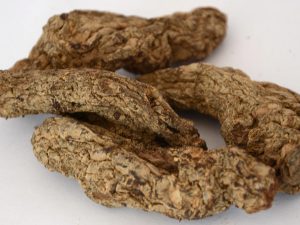
This product is flat and cylindrical in shape, slightly curved, 15–60 cm long, and 0.3–2 cm in diameter. The surface is grayish-brown or brown, rough, with longitudinal ridges and distinct nodes; internodes are 3–12 cm long, and the nodes are swollen, with adventitious roots growing from them.It is light in weight, brittle, and breaks easily; the fracture surface is irregular. The phloem is narrow, and the xylem is broad and grayish-yellow, containing numerous vascular pores. The rays are grayish-white and arranged radially; there is often a fissure at the boundary between the phloem and xylem, with a grayish-brown pith at the center. It has a fragrant odor and a slightly bitter, pungent taste.
Properties of Processed Slices
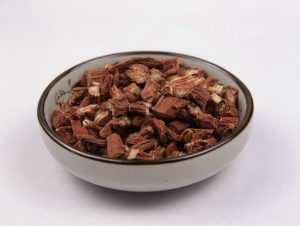
This product consists of irregular, flattened cylindrical thick slices with a diameter of 0.3–2.0 cm. The surface is grayish-brown or brown, with longitudinal ridged texture.On the cross-section, the phloem is narrow, while the xylem is broad and grayish-yellow, with numerous vascular pores and a radial pattern of alternating grayish-yellow and grayish-white bands; a fissure is present at the boundary between the phloem and xylem, and the center contains grayish-brown pith. It is light in weight and brittle. It has a fragrant aroma and a slightly bitter, pungent taste.
Botanical Information
Botanical Classification
A plant of the genus Piper in the family Piperaceae, known as "Wind Vine."
Morphological Characteristics
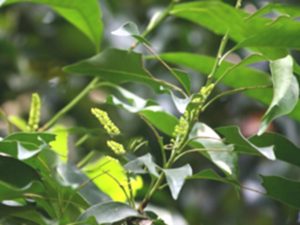
A woody vine. The stems are longitudinally ridged, sparsely hairy when young, and produce roots at the nodes. The leaves are nearly leathery, with white glandular dots; they are ovate or oblong-ovate, 6–12 cm long and 3.5–7 cm wide, with a short acute or obtuse apex and a cordate or, rarely, obtuse-rounded base; the upper surface is glabrous, while the lower surface is usually covered with short soft hairs; there are five veins, arising from the base or near the base;petioles 1–1.5 cm long, sometimes hairy; leaf sheaths present only at the base. Flowers unisexual, dioecious, arranged in spicate inflorescences opposite the leaves; male inflorescences 3–5.5 cm long; peduncle slightly shorter than the petiole, rachis covered with fine stiff hairs; bracts round, nearly sessile, scutellate, about 1 mm in diameter, upper surface covered with white coarse hairs;There are 2–3 stamens with short filaments; the female inflorescence is shorter than the leaf blade; the peduncle is as long as the petiole; the bracts and inflorescence axis are the same as those of the male inflorescence; the ovary is globose and free, with 3–4 linear stigmas covered with short soft hairs. The berry is globose, brownish-yellow, and 3–4 mm in diameter. Flowering occurs from May to August.
Distribution Area
Distributed in Zhejiang, Fujian, Taiwan, Guangdong, and other areas.