Mesona chinensis, a name for a traditional Chinese medicinal herb. It refers to the dried aerial parts of Mesona chinensis Benth., a plant in the genus Mesona of the Lamiaceae family. It has the effects of relieving summer heat, clearing heat, cooling the blood, and detoxifying.It is primarily used to treat heatstroke, diabetes, jaundice, diarrhea, dysentery, hypertension, muscle and joint pain, acute nephritis, wind-fire toothache, burns and scalds, erysipelas, syphilis, and lacquer allergy.

Mesona
Mesona chinensis, a name for a traditional Chinese medicinal herb. It refers to the dried aerial parts of Mesona chinensis Benth., a plant in the genus Mesona of the Lamiaceae family. It has the effects of relieving summer heat, clearing heat, cooling the blood, and detoxifying.It is primarily used to treat heatstroke, diabetes, jaundice, diarrhea, dysentery, hypertension, muscle and joint pain, acute nephritis, wind-fire toothache, burns and scalds, erysipelas, syphilis, and lacquer allergy.
Chinese Name : 凉粉草
Latin Name : Herba Mesonae Chinensis
Aliases : Herb of the Immortals, Immortal Jelly, Immortal Grass
Authentic Producing Area : Zhejiang, Jiangxi, Guangdong, Guangxi
Nature, Flavor & Meridian Tropism : Sweet and bland in taste; cold in nature; enters the Liver and Spleen meridians
Benefits & Efficacy
Benefits
Relieves summer heat, clears heat, cools the blood, and detoxifies.
Indications
Heatstroke, diabetes, jaundice, diarrhea, dysentery, hypertension, muscle and joint pain, acute nephritis, wind-fire toothache, burns and scalds, erysipelas, syphilis, lacquer allergy.
Usage and Dosage
1. Internal use: Decoct 15–30 g; a high dose of up to 60 g may be used. 2. External use: Apply an appropriate amount as a powdered poultice; wash with a decoction; or apply a poultice made from the fresh herb.
Precautions
Do not use in cases of wind-cold common cold.
Chemical Constituents
It primarily contains chemical components such as flavonoids, phenols, terpenoids, tannins, amino acids, polysaccharides, and vitamins, as well as trace elements including calcium, zinc, iron, manganese, and potassium.
Pharmacological Actions
The flavonoids in cool-powder grass inhibit the growth of cancer cells and lower blood pressure; polysaccharides enhance and boost the body’s immune function; trace elements inhibit the formation of free radicals and possess anti-aging and anticancer effects; vitamins regulate and enhance physiological functions.
Relevant Discussions
1. *Supplements to the Compendium of Materia Medica*: “Relieves hunger and enhances complexion.”
2. *The Origin of Materia Medica*: “Clears summer heat, eliminates heat toxins accumulated in the viscera, and treats alcohol-induced disorders.”
3. *Record of Medicinal Herb Collection in Lingnan*: “Brings a cooling sensation to the heart and spleen.” “Treats venereal toxins that have penetrated the bones.”
4. *Illustrated Guide to Chinese Medicinal Plants*: “Serves as a cooling, thirst-quenching, and heat-relieving agent. Can be used as a summer beverage. Treats diabetes.”
5. Guangzhou Military Region’s *Manual of Common Chinese Herbal Medicines*: “Clears heat and relieves summer heat. Treats heatstroke, colds, hypertension, and muscle and joint pain.”
6. *Compendium of Chinese Herbal Medicines*: “Clears heat and drains dampness; cools the blood and relieves summer heat. Primarily treats acute rheumatoid arthritis, jaundice, and acute nephritis.”
Applications
Clinical Applications
1. For summer heat: Take an appropriate amount of Liangfencao, pound it into a paste, and boil in water. Once it turns yellowish-brown, strain out the residue. Mix the liquid with rice paste, heat until warm, then let it cool to form a black gel-like substance. Mix with sugar and drink as a tea substitute. (Jiangxi *Manual of Herbal Medicine*)
2. For dysentery: 30 g each of Liangfencao and Baijiangcao. Decoct in water and take orally. (*Fujian Pharmacopoeia*)
3. For erysipelas (erysipelas of the head and face): 250g of Liangfencao and 1500ml of water. Boil together with a copper vessel to make a concentrated decoction. When warm, use it to rinse the head and face for 10 minutes. After rinsing, soak gauze or cotton in fresh decoction and apply to the affected area. Repeat this rinse and application 3 times daily.
4. For burns and scalds:Grind Liangfencao, Huangbai, and Bingpian into a powder; mix with tea seed oil and apply as a poultice. (Formulas 3 and 4 are from the Jiangxi *Manual of Herbal Medicine*)
5. For venereal diseases that have penetrated the bones: Six liang of Xianren Dong; steam several times, then add eight sparrows (with feathers) and soak in four jin of Shuangliao wine for twenty days. Take no more than three liang at a time. (*Record of Medicinal Plant Collection in Lingnan*)
Notes
Patients requiring treatment with Chinese herbal medicine should first consult a licensed Traditional Chinese Medicine (TCM) hospital to receive a prescription following a professional TCM differential diagnosis.
Processing & Preparation
Harvesting & Processing
Harvest in summer and fall, remove impurities, and sun-dry.
Processing Methods
Take the raw herb, remove impurities, wash thoroughly, cut into sections, and dry.
Storage Methods
Store in a dry place.
Crude Drug Identification
Properties of Crude Drugs
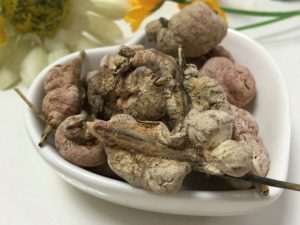
The stem is square-columnar, covered with grayish-brown long hairs, and brownish-gray on the outside; it is brittle and breaks easily, with a pith in the center.Leaves are opposite, often shriveled or fragmented; intact leaves are oblong or ovate, 2–5 cm long and 0.8–2.8 cm wide, with a bluntly rounded apex, a base tapering gradually into a petiole, and margins bearing small serrations; they are papery, slightly flexible, and covered with sparse, long hairs on both surfaces. They have a faint odor, a slightly sweet taste, and are sticky when chewed.
Properties of Processed Slices
Presented in irregular segments. The stem is quadrangular, with a brownish-gray surface covered in grayish-brown long hairs. It is brittle and breaks easily, with a pith in the center. The leaves are opposite, often shriveled or fragmented; intact leaves are oblong or ovate, with a bluntly rounded apex, a base tapering gradually into a petiole, and margins bearing small serrations; they are papery, slightly flexible, and covered with sparse, long hairs on both surfaces.It has a faint odor and a slightly sweet taste; when chewed, it has a gelatinous texture.
Botanical Information
Botanical Classification
A plant of the genus Polygonum in the Lamiaceae family.
Morphological Characteristics
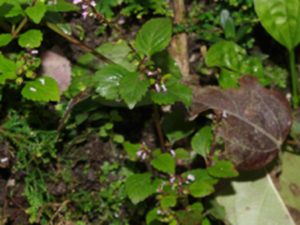
An annual herb, 15–100 cm tall. The upper part of the stem is erect, while the lower part is prostrate; it is quadrangular and covered with long, soft hairs or fine bristles that eventually fall off.Leaves are opposite; petioles are 2–15 mm long and pubescent; leaf blades are narrowly ovate or broadly ovate-orbicular, 2–5 cm long and 0.8–2.8 cm wide, with an acute or obtuse apex, a broadly cuneate or rounded base, serrate margins, and both surfaces covered with fine bristles or soft hairs.The whorled inflorescences are many-flowered, forming racemes that are terminal or borne on lateral branches; the inflorescence is 2–10 cm long; bracts are round or rhombo-ovate, with a tail-like projection; the calyx is bell-shaped, 2–2.5 mm long, densely covered with sparse soft hairs; the upper lip is 3-lobed, with the middle lobe exceptionally large and pointed at the apex; the lower lip is entire, occasionally with a slight notch;The corolla is white or pale red, approximately 3 mm long, externally covered with fine soft hairs; the upper lip is broad, with 4 teeth, the 2 lateral teeth being taller, and the central 2 teeth indistinct; the lower lip is entire and boat-shaped; there are 4 stamens, with the anterior pair being longer; the filaments of the posterior pair bear toothed appendages at the base, which are covered with stiff hairs, and the anthers are fused into a single chamber; the ovary is 4-lobed, the style is relatively long, and the stigma is shallowly 2-lobed.The nutlets are oblong and black. Flowering occurs from July to October; fruiting occurs from August to November.
Distribution Area
It is distributed in Zhejiang, Jiangxi, Taiwan, Guangdong, Guangxi, and other areas.