Chuanposhi is the name of a traditional Chinese medicine. It is the root of Maclura cohinchinensis (Lour.) Corner or Maclura tricuspidata Carr., plants belonging to the genus Maclura in the Moraceae family.This herb has a bland, slightly bitter taste and a cool nature. It has the effects of dispelling wind-dampness, clearing heat, and reducing swelling. It is primarily used to treat rheumatic arthralgia, low back pain, trauma, jaundice, masses and masses,mumps, pulmonary tuberculosis with hemoptysis, epigastric pain, turbid urinary discharge, bloating caused by poisonous substances, amenorrhea, childhood heart heat, tongue swelling, thrush, scrofula, boils and abscesses, and bleeding from external hemorrhoids.

Chuanposhi
Chuanposhi is the name of a traditional Chinese medicine. It is the root of Maclura cohinchinensis (Lour.) Corner or Maclura tricuspidata Carr., plants belonging to the genus Maclura in the Moraceae family.This herb has a bland, slightly bitter taste and a cool nature. It has the effects of dispelling wind-dampness, clearing heat, and reducing swelling. It is primarily used to treat rheumatic arthralgia, low back pain, trauma, jaundice, masses and masses,mumps, pulmonary tuberculosis with hemoptysis, epigastric pain, turbid urinary discharge, bloating caused by poisonous substances, amenorrhea, childhood heart heat, tongue swelling, thrush, scrofula, boils and abscesses, and bleeding from external hemorrhoids.
Chinese Name : 穿破石
Aliases : Zhegen, Chuanposhi, Dimian Gen, Laniu Rushi
Authentic Producing Area : Native to regions south of the middle and lower reaches of the Yangtze River
Nature, Flavor & Meridian Tropism : Taste: bland, slightly bitter; Nature: cool
Benefits & Efficacy
Benefits
Dispels wind-dampness, clears heat, and reduces swelling.
Indications
Chuanposhi is primarily used to treat rheumatic arthralgia, low back pain, trauma, jaundice, masses and masses,mumps, pulmonary tuberculosis with hemoptysis, epigastric pain, turbid urinary discharge, bloating caused by parasitic toxins, amenorrhea, childhood heart heat, tongue swelling, thrush, scrofula, boils and abscesses, and bleeding from external hemorrhoids.
Usage and Dosage
1. Internal use: Decoct 9–30 g; up to 120 g of fresh herb may be used; or steep in wine. 2. External use: Apply an appropriate amount after pounding into a paste.
Precautions
Use with caution during pregnancy.
Chemical Constituents
The root contains Ziziphus isoflavone A, 3-O-methyl coumarol, dehydro-linalool, methyl linoleate, and β-sitosterol.
Pharmacological Actions
This herb has antitubercular and other effects.
Relevant Discussions
1. *Essentials of the Properties of Raw Herbs*: Treats hangovers and relieves bloating caused by poisonous insects; when steeped in wine, it dispels wind.
2. *Ben Cao Qiu Yuan*: Strengthens tendons and bones, promotes blood circulation, and treats contusions and bruises.
3. *Lingnan Caiyao Lu*: Dispels wind-dampness; steam ten times and sun-dry nine times; for shoulder sores, pound with honey and apply as a poultice.
4. Guangzhou Military Region *Manual of Common Chinese Herbal Medicines*: Mainly used to treat amenorrhea.
5. *Yunnan Chinese Herbal Medicine*: Clears heat and detoxifies. Mainly used to treat mumps, lymph node tuberculosis, cough, hemoptysis due to pulmonary tuberculosis, hepatitis, cystitis, dizziness, insufficient lactation, and boils.
6. *Compendium of Chinese Herbal Medicine*: Suppresses cough and resolves phlegm. Mainly used to treat jaundice-type hepatitis, hepatosplenomegaly, and gastric and duodenal ulcers.
Applications
Clinical Applications
1. For rheumatic pain: 15 g of Chuanposhi, 9 g each of Gulingshou’ercha and Qingmianhuateng. Decoct in water and take orally. (From *Commonly Used Folk Herbs of Zhejiang*)
2. For treating fractures: Equal parts of Chuanposhi, Sanjiapí, and Hutuzi (all root bark). Roast until dry, grind into powder, and mix with an appropriate amount of heated petroleum jelly to form a paste. After realignment, apply the ointment externally and secure with a splint. Change the dressing every other day.
3. For treating acute jaundice-type hepatitis: 30g of Chuanposhi,15 g each of *Ladania root* and *Phyllanthus emblica*, and 9 g of *Gourd Tea*. Decoct twice and take in divided doses; one dose per day. (Formulas 2 and 3 are from *Compendium of Chinese Herbal Medicines*)
4. For ascaris in the biliary tract: 15 g each of *Poria cocos root*, *Acanthopanax root*, and *Broad-leaved Ten-Merit root*. Decoct in water and take orally. (*Fujian Materia Medica*)
5. For lower limb “flowing fire” (acute lymphangitis): 90g of Chuanposhi root bark, 15g of Weilingxian, and 120g of lean pork. Stew in water; drink the broth and eat the meat. (*Jiangxi Herbal Medicine*)
6. For urinary tract stones: 15g of Zhe藤 root, 15g of wild Sichuan pepper, 30g of Qianjinba, and 30g of Plantain herb.One dose daily; decoct in water and take in two divided doses. (Jiangxi *Manual of Herbal Medicine*)
7. For pulmonary tuberculosis: 30g of Zhe Teng root, 60g of Tie Bao Jin (Fine-veined Gou’ercha), and 9g of Bai Bu. One dose daily; decoct in water and take in two divided doses. (Jiangxi *Manual of Herbal Medicine*
8. For treating deafness, tinnitus, and ear discharge—effective even after one or two decades: 20 jin of old iron (burned until red-hot; soaked in 5 dou of water for three nights; remove the iron and clarify the liquid), 30 jin of Zhe root (boiled in 1 shi of water until reduced to 5 dou; remove the dregs and clarify the liquid), and 5 dou of sliced Acorus (boiled in 1 shi of water until reduced to 5 dou; remove the dregs and clarify the liquid).Combine these three ingredients, which total one shi and five dou in weight, with two shi of rice and two dou of rice malt, and brew into wine using the standard method. After one month, seal the top and separate the clear liquid from the sediment. Use three jin of magnetite (which has been used to attract iron) and grind it into a fine powder; add it to the wine and let it steep for three nights. Drink it day and night, maintaining a slight buzz before sleeping; stop taking the medicine once you can hear people speaking clearly. (*Thousand Gold Prescriptions*)
Notes
Patients requiring treatment with Chinese herbal medicine should first consult a licensed Traditional Chinese Medicine (TCM) hospital, where a TCM practitioner will conduct a professional pattern differentiation and prescribe an herbal formula.
Processing & Preparation
Harvesting & Processing
It can be harvested year-round. The root can be sun-dried or sliced while fresh and then sun-dried; it may also be used fresh.
Processing Methods
Take the raw herb, remove impurities, wash thoroughly, moisten thoroughly, cut into thick slices, and dry.
Storage Methods
Store in a dry container in a well-ventilated, dry place.
Crude Drug Identification
Properties of Crude Drugs
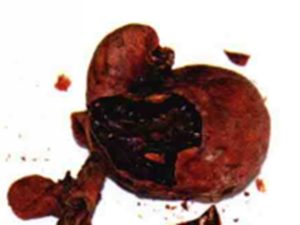
The root is cylindrical, varying in length, with a diameter of 1.5–2.5 cm; or it may be cut into thick, round slices. The outer bark is yellow or orange-red, with prominent longitudinal wrinkles and a few traces of fibrous roots. The cork layer is thin and easily peels off. The texture is hard and difficult to break; the cross-section shows a thin, grayish-yellow phloem containing tough fibers, with the xylem constituting the vast majority of the cross-section.Yellow in color, with a woody texture; vascular pores are clearly visible, and some specimens have a small pith in the center. Slight odor; bland taste.
Properties of Processed Slices
This product consists of thick, round slices with a thin, distinctly fibrous phloem; the xylem is well-developed, yellow, and densely covered with small pores (vessels), with a very small central pith. The periphery is grayish-yellow, with brownish-yellow or orange-yellow patches. It is hard in texture. It has a faint odor and a bland taste.
Botanical Information
Botanical Classification
Derived from the plant *Corylus* or *Ziziphus* of the Moraceae family.
Morphological Characteristics
1. Cudrania: An evergreen shrub, 2–4 m tall. Erect or climbing; root bark orange-yellow; branches gray-brown, smooth, with scattered lenticels, bearing erect or slightly curved, stout thorns.Simple, alternate leaves; petioles 5–10 mm long; leaf blades leathery, obovate-elliptic, elliptic, or oblong-elliptic, 3–9 cm long, 1–2.8 cm wide, with a blunt or acuminate apex, or with a slight notch, cuneate at the base, entire; 3 basal veins, 6–9 pairs of lateral veins.Flowers are unisexual, with separate male and female plants; spherical inflorescences are solitary or in pairs, axillary, short-stalked, and pubescent; male inflorescences are about 6 mm in diameter, with male flowers bearing 3–5 perianth segments that are wedge-shaped, unequal, and pubescent; female inflorescences are about 1.8 cm in diameter, with female flowers bearing 4 perianth segments that are thickened at the apex and tomentose.The aggregate fruit is spherical, fleshy, orange-red when ripe, 3–5 cm in diameter, and hairy; the achenes are enclosed within the fleshy perianth and bracts. Flowering occurs from April to May, and fruiting from September to October.
2. Chinese Mulberry: A deciduous shrub or small tree, growing up to 8 m tall. Young branches are dark greenish-brown, bearing stiff thorns 5–35 mm long. Simple leaves are alternate; petioles are 0.5–2 cm long; stipules are lateral and separate;leaf blades are nearly leathery, ovate or obovate, 5–13 cm long, with a blunt or acuminate apex, a cuneate or rounded base, and entire or 3-lobed margins; the upper surface is dark green, the lower surface pale green; both surfaces are hairy when young, but as the leaves mature, the lower surface along the midvein becomes slightly hairy, while the rest remains smooth and glabrous; there are 3 basal veins and 4–5 pairs of lateral veins.Flowers are unisexual, with separate male and female plants; all are spherical capitula, short-stalked, and borne singly or in pairs in the leaf axils; male flowers have 4 perianth segments, oblong, with 2 or 4 bracts at the base, and 4 stamens with erect filaments; female flowers have 4 perianth segments and a single, linear style.The aggregate fruit is spherical, fleshy, about 2.5 cm in diameter, orange-red or orange-yellow, with a slightly wrinkled surface; the achenes are enclosed within the fleshy perianth. Flowering occurs from May to June, and fruiting from September to October.
Distribution Area
1. Chinese Spiny Dogwood: Distributed in Anhui, Zhejiang, Jiangxi, Fujian, Hubei, Hunan, Guangdong, Hainan, Guangxi, Sichuan, Guizhou, Yunnan, and other areas. 2. Chinese Mulberry: Distributed in East China, Central and South China, Southwest China, as well as Hebei, Shaanxi, Gansu, and other areas.