
Panax notoginseng Flower, a traditional Chinese medicine. It is the dried inflorescence of Panax notoginseng (Burk.) F.H. Chen, a plant of the Araliaceae family. This herb has a sweet taste and a cool nature; it enters the Liver and Kidney meridians. It has the effects of clearing heat and detoxifying, calming the liver and improving vision, and promoting fluid production to quench thirst. It can be used to treat dizziness, tinnitus, insomnia, hypertension, migraines, and acute pharyngitis.
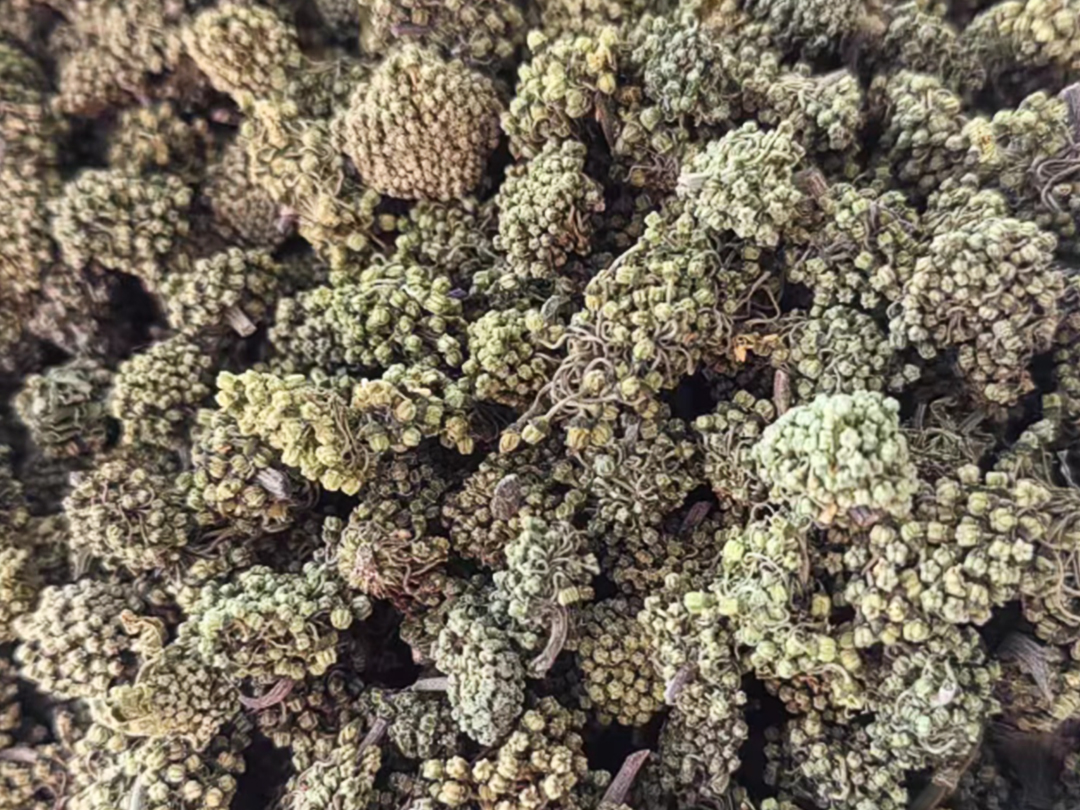
Notoginseng Flower
Panax notoginseng Flower, a traditional Chinese medicine. It is the dried inflorescence of Panax notoginseng (Burk.) F.H. Chen, a plant of the Araliaceae family. This herb has a sweet taste and a cool nature; it enters the Liver and Kidney meridians. It has the effects of clearing heat and detoxifying, calming the liver and improving vision, and promoting fluid production to quench thirst. It can be used to treat dizziness, tinnitus, insomnia, hypertension, migraines, and acute pharyngitis.
Chinese Name : 三七花
Aliases : Panax notoginseng flower
Authentic Producing Area : Yunnan, Guangxi
Nature, Flavor & Meridian Tropism : Sweet in taste, cool in nature; enters the Liver and Kidney meridians
Benefits & Efficacy
Benefits
Clears heat and detoxifies; calms the liver and improves vision; promotes fluid production and quenches thirst.
Indications
Sanqi Flower can be used to treat dizziness, tinnitus, insomnia, hypertension, migraines, and acute pharyngitis.
Usage and Dosage
Internal use: 1–3 g, decocted or steeped.
Precautions
Not yet established.
Applications
Notes
Patients requiring treatment with traditional Chinese medicine should first consult a licensed TCM hospital, where a TCM practitioner will conduct a professional pattern differentiation and issue a prescription.
Processing & Preparation
Harvesting & Processing
Harvest in summer before or just as the flowers begin to bloom, then dry.
Processing Methods
Remove impurities such as excessively long flower stalks from the herb and sift out any dust or debris.
Storage Methods
Store in a well-ventilated, dry place to prevent mold.
Crude Drug Identification
Properties of Crude Drugs
They are hemispherical, spherical, or umbellate, 0.5–2.5 cm in diameter; the main flower stalk is 0.5–4.5 cm long, cylindrical, often curved, and has fine longitudinal striations.When spread out, the pedicels are 0.1–1.5 cm long, with hairy, scale-like bracts at the base. The calyx is yellowish-green, with a 5-lobed apex. When cut open and examined under a magnifying glass, there are 5 yellowish-green petals. The anthers are elliptical, dorsifixed, and 5-lobed inward; there are 2 styles, fused at the base. The texture is brittle and easily broken. It has a faint odor and a sweet, slightly bitter taste.
Properties of Processed Slices
See “Characteristics of the Medicinal Material.”
Botanical Information
Botanical Classification
Panax notoginseng, a plant of the genus Panax in the Araliaceae family.
Morphological Characteristics
A perennial herb, 30–60 cm tall. The rhizome is short; the main root is inversely conical or cylindrical, 2–5 cm long and 1–3 cm in diameter, with wart-like protrusions and transverse lenticels. The stem is solitary and erect.Palmately compound leaves are arranged in a whorl at the stem apex; there are usually 5–7 leaflets, which are elliptic or oblong-lanceolate, 5–15 cm long, with a nearly rounded or cuneate base and finely serrated margins. A single umbel is terminal, bearing more than 80 florets; the flowers are yellowish-green and pentamerous;with a single pistil; the ovary is inferior and 2-chambered, and the style is 2-lobed at the apex. The drupe is berry-like, flattened-globose, and bright red when ripe. There are 1–3 seeds with white seed coats. Flowering occurs from June to August, and fruiting from August to October.
Distribution Area
Distributed in Jiangxi, Hubei, Guangdong, Guangxi, Sichuan, Guizhou, Yunnan, Tibet, and other regions.