Purple-oil Tree, a name for a traditional Chinese medicinal herb. It refers to the tips of the young leaves of Pistacia weinmannifolia Poiss. (family Anacardiaceae). It has the effects of clearing heat and detoxifying, as well as astringing and stopping bleeding. It is primarily used to treat dysentery, enteritis, diarrhea, bleeding from external injuries, and sores and eczema.

Purple-oil Tree
Purple-oil Tree, a name for a traditional Chinese medicinal herb. It refers to the tips of the young leaves of Pistacia weinmannifolia Poiss. (family Anacardiaceae). It has the effects of clearing heat and detoxifying, as well as astringing and stopping bleeding. It is primarily used to treat dysentery, enteritis, diarrhea, bleeding from external injuries, and sores and eczema.
Chinese Name : 紫油木
Aliases : Qingxiangmu, Meijiang
Nature, Flavor & Meridian Tropism : Slightly bitter and astringent in taste; cool in nature
Benefits & Efficacy
Benefits
Clears heat and detoxifies; astringes and stops bleeding.
Indications
Dysentery, enteritis, diarrhea, bleeding from external injuries, sores, and eczema.
Usage and Dosage
Internal use: Decoct 9–15 g. External use: Apply an appropriate amount; decoct in water for washing.
Relevant Discussions
1. *Commonly Used Chinese Herbs of Sichuan*: “Promotes the flow of qi and relieves pain. Treats abdominal pain, diarrhea, bloody dysentery, and cracked feet.”
2. *Chinese Herbs of Yunnan*: “Clears heat and detoxifies. Primarily treats dysentery, enteritis, diarrhea, sores, eczema, hives, and food stagnation.”
Applications
Notes
The bark of the purple teak tree is also used medicinally and is known as “purple teak bark.” It has an astringent and slightly bitter taste and a cool nature. It has astringent and hemostatic properties and is primarily used to treat bleeding from external injuries. External use: Apply an appropriate amount as a powder.
Processing & Preparation
Harvesting & Processing
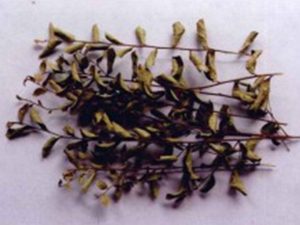
In spring, harvest the tender leaf tips and use them fresh or sun-dry them.
Crude Drug Identification
Botanical Information
Botanical Classification
Purple Oilwood of the Anacardiaceae family.
Morphological Characteristics
Purple Oilwood, also known as Fragrant Wood, Kunming Ebony, Zi You Tree, Fragrant Tree, Fragrant-Leaf Tree, and Narrow-Leaf Kaiwood. A shrub or small tree, 2–8 meters tall, rarely reaching 10–15 meters; the bark is gray, with brown lenticels on the twigs; young branches are covered with grayish-yellow fine pubescence.The leaves are even-pinnate, alternate, with 4–9 pairs of leaflets; the rachis is narrowly winged, grooved on the upper surface, and covered with gray, fine soft hairs; the petioles are covered with fine soft hairs;Leaflets are leathery, oblong or obovate-oblong, small, 1.3–3.5 cm long and 0.8–1.5 cm wide, rarely larger (5 × 1.8 cm), with a slightly notched apex bearing a bristle-like, stiff tip; the base is slightly asymmetrical,broadly cuneate, entire, slightly revolute; both surfaces of the midvein covered with extremely fine pubescence; lateral veins slightly sunken on the adaxial surface and prominently raised on the abaxial surface; leaflet petioles extremely short.Inflorescences are axillary, arising from the same axil as the leaves, covered with yellowish-brown soft hairs and red glandular hairs; flowers are small, purplish-red, sessile, with a single bract that is ovate, concave, approximately 1.5 mm in diameter, covered with brown soft hairs on the outside, and with fine cilia along the margins;Male flowers: 5–8 perianth segments, oblong or oblong-lanceolate, 1.5–2 mm long, membranous, translucent, apex acuminate or fringed; the outer 2–3 segments with fine cilia along the margins; 5 stamens, rarely 7, filaments extremely short, anthers oblong, apex acuminate; sterile pistils present;Female flowers: perianth segments 7–10, ovate-lanceolate, 1–1.5 mm long, membranous, apex acuminate or slightly fringed; the outer 2–5 segments ciliate along the margins; no sterile stamens; ovary globose, ca. 0.7 mm in diameter, glabrous; style extremely short; stigma 3-lobed, reflexed.The drupe is globose, approximately 5 mm long and 6 mm in diameter, red when ripe, with a finely pointed apex.
Distribution Area
It is distributed in southwestern China, Guangxi, Tibet, and other areas.
Growth Habits
It prefers a warm, humid climate and is best cultivated in sunny, well-drained areas. Since the plant’s taproot extends deep into the soil, it is best grown in deep, sandy loam rich in humus.
Propagation Methods
Propagated by seed.
Cultivation Techniques
Harvest the ripe, plump fruits, air-dry them, and store them in sand. Sow in March of the following spring using furrow seeding: space rows 30 cm apart and seeds 5 cm apart. Cover with soil, water, and keep the soil moist. Transplant when seedlings reach 35–40 cm in height. Plant at a spacing of 300 cm × 300 cm.