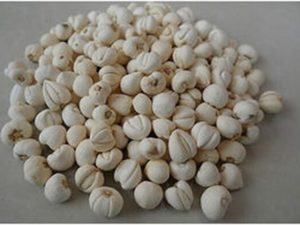
Renmianzi is the name of a traditional Chinese medicine. It is the fruit of the plant Dracontomelon duperreanum Pierre [D. daoauct. non (Blanco) Merr. et Rolfe; D. sinense Stopf].The fruits are harvested in the fall, sun-dried, or pickled in salt. It is used medicinally; it has a sweet and sour taste and a cool nature. It enters the Spleen, Stomach, and Liver meridians. It has the effects of strengthening the stomach, promoting fluid production, sobering up, and detoxifying. It is primarily used to treat loss of appetite, thirst associated with febrile illnesses, drunkenness, sore throat, and itchy sores caused by wind-toxin.

Renmianzi
Renmianzi is the name of a traditional Chinese medicine. It is the fruit of the plant Dracontomelon duperreanum Pierre [D. daoauct. non (Blanco) Merr. et Rolfe; D. sinense Stopf].The fruits are harvested in the fall, sun-dried, or pickled in salt. It is used medicinally; it has a sweet and sour taste and a cool nature. It enters the Spleen, Stomach, and Liver meridians. It has the effects of strengthening the stomach, promoting fluid production, sobering up, and detoxifying. It is primarily used to treat loss of appetite, thirst associated with febrile illnesses, drunkenness, sore throat, and itchy sores caused by wind-toxin.
Chinese Name : 人面子
Aliases : Human-Face Fruit, Silver Lotus Fruit
Nature, Flavor & Meridian Tropism : Taste: sweet and sour; nature: cool. Enters the Spleen, Stomach, and Liver meridians
Benefits & Efficacy
Benefits
Stomach-strengthening, promoting fluid production, sobering up, and detoxifying.
Indications
Loss of appetite, thirst due to febrile illnesses, alcohol intoxication, sore throat, and itchy skin rashes caused by wind-toxin, among other conditions.
Usage and Dosage
Internal use: Eat 3–5 fruits raw; or decoct into a soup; or burn the fruit kernels to charcoal and grind into a powder. External use: Apply an appropriate amount as a poultice.
Precautions
Use with caution in patients with spleen and stomach deficiency-cold.
Relevant Discussions
1. *Lu Chuan Bencao*: Strengthens the stomach. Treats loss of appetite.
2. *Bencao Qiuyuan*: Recommended for pregnant women with abdominal pain.
3. *Lingnan Ciyao Lu*: Relieves sore throat and helps heal necrotic tissue.
Applications
Related Compatibility
1. To treat childhood convulsions caused by pathogenic factors, characterized by upward rolling of the eyes, twitching of the hands and feet, and opisthotonos: Take the charred ash of the *Renmianzi* seed. (*Compendium of Food and Materia Medica*)
2. To treat a boil on the back: Take several *Renmianzi* fruits, remove the seeds, mix with one crucian carp, pound into a paste, and apply as a poultice. (*Record of Medicinal Plant Collection in Lingnan*)
Processing & Preparation
Harvesting & Processing
Harvested in the fall.
Crude Drug Identification
Botanical Information
Botanical Classification
Plant: Manmianzi.
Morphological Characteristics
*Euphorbia humilis* is an evergreen large tree that can grow to over 20 m in height. Young branches are striated with small white lenticels and covered with gray tomentum. Leaves are alternate, odd-pinnate compound, 30–45 cm long, with 11–15 leaflets; the rachis and petioles are striated and sparsely hairy, with short petiolules measuring 2–3 mm;The leaflets are oblong, gradually increasing in size from the base upward, 5–14.5 cm long and 2.5–4.5 cm wide, with a long acute apex and a base that is often oblique; they are entire, sparsely covered with fine pubescence along the midrib on both surfaces, with grayish-white beard-like hairs in the axils of the veins on the underside; there are 8–9 pairs of lateral veins, and the reticulate venation is distinct.Flowers are small and bisexual, arranged in terminal or axillary panicles 10–23 cm long, sparsely covered with grayish fine pubescence; flowers are white, with pedicels 2–3 mm long; calyx 5-lobed, broadly ovate; petals 5, longer than the sepals, lanceolate, ca. 6 mm long, ca. 1.7 mm wide, glabrous;filaments linear, ca. 3.5 mm long, glabrous; anthers oblong, ca. 1.5 mm long; disk cup-shaped, glabrous, margin shallowly undulate; stamens 10, attached at the base of the disk; ovary superior, 5-locular, glabrous, 2.5–3 mm long;There are 5 styles, short, fused at the top and separate at the base, approximately 2 mm long. The drupe is flattened-globose, approximately 2.5 cm long, yellow when ripe; the stone is flattened, 1.7–1.9 cm in diameter, with a shield-shaped depression on the upper surface, 5-chambered, with 1–2 chambers usually sterile. There are 3–4 seeds. Flowering occurs in spring and summer.