Centella asiatica, a traditional Chinese medicine. It is the whole plant of Centella asiatica (L.) Urb., a member of the Apiaceae family. It has the effects of clearing heat, draining dampness, detoxifying, and reducing swelling. It is primarily used to treat damp-heat jaundice, heatstroke-induced diarrhea, urinary and hematuric disorders, abscesses, boils, and toxic sores, as well as injuries from falls or blows.

Centella
Centella asiatica, a traditional Chinese medicine. It is the whole plant of Centella asiatica (L.) Urb., a member of the Apiaceae family. It has the effects of clearing heat, draining dampness, detoxifying, and reducing swelling. It is primarily used to treat damp-heat jaundice, heatstroke-induced diarrhea, urinary and hematuric disorders, abscesses, boils, and toxic sores, as well as injuries from falls or blows.
Chinese Name : 积雪草
Latin Name : Centellae Herba
Aliases : Lianqiancao, Diqueancao, Maticao, Laogonggen, Kuipengcai, Bengkouwan, Luodeda, Ditangcao, Damaticao, Tuxixin, Bengdawan, Leigonggen, Gangguolong, Majiaojì, Yahuangcao
Authentic Producing Area : Jiangsu, Zhejiang, Fujian
Nature, Flavor & Meridian Tropism : Bitter and pungent in taste; cold in nature; enters the Liver, Spleen, and Kidney meridians
Benefits & Efficacy
Benefits
Clears heat and drains dampness; detoxifies and reduces swelling.
Indications
Damp-heat jaundice, heatstroke-induced diarrhea, urinary and hematuric disorders, abscesses, swellings, and toxic sores; injuries from falls or blows.
Usage and Dosage
1. Internal use: Decoct 9–15 g (15–30 g if fresh) in water; or crush to extract juice. 2. External use: Apply an appropriate amount as a poultice or apply the extracted juice.
Precautions
Use with caution in patients with spleen and stomach deficiency-cold.
Chemical Constituents
It primarily contains triterpenoid saponins (centella-saponin, hydroxycentella-saponin, etc.) and triterpenoic acids (centellaic acid, hydroxycentellaic acid, betulinic acid, etc.), as well as flavonoids and alkaloids.
Pharmacological Actions
Centella asiatica promotes wound healing, inhibits skin scarring, and possesses anti-inflammatory, antidepressant, and antitumor effects.
Relevant Discussions
1. *The Classic of Herbal Medicine*: “Treats severe fever, malignant sores, spreading abscesses and boils, erythema, skin redness, and body heat.”
2. *Herbal Medicine of Southern Yunnan*: “Treats midday and midnight tidal fevers, dizziness, aversion to cold, aching and fatigue in the limbs, loss of appetite, and chronic wasting disorders in men, women, and children, as well as persistent fever due to debility. It promotes urination; water buffalo meat is used as a carrier.”
3. *Essentials of the Properties of Raw Herbs*: “Treats turbidity; dispels damp-heat toxins; rinse briefly under running water and mix with ginger and vinegar before eating. Also treats small intestine pain and is used to wash malnutrition sores.”
4. *Record of Medicinal Plant Collection in Lingnan*: “Clears summer heat and dissipates heat. For the initial stage of mastitis, use its leaves combined with one areca nut, decocted in hot water and taken orally.”
Applications
Clinical Applications
1. For common cold-induced headaches: 30 g of Lei Gong Gen, 9 g of fresh ginger. Pound into a paste and apply to the forehead. (*Manual of Commonly Used Folk Herbs in Guangxi*)
2. For fever due to external pathogens, accompanied by restlessness, thirst, and delirium: 60 g of Lei Gong Gen, 4 white-necked earthworms. Pound them together into a paste, simmer in water for 2 hours, then strain and drink the liquid.(*Manual of Commonly Used Folk Herbs in Guangxi*)
3. For lung-heat cough: 30g Centella asiatica, 30g Ophiopogon japonicus (ground), 30g Imperata cylindrica root, 15g loquat leaves, 15g mulberry leaves. Decoct in water and drink. (*Chronicle of Sichuan Traditional Chinese Medicine*, 1960)
4. For asthma: 30g dried whole Centella asiatica herb,15g each of jaundice grass and Schisandra vine. Decoct in water and drink the decoction. (Fuzhou Military Region *Manual of Chinese Herbal Medicine*)
5. For persistent fever due to deficiency-syndrome (chills in the afternoon, fever at night, spontaneous sweating and a cool body at dawn): Water chestnut grass, sheep’s hoof root, and mountain mint (in appropriate amounts), with wine and children’s urine as adjuvants.(*Commonly Used Folk Herbs of Kunming*)
6. For watery diarrhea and abdominal distension: 7 leaves of water chestnut grass, 7 tender tips of sweet potato vine. Chew together with cold water and swallow. (*Hunan Materia Medica*)
7. For dysentery: 60 g of fresh Centella asiatica whole plant, or add 30 g each of fresh Phoenix Tail Grass and fresh Purple-flowered Groundsel whole plants.Decoct in water, then mix with an appropriate amount of rock sugar and honey before taking. (Fujian Chinese Herbal Medicine)
8. For jaundice-type infectious hepatitis: 15–30 g of fresh Centella asiatica whole plant; or add 15 g of Artemisia capillaris, 6 g of Gardenia jasminoides, and 15 g of white sugar. Decoct in water and take. (Fujian Chinese Herbal Medicine)
9. For acute cholecystitis: 30–60 g of water chestnut leaves, 15 g of Coptis chinensis, and 15 g of Gentiana. Decoct in water and take orally. (*Medicinal Herbs of Yuxi*)
10. For hepatomegaly: 250–500 g of *Beng Da Wan*. Decoct in water and take orally. (*Compendium of Lingnan Herbal Medicine*)
Related Compatibility
Centella Asiatica Combined with Plantain Seed: Centella Asiatica is bitter and cold in nature, clearing heat, resolving dampness, promoting urination, and relieving dysuria; Plantain Seed is sweet, cold, and mildly diuretic, capable of promoting urination, clearing heat accumulation in the bladder, and resolving dampness to stop diarrhea. When used together, these two herbs enhance the effects of clearing damp-heat and stopping diarrhea. They can be used to treat dysuria with painful, scanty, and intermittent urination caused by damp-heat descending to the bladder, as well as summer-dampness-induced diarrhea.
Medicinal Identification
Centella Asiatica and Desmodium Styracifolium: Both herbs can resolve dampness and alleviate jaundice, promote urination and relieve dysuria, as well as detoxify and reduce swelling. They are both effective for treating damp-heat jaundice, painful and difficult urination due to heat, and abscesses, swellings, and toxic sores. However, Centella Asiatica not only clears damp-heat from the liver and gallbladder to alleviate jaundice but also clears damp-heat from the middle jiao to stop diarrhea; therefore, it can be used for damp-heat jaundice and diarrhea caused by summer heat.Moneywort excels at clearing damp-heat from the liver, gallbladder, and bladder, as well as promoting diuresis and expelling stones; therefore, it is frequently used to treat stone-induced dysuria and painful, scanty urination.
Related Medicines
Sanjin Tablets (granules, capsules), Shangshi Zhitong Plaster.
Notes
Patients requiring treatment with Chinese herbal medicine should first consult a licensed Traditional Chinese Medicine (TCM) hospital, where a TCM practitioner will conduct a professional pattern differentiation and prescribe an herbal formula.
Processing & Preparation
Harvesting & Processing
Harvest in summer and fall; remove dirt and sand, then sun-dry or use fresh.
Processing Methods
Take the raw herbal material, remove impurities, rinse thoroughly with running water, air-dry briefly, cut into sections, and dry completely.
Storage Methods
Store in a dry container in a well-ventilated, dry place.
Crude Drug Identification
Properties of Crude Drugs
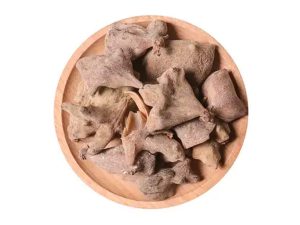
The dried whole plant is often curled into a ball-like shape. The root is cylindrical, 2–4 cm long, and 1–1.5 mm in diameter; its surface is pale yellow or grayish-yellow. The stem is slender, long, and curved, yellowish-brown in color, with fine longitudinal wrinkles; fibrous roots often grow from the nodes.Leaves are mostly shriveled and fragmented; intact leaves, when flattened, are nearly circular or reniform, 1–4 cm in diameter; gray-green in color, with coarse, blunt teeth along the margins; petioles are 3–6 cm long and twisted; umbellate inflorescences are axillary and small. The double-suspended fruit is flattened and round, with distinctly raised longitudinal ridges and fine reticulate patterns; the fruit stalk is very short. It has a faint odor and a bland taste.
Properties of Processed Slices
It appears in irregular segments. The root is cylindrical, with a pale yellow or grayish-yellow surface. The stem is slender, yellowish-brown, with fine longitudinal wrinkles and visible nodes; fibrous roots often grow from the nodes. The leaf blades are mostly shriveled and fragmented; when intact and flattened, they are nearly circular or reniform, grayish-green, with coarse, blunt teeth along the margins. The umbel is small and short.The double-suspended fruit is flattened-round, with distinctly raised longitudinal ridges and fine reticulate patterns. It has a faint odor and a bland taste.
Botanical Information
Botanical Classification
Centella asiatica, a plant of the genus Centella in the family Apiaceae.
Morphological Characteristics
A perennial herb with creeping, slender stems that root at the nodes; glabrous or slightly hairy. Simple leaves are alternate; petioles are 2–15 cm long, sheathing at the base;leaf blades are reniform or nearly round, 1–3 cm long, 1.5–5 cm wide, with a broadly cordate base and bluntly serrate margins; both surfaces are glabrous or sparsely pubescent along the veins on the abaxial surface; palmate venation consists of 5–7 veins. Solitary umbels or clusters of 2–4 umbels in the leaf axils; bracts 2–3, ovate, membranous;umbels bear 3–6 flowers, clustered into a capitulum; petals are ovate, purplish-red or milky white. The fruit is globose, with a heart-shaped or truncate base, 2–3 mm long and 2–3.5 mm wide, bearing several longitudinal ridges on each side; between the ridges are distinct small transverse veins, forming a reticulate pattern; the surface is smooth or hairy. Flowering and fruiting occur from April to October.
Distribution Area
Distributed in Southwest China, as well as Shaanxi, Jiangsu, Anhui, Zhejiang, Jiangxi, Fujian, Taiwan, Hubei, Hunan, Guangdong, and Guangxi.
Growth Habits
It grows in shaded, moist areas such as open fields, roadsides, and ditch banks, and prefers sunlight and relatively humid environments.
Propagation Methods
Propagated by seeds and division.
Cultivation Techniques
1. Propagation by seed: Sow in rows in spring or fall, covering with 2–3 cm of soil.
2. Propagation by division: Perform in early spring. Weed frequently during the seedling stage, and water carefully during dry seasons.