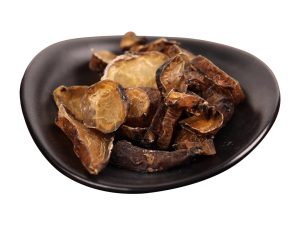
Slugs, a name for a traditional Chinese medicinal material. It consists of the entire body of the yellow slug (Limax fravus (Linnaeus)) and the wild slug (Agriolimax agrestis (Linnaeus)) from the Limacidae family. It has the effects of dispelling wind and calming convulsions, clearing heat and detoxifying, and reducing swelling and relieving pain.It is primarily used to treat stroke-induced facial paralysis, stiffness and spasms of the tendons and meridians, convulsions, shortness of breath, swelling of the throat, laryngeal obstruction, abscesses, erysipelas, pharyngeal nodules, swollen and painful hemorrhoids, and rectal prolapse.

Slugs
Slugs, a name for a traditional Chinese medicinal material. It consists of the entire body of the yellow slug (Limax fravus (Linnaeus)) and the wild slug (Agriolimax agrestis (Linnaeus)) from the Limacidae family. It has the effects of dispelling wind and calming convulsions, clearing heat and detoxifying, and reducing swelling and relieving pain.It is primarily used to treat stroke-induced facial paralysis, stiffness and spasms of the tendons and meridians, convulsions, shortness of breath, swelling of the throat, laryngeal obstruction, abscesses, erysipelas, pharyngeal nodules, swollen and painful hemorrhoids, and rectal prolapse.
Chinese Name : 蛞蝓
Aliases : Land snails, attached snails, centipedes, pregnancy-inducing worms, slugs, slime snails, and centipede snails
Nature, Flavor & Meridian Tropism : Salty in taste, cold in nature; enters the Liver, Lung, and Large Intestine meridians
Benefits & Efficacy
Benefits
Dispels wind and calms convulsions; clears heat and detoxifies; reduces swelling and relieves pain.
Indications
Tension and stiffness of tendons and meridians; convulsions and epilepsy; wheezing; swelling of the throat; laryngeal obstruction; abscesses and swellings; erysipelas; phlegm nodules; swollen and painful hemorrhoids; rectal prolapse.
Usage and Dosage
Internal use: Dry in an oven, grind into powder, or grind into a paste to form pills; take 2–3 specimens. External use: Grind into powder or pound into a paste for application; use 5–10 specimens.
Precautions
Use with caution in cases not involving actual heat syndromes and in patients with spleen-stomach deficiency-cold.
Chemical Constituents
The entire plant contains a special lectin: sialic acid.
Pharmacological Actions
When a slug suspension was administered orally to tumor-bearing mice at a dose of 800 mg/kg, it exhibited a significant inhibitory effect on ARS sarcoma (ascites type) after 24 hours, with an inhibition rate of 47.4%; at a dose of 120 mg/kg, the tumor inhibition rate reached 51.6% after 48 hours.For Lewis lung cancer, administration of the slug suspension at a dose of 800 mg/kg was most effective at 24 hours, with a tumor inhibition rate of over 30%. In vitro experiments showed that a 0.6% slug extract significantly inhibited the growth of lung cancer cells (A549).Furthermore, when a slug suspension was administered to mice via gastric lavage at doses of 600–1,200 mg/kg for 7 days, it exhibited a significant inhibitory effect on P388 lymphocytic leukemia, with the 900 mg/kg dose showing the best results.
Relevant Discussions
1. *The Classic of Herbal Medicine*: “Treats sudden onset of wind-induced paralysis, muscle spasms, rectal prolapse, and convulsions with muscle contractions.”
2. *Extended Commentary on the Materia Medica*: “Treats centipede and scorpion venom.”
3. *Compendium of Materia Medica*: “Treats swollen, toxic, and burning sores, as well as hot, swollen, and painful ulcers.”
4. *Medicinal Animals of Guangxi*: “Relieves wheezing and treats hernias. Primarily used for asthma and hernias.”
5. *Ben Cao Chong Yuan*: “Primarily used to calm convulsions, clear heat, detoxify, and relax tendons. Treats swelling and pain in the throat, as well as wind-heat laryngitis. Place it in the throat and swallow.”
6. *De Pei Ben Cao*: “Dissolves phlegm nodules.”
7. *Jilin Chinese Herbal Medicine*: “Dispels wind, calms convulsions, and prevents prolapse. Treats swollen and painful heat sores, bronchitis, and rectal prolapse.”
Applications
Related Compatibility
1. For treating infantile convulsions: Take 1 leech, add a small amount of white sugar, crush them into a paste, and apply externally to the infant’s fontanelle. Then use a needle to prick the Sisheng acupoint. (*Applications of Insect Medicines*)
2. For treating wheezing: Take 100 slugs. Wash them thoroughly, add an appropriate amount of fritillary bulb, crush them together into a paste, and form into pills. Take 1.5 g each time, twice daily.(*Jilin Herbal Medicine*)
3. For tonsillitis: 2 leeches (washed) and 3 black plums. Decoct and drink. (*Applications of Insect Medicines*)
4. For erysipelas and abscesses: Several live slugs. Soak in vinegar, pound into a paste, mix with a small amount of borneol, and apply to the affected area. (*Quanzhou Materia Medica*)
5. For treating carbuncles: 1–2 leeches and 6 g of alum. Pound into a paste and apply to the affected area; change the dressing twice daily. (*Applications of Insect Medicines*)
6. For hemorrhoids with heat, swelling, and pain: Grind slugs and Beijing ink together and apply the mixture. (Effective Formulas for Women)
7. For festering sores on the shins that are so foul-smelling they cannot be approached: Ten leeches. Roast them on a tile, grind into a powder, mix with oil, and apply to the affected area. (Emergency Formulas)
8. For burns and scalds: Place 10 slugs and an appropriate amount of sesame oil together in a glass bottle to steep. Once the slugs have dissolved, dip a duck feather in the liquid and apply it to the affected area; reapply once it dries. (*Medicinal Animals of Guangxi*)
9. For amenorrhea with pain caused by blood stasis: Grind vinegar-roasted slugs into a powder. Soak in wine and take 3 g at a time. (*Quanzhou Materia Medica*)
10. For toothache: Take one slug, wrap it in fine muslin, and rub it on the affected area. (*Collection of Effective Formulas*)
Notes
Among animals of the same genus, the two-lined mucus-loving slug *Phiolomycus bilieatus* (Benson) and the wrinkled mucus-loving slug *P. rugulosus* (Chenet & Kao) can also be used medicinally.
Processing & Preparation
Harvesting & Processing
Capture them in damp, dark places during summer.
Crude Drug Identification
Botanical Information
Morphological Characteristics
1. Yellow slug: No exoskeleton; soft body; irregular cylindrical shape; wider at the front and narrower at the rear; tail features a short dorsal ridge. When active, the largest specimens can reach 120 mm in length and 12 mm in width.The head bears two pairs of pale blue tentacles; the tips of the larger tentacles have ocular spots. At the anterior one-third of the dorsal surface, there is an oval-shaped mantle, the anterior half of which is free-floating. The dorsal surface features concentric circular folds. The body is yellowish-brown or deep orange, with scattered pale yellow spots; the color is lighter on both sides near the feet, and the foot is pale yellow.The shell has regressed into an endocarp, enclosed within the mantle; it is a thin, transparent, elliptical calcareous plate. The dorsal surface bears distinct growth lines. 2. Wild slugs: These lack a shell; their bodies are soft and smooth, with an irregular cylindrical shape, a narrow, elongated tail, and a blunt caudal ridge.When fully extended, the body measures 30–60 mm in length and 4–6 mm in width; the endoskeleton is 4 mm long and 2 mm wide. The body surface is gray, yellowish-brown, or dark brown; some individuals have faint, indistinct dark bands or spots.
Distribution Area
1. Yellow slug: Found in Heilongjiang, Jilin, Xinjiang, Jiangsu, Zhejiang, Henan, Hunan, Guangdong, Guangxi, Sichuan, Yunnan, as well as Beijing and Shanghai. 2. Wild slug: Found in Inner Mongolia, Hebei, Xinjiang, Jiangsu, Anhui, Zhejiang, Jiangxi, Fujian, Henan, Hubei, Hunan, Guangdong, Hainan, Guangxi, Guizhou, Yunnan, and Tibet.