Maple-leaved Herb, a name in traditional Chinese medicine. It refers to the whole plant of Mukdeniarossii (Oliv.) Koidz., a member of the Saxifragaceae family. It is distributed in the Northeast region. It has the efficacy of calming the mind and soothing the spirit. It is commonly used to treat palpitations and anxiety.

Maple-leaved Grass
Maple-leaved Herb, a name in traditional Chinese medicine. It refers to the whole plant of Mukdeniarossii (Oliv.) Koidz., a member of the Saxifragaceae family. It is distributed in the Northeast region. It has the efficacy of calming the mind and soothing the spirit. It is commonly used to treat palpitations and anxiety.
Chinese Name : 槭叶草
Latin Name : Mukdenia rossii (Oliv.) Koidz.
Aliases : Laba Vegetable, Virginia Creeper
Authentic Producing Area : Jilin, Liaoning
Nature, Flavor & Meridian Tropism : Sweet and slightly bitter in taste; neutral in nature. Enters the Heart meridian
Benefits & Efficacy
Benefits
Calms the mind and soothes the spirit.
Indications
Used for heart palpitations and anxiety.
Usage and Dosage
Internal use: Decoct 9–15 g.
Precautions
Not yet established.
Pharmacological Actions
Used to treat tachycardia; has a heart-rate-slowing effect, but further research is needed.
Relevant Discussions
*Xinhua Bencao Gangyao*: “Whole herb: Has the effect of slowing the heart rate. Used for tachycardia.”
Applications
Processing & Preparation
Harvesting & Processing
Harvested in summer, washed, and sun-dried.
Crude Drug Identification
Properties of Crude Drugs
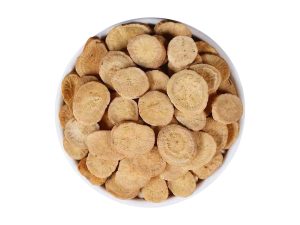
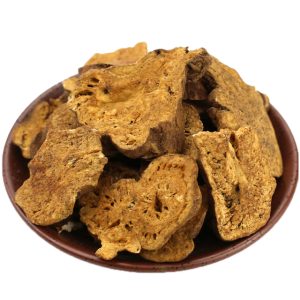
The rhizome is subcircular or irregularly tuberous, 6 cm long and approximately 1 cm in diameter. Its surface is dark brown, with remnants of brown scale leaves, fibrous roots, and root scars. It is hard in texture and difficult to break; the cross-section is starchy and gray.Leaves are basal, 1–2 in number, often fragmented; when a complete leaf is flattened, it is round-ovate, 4–7 cm long and 3–5 cm wide, with a cordate base and deeply palmate-lobed; the lobes are narrowly ovate with serrated margins. The upper surface of the leaf is gray. Petioles are 5–8.5 cm long, glabrous or sparsely hairy.In some specimens, a flower stalk is visible, sparsely pubescent; the inflorescence is a compound corymb, with the inflorescence axis densely covered with short glandular hairs and fine pubescence. The petals are yellowish-white and lanceolate. Capsules are sometimes present, approximately 7.5 mm long. The plant has a faint odor and a bitter taste.
Botanical Information
Botanical Classification
Maple-leaved Herb (a member of the Saxifragaceae family).
Morphological Characteristics
Maple-leaved Grass, also known as Red-crested Grass. A perennial herb, 10–30 cm tall. The rhizome is stout and bears brown scales. Basal leaves occur in 1–2 whorls and are glabrous;petioles 5–18 cm long; leaf blades ovate, palmately 5–7-lobed (shallowly or deeply); lobes ovate-lanceolate, apex acuminate or acute, base cordate or cuneate, margins serrate; flower stalks sparsely pubescent. Compound umbel, 5–7 cm long, densely covered with short glandular hairs and fine soft hairs; flower stalks 2–4 mm long;Calyx campanulate, white, 5–6 mm long, deeply 5–6-lobed; lobes narrowly ovate, apex obtuse; petals 5–6, lanceolate, white, shorter than the sepals; stamens 5–6, ca. 2 mm long, anthers nearly spherical; carpels 2, fused to the middle, ovary semi-inferior. Capsule. Seeds numerous.Flowering period: May–June; fruiting period: June–July.
Distribution Area
Distributed in the Northeast region.