Barley, a name in traditional Chinese medicine. It is the caryopsis of the grass species Hordeum vulgare L. This herb has a sweet taste and a cool nature; it enters the Spleen and Kidney meridians. It has the effects of strengthening the spleen and harmonizing the stomach, relieving constipation, and promoting diuresis. It is primarily used to treat abdominal distension, food stagnation with diarrhea, and difficulty urinating.
Barley
Barley, a name in traditional Chinese medicine. It is the caryopsis of the grass species Hordeum vulgare L. This herb has a sweet taste and a cool nature; it enters the Spleen and Kidney meridians. It has the effects of strengthening the spleen and harmonizing the stomach, relieving constipation, and promoting diuresis. It is primarily used to treat abdominal distension, food stagnation with diarrhea, and difficulty urinating.
Chinese Name : 大麦
Aliases : Barley, Mu Mai, Fan Mai, Chi Bo Mai
Authentic Producing Area : Cultivated throughout China
Nature, Flavor & Meridian Tropism : Sweet in taste, cool in nature; enters the Spleen and Kidney meridians
Benefits & Efficacy
Benefits
Strengthens the spleen, harmonizes the stomach, relieves intestinal distension, and promotes diuresis.
Indications
Barley is primarily used to treat abdominal distension, indigestion with diarrhea, and difficulty urinating.
Usage and Dosage
1. Internal use: Decoct 30–60 g; or grind into powder. 2. External use: Roast, grind, and apply as a poultice; or decoct in water for washing.
Precautions
Zhu Danxi: “When barley is first ripe, many people roast and eat it; this substance contains fire and can induce febrile diseases.” (Quoted from *Compendium of Materia Medica*)
Relevant Discussions
1. *The Supplementary Record*: “Treats thirst due to diabetes, clears heat, tonifies qi, and harmonizes the middle jiao.”
2. *The Newly Revised Materia Medica*: “Barley flour soothes the stomach, quenches thirst, aids digestion, and relieves bloating.”
3. *Supplementary Notes to the Materia Medica*: “Harmonizes the middle jiao to stop diarrhea and promotes robust health.”
4. *Dietary Therapy Materia Medica*: “Long-term consumption prevents hair from turning white; when mixed with needle sand and molybdenite, it dyes hair black. Prolonged use is highly beneficial, and when cooked, it is especially nourishing.”
5. *Materia Medica on Food Properties*: “Barley replenishes deficiencies, strengthens blood vessels, improves complexion, fortifies the five viscera, and aids digestion. Long-term consumption promotes a plump and fair complexion and smoothes the skin. As flour, it surpasses wheat and lacks the drying heat of wheat.”
6. *Extended Commentary on the Materia Medica*: “For laryngeal spasms preventing swallowing, make a thin paste from this (barley) flour and have the patient swallow it; its smooth and slippery texture makes it easy to swallow, thereby aiding stomach qi.”
7. *Compendium of Materia Medica*: “Relieves chest congestion and descends qi, cools the blood, eliminates food stagnation, and stimulates appetite.”
Applications
Clinical Applications
1. For treating postprandial fullness and restlessness accompanied by a desire to lie down: Roast barley flour until it emits a faint aroma; take one fangcun bi with plain hot water. (From *Formulas for Emergency Care*)
2. For treating sudden painful and scanty urination: Take three liang of barley and two da zhan of water; decoct until reduced to one zhan and three fen; strain out the residue; add half a he of ginger juice and half a he of honey; mix well; divide into three doses to be taken before meals.(*Shenghui Fang*)
3. For sores caused by centipede or cockroach bites: Grind barley into a fine powder, mix with a binder, and apply as a poultice three times daily. (*Shanghan Leiyao*)
4. For burns from hot liquids or fire: Roast barley until black, grind into a fine powder, mix with oil, and apply to the affected area. (*Ben Cao Gang Mu*)
Medicinal Diet Therapy
Barley Porridge
1. Benefits: Relieves abdominal distension and promotes urination. Suitable for symptoms such as abdominal distension and difficulty urinating caused by qi stagnation in the middle jiao and impaired transformation and transportation.
2. Ingredients: 50 grams of barley. Brown sugar or honey to taste.
3. Preparation: First, grind the barley grains into a fine powder. Cook into porridge with water using the standard method; add brown sugar after it is cooked.
4. Usage: Consume as desired.
Notes
Patients requiring treatment with Chinese herbal medicine should first consult a licensed Traditional Chinese Medicine (TCM) hospital, where a TCM practitioner will conduct a professional pattern differentiation and prescribe an herbal formula.
Processing & Preparation
Harvesting & Processing
Harvest when the fruits ripen in April–May, then sun-dry them.
Crude Drug Identification
Properties of Crude Drugs
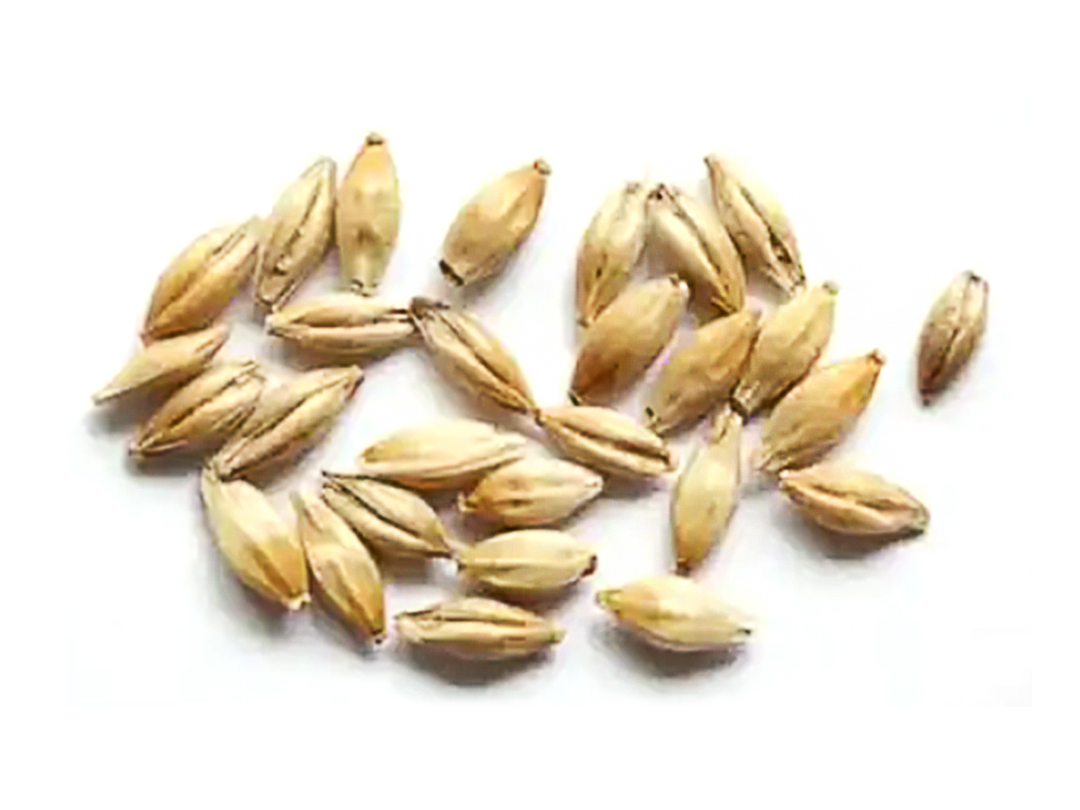
The fruit is spindle-shaped, 8–12 mm long and 1–3 mm in diameter. The surface is pale yellow; the dorsal side is enclosed by the outer glume and has five veins, with the long awn at the apex having fallen off; the ventral side is enclosed by the inner glume and has one longitudinal groove. The texture is hard. The cross-section is starchy and white. It is odorless and has a slightly sweet taste.
Botanical Information
Botanical Classification
Barley (Hordeum vulgare) of the Poaceae family.
Morphological Characteristics
A biennial herb. The culm is stout, smooth, glabrous, and erect, 50–100 cm tall. The leaf sheaths are loose and clasp the stem; there are large auricles on both sides; the ligule is membranous, 1–2 mm long; the leaf blade is flat, 9–20 cm long, and 6–20 mm wide.The spike is 3–8 cm long (excluding the awn) and approximately 1.5 cm in diameter; the spikelets are densely arranged, with three developed spikelets per node; the spikelets are typically sessile, 1–1.5 cm long (excluding the awn); the glumes are linear-lanceolate, slightly pubescent, with the apex extending into an awn 8–14 mm long;The outer glume is glabrous on the back, with 5 veins, and extends into an awn at the apex; the awn is 8–15 cm long, with fine spines along the marginal ridges; the inner glume is equal in length to the outer glume. The caryopsis has a longitudinal groove or depression on the ventral surface and is pubescent at the apex; when mature, it adheres to the outer glume and is difficult to separate, although some cultivated varieties separate easily.Flowering occurs from March to April; fruiting occurs from April to May.
Distribution Area
It is widely cultivated throughout China.
Growth Habits
Barley is highly adaptable and widely distributed, growing in both cold and warm climates. It is best cultivated in loose, fertile, slightly alkaline soils; highly acidic red soils are not suitable for cultivation.
Propagation Methods
Propagation is by seed.
Cultivation Techniques
Seed propagation: Seeding generally takes place in October–November, with winter and semi-winter varieties sown first, followed by spring varieties. On prepared soil, evenly broadcast the treated seeds to a depth of 2–3 cm, then cover with soil.
Pest and Disease Control
1. Diseases: Powdery mildew can be controlled by spraying with a 0.5° Baumé lime-sulfur solution.
2. Pests: Mole crickets, wireworms, and flea beetles damage the roots; to control them, mix 500 g of 90% diazinon with 500 kg of water and apply the solution around the affected seedlings.