Belamcanda, a name in traditional Chinese medicine, refers to the dried rhizome of Belamcanda chinensis (L.) DC., a plant of the genus Belamcanda in the Iris family. It is primarily produced in Hubei, Jiangsu, Henan, and Anhui. This product has the effects of clearing heat and detoxifying, resolving phlegm, and relieving throat discomfort. It is primarily used to treat stagnation of heat-toxin, phlegm-fire, and throat swelling and pain, as well as excessive phlegm and coughing with shortness of breath.

Belamcanda
Belamcanda, a name in traditional Chinese medicine, refers to the dried rhizome of Belamcanda chinensis (L.) DC., a plant of the genus Belamcanda in the Iris family. It is primarily produced in Hubei, Jiangsu, Henan, and Anhui. This product has the effects of clearing heat and detoxifying, resolving phlegm, and relieving throat discomfort. It is primarily used to treat stagnation of heat-toxin, phlegm-fire, and throat swelling and pain, as well as excessive phlegm and coughing with shortness of breath.
Chinese Name : 射干
Latin Name : Belamcandae Rhizoma
Aliases : Black Fan, Flat Bamboo, Twisted Scissors Grass, Scissors Grass, Mountain Fan, Wild Daylily, Butterfly Flower
Authentic Producing Area : Hubei, Jiangsu, Henan, Anhui
Nature, Flavor & Meridian Tropism : Cold in nature, bitter in taste; enters the Lung meridian
Benefits & Efficacy
Benefits
Clears heat and detoxifies; resolves phlegm; soothes the throat.
Indications
Mainly used for heat-toxin and phlegm-fire stagnation, sore and swollen throat, excessive phlegm, and coughing and wheezing.
Usage and Dosage
Internal use: Decocted, 3–10 g.
Precautions
Not suitable for individuals with spleen deficiency and loose stools.
Chemical Constituents
This product primarily contains flavonoid components such as sub-wild iris flavone, irisin, wild iris glycoside, wild iris aglycone, iris isoflavone, and iris aglycone. In addition, it contains diphenylethylene compounds, bicyclotriterpenes, and their derivatives.
Pharmacological Actions
This product possesses antimicrobial, antipyretic, anti-inflammatory, and bronchodilatory effects.
Relevant Discussions
1. *Shennong’s Classic of Materia Medica*: “It treats coughing with shortness of breath, sore throat and difficulty swallowing, and relieves stagnant qi; it also addresses abdominal distension caused by pathogenic factors and excessive heat from food and drink.”
2. *Compendium of Materia Medica*: “Belamcanda can reduce internal heat; therefore, it is a key herb in ancient formulas for treating sore throat and difficulty swallowing.”
Applications
Clinical Applications
1. To treat stagnation of heat-toxin, phlegm, and fire, as well as swelling and pain in the throat, it may be used alone, such as in the Belamcanda Decoction (*Shengji Zonglu*); or in combination with Cimicifuga and licorice. For treating exogenous wind-heat with sore throat and hoarseness, it is often used in combination with Schizonepeta, Forsythia, and Arctium seeds.
2. To treat lung heat with coughing and wheezing accompanied by copious yellow phlegm, it is often combined with Mulberry Bark (桑白皮), Aristolochia (马兜铃), and Platycodon (桔梗); to treat cold phlegm with coughing and wheezing accompanied by copious thin, clear phlegm, it is combined with Ephedra (麻黄), Asarum (细辛), Ginger (生姜), and Pinellia (半夏), as in the Belamcanda and Ephedra Decoction (《金匮要略》).
Related Compatibility
1. Belamcanda combined with Cimicifuga: Belamcanda is bitter and cold in nature, with descending and draining properties; it specifically enters the Lung Meridian and excels at clearing and draining lung fire. It has detoxifying, phlegm-resolving, and throat-soothing effects, making it a key herb for treating throat obstruction and sore throat.Cimicifuga, on the other hand, has a pungent, sweet, and slightly cold nature. It primarily enters the Stomach and Lung meridians. It possesses both ascending and dispersing properties; it can release exterior pathogens and reduce fever, as well as clear heat and detoxify. It is particularly effective at clearing Yangming heat toxins and is an excellent remedy for swollen and painful gums, mouth and tongue sores, and swollen throat and sore throat caused by the accumulation of stomach fire and heat toxins.When combined, these two herbs exhibit remarkable efficacy in clearing heat, eliminating toxins, soothing the throat, and dispersing nodules. They are suitable for treating throat obstruction, swollen lips, and mouth sores caused by the accumulation of phlegm, fire, and toxic heat in the Lung and Stomach meridians.Furthermore, Shengma also promotes lung function, detoxifies, and helps bring rashes to the surface, while Shegan excels at descending lung qi, eliminating phlegm, and relieving cough. When combined, these two herbs effectively detoxify, bring rashes to the surface, clear the lungs, resolve phlegm, and relieve cough, making them suitable for treating measles accompanied by cough and hoarseness, as well as swollen and painful throat.
2. Belamcanda combined with Platycodon: Belamcanda excels at clearing and draining lung fire, with effects of clearing heat, detoxifying, eliminating phlegm, and soothing the throat; Platycodon excels at dispersing and regulating lung qi to relieve congestion in the chest, diaphragm, and throat. When used together, these two herbs provide a more rapid effect in clearing and soothing the throat. They are used for sore throat, loss of voice, and lung-heat coughs characterized by copious, yellow, thick, and difficult-to-cough-up phlegm.
Medicinal Identification
1. Belamcanda and Arctium: Both herbs are bitter and cold in nature, enter the Lung Meridian, and are capable of clearing heat, eliminating toxins, reducing swelling, and relieving throat discomfort. They are used to treat wind-heat colds, sore throat, and laryngeal obstruction.However, Belamcanda is bitter and cold in nature, with a descending and draining action; it excels at clearing lung heat and draining fire, and is particularly effective at descending qi and resolving phlegm. It is thus a key herb for treating sore throat caused by the stagnation of heat, toxins, phlegm, and fire; it is also commonly used to treat excessive phlegm and saliva, as well as coughing and shortness of breath.Burdock Seed (Niúbàngzǐ), on the other hand, has a pungent flavor; its pungent nature disperses, while its bitter nature drains. It ascends to disperse and descends to clear, excelling at promoting lung function and eliminating phlegm. It can disperse wind-heat externally and resolve heat toxins internally, demonstrating superior efficacy in clearing heat, detoxifying, reducing swelling, and soothing the throat. Therefore, it is not only commonly used for sore throat caused by wind-heat common cold but is also frequently employed to treat abscesses, boils, toxic sores, erysipelas, and mumps;It is also effective at promoting the eruption of rashes and relieving itching, making it an excellent remedy for measles that fail to erupt and itchy rubella; due to its cold and slippery nature, it can lubricate the intestines and relieve constipation, making it particularly suitable for the aforementioned conditions when accompanied by heat-induced constipation.
2.Belamcanda, Poria, and Sophora Root: All three herbs can clear heat, eliminate toxins, and relieve throat discomfort, making them common choices for treating sore throats. However, Belamcanda also expels phlegm, making it particularly suitable for sore throats caused by the stagnation of heat-toxin, phlegm, and fire; furthermore, it can clear and drain lung fire, descend qi, and expel phlegm to relieve coughing and wheezing, and is often used to treat conditions characterized by excessive phlegm and saliva, coughing, and shortness of breath.Puffball, on the other hand, is light in nature and dispersing; it is particularly effective for treating sore throat, hoarseness, and cough caused by wind-heat stagnating in the lungs. It can also stop bleeding and is used externally to treat nosebleeds and bleeding from wounds.Shan Dougen is bitter and cold in nature, with descending and purging properties that clear and purify. It excels at clearing lung fire, resolving heat toxins, and alleviating swelling and pain; it directly counteracts the upward rise of fire toxins, making it an essential herb for treating sore throat and swelling. It can be used for all cases of tonsillitis, laryngeal obstruction, and sore throat caused by the accumulation of heat toxins; it is also used to treat swollen and painful gums, as well as mouth and tongue ulcers.
Related Medicines
Throat-Clearing and Diaphragm-Relieving Pills, Throat-Clearing and Throat-Moistening Pills, Pediatric Pharyngotonsil Granules, Shegan-Ma Huang Oral Solution.
Related Prescriptions
Shegan-Ma Huang Decoction (*Jin Gui Yao Lue*), Shegan Decoction (*Sheng Ji Zong Lu*), Shegan Disinfecting Decoction (*Zhang’s Medical Compendium*).
Medicinal Diet Therapy
Shegan-Ma Huang Decoction:
1. Indications: Treatment of chronic bronchitis or bronchial asthma.
2. Ingredients: 6 g of Shegan, 3 g of Ma Huang, 3 g of Ginger, 1.5 g of Xixin, 1.5 g of Schisandra, 9 g of Ziwan, 6 g of Tussilago Flower, 9 g of Processed Pinellia, and 4 jujubes.
3. Preparation: Rinse all ingredients briefly with water, then place them in a pot. Add enough water to just cover the herbs. Bring to a boil over high heat, then reduce to low heat and simmer for about 30 minutes.
4. Dosage: Take 1–2 times daily.
Notes
Patients requiring treatment with Chinese herbal medicine should first consult a licensed Traditional Chinese Medicine (TCM) hospital, where a TCM practitioner will conduct a professional pattern differentiation and prescribe an herbal formula.
Processing & Preparation
Harvesting & Processing
Harvest in early spring just as new shoots emerge or in late autumn when the stems and leaves have withered; remove fibrous roots and soil, then dry.
Processing Methods
1. Belamcanda: Remove impurities and residual stems, wash thoroughly, moisten thoroughly, slice thinly, and dry.
2. Roasted Belamcanda: Take the cleaned Belamcanda slices and roast over low heat until golden yellow with slight scorch marks; remove and allow to cool.
Storage Methods
Store in a dry container in a well-ventilated, dry place to prevent insect infestation.
Crude Drug Identification
Identification
1. Cross-section of this product: The epidermis is sometimes present. Cork cells are arranged in multiple rows. The cortex contains sparse vascular bundles with leaf traces; the endodermis is not distinct. The vascular bundles in the stele are of the pericycle and exarch types, with those on the outer side arranged more densely. The parenchyma contains calcium oxalate prisms, starch grains, and oil droplets.The powder is orange-yellow. Calcium oxalate prisms are abundant, prismatic in shape, and mostly fragmented; intact ones measure 49–240 (315) μm in length and up to approximately 49 μm in diameter. Starch grains are single, round or elliptical, 2–17 μm in diameter, with punctate hilum; compound grains are extremely rare, consisting of 2–5 subgrains.Thin-walled cells are round or elliptical, with slightly thickened or bead-like thickened walls and single pit pores. Cork cells are brown, with slightly wavy vertical walls; some contain brown material.
2. Take 1 g of the powdered sample, add 10 mL of methanol, sonicate for 30 minutes, filter, and concentrate the filtrate to 1.5 mL to prepare the test solution. Separately, take 1 g of the reference material (Belamcanda chinensis) and prepare the reference solution using the same method.Perform the test according to the thin-layer chromatography method (General Chapter 0502). Pipette 1 μL of each of the two solutions and apply them separately onto the same polyamide membrane. Develop with a mobile phase of chloroform–acetone–methanol (3:1:1), remove the membrane, allow it to air-dry,spray with aluminum trichloride solution, and examine under ultraviolet light (365 nm). In the test sample chromatogram, fluorescent spots of the same color appear at positions corresponding to those in the reference herbal material chromatogram.
Properties of Crude Drugs
This product appears as irregular nodules, 3–10 cm long and 1–2 cm in diameter. The surface is yellowish-brown, brownish-black, or blackish-brown, wrinkled, and bears relatively dense annular rings. The upper surface has several disc-shaped, depressed stem scars, with occasional remnants of the stem base; the lower surface bears remnants of fine roots and root scars. It is hard in texture, with a yellow, granular cross-section.It has a faint odor and a bitter, slightly pungent taste.
Properties of Processed Slices
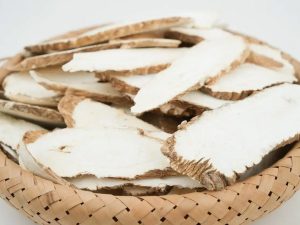
1. Belamcanda Rhizome: This product consists of thin slices of irregular or elongated shape. The outer surface is yellowish-brown, brownish-black, or blackish-brown, shriveled, with visible residual fibrous roots and root scars; some may show annular rings. The cross-section is pale yellow or bright yellow, with scattered small dots or patterns of vascular bundles; some may show annular rings. It has a faint odor and a bitter, slightly pungent taste.
2. Roasted Belamcanda: Similar in appearance to Belamcanda, but with a darker color on one side of the slice and scorch marks.
Botanical Information
Botanical Classification
Belongs to the genus Belamcanda in the family Iridaceae.
Morphological Characteristics
A perennial herb. It has a bright yellow, irregularly nodular rhizome underground, bearing numerous fibrous roots. The stem is erect, 0.5–1.5 m tall. Leaves are alternate, arranged in an imbricate pattern; they are sword-shaped, 20–60 cm long and 2–4 cm wide, with a sheath-like base clasping the stem, a gradually tapering apex, and no midrib.The inflorescence is terminal and forked; both the flower stalks and the branches of the inflorescence are sheathed by membranous bracts;Flowers are orange-red, scattered with purplish-brown spots, 4–5 cm in diameter; the perianth segments of the outer whorl are obovate or oblong, approximately 2.5 cm long and 1 cm wide; those of the inner whorl are slightly shorter and narrower than those of the outer whorl; there are 3 stamens, 1.8–2 cm long, attached at the base of the outer perianth segments; the anthers are linear and dehisce outward;The upper part of the style is slightly flattened and bears fine, short hairs; the ovary is inferior and obovate. The capsule is obovate or oblong, yellowish-green, 2.5–3 cm long, dehiscent along the back, with the valves everted and a central, erect fruit axis; the seeds are spherical, blackish-purple, and glossy. Flowering occurs from June to August, and fruiting from July to September.
Distribution Area
Distributed throughout China.
Growth Habits
It prefers warm, sunny conditions, is tolerant of drought and cold, and is not particular about soil type; it can be cultivated on both mountain slopes and dry land, though it thrives best in fertile, loose, sandy loam on higher ground with good drainage. Neutral or slightly alkaline loam is suitable; it should not be planted in low-lying areas or saline-alkali soils.